TypeScript utility types are built-in generic types that transform, reuse, or refine existing types. Instead of writing a new interface every time a function return value, event union, class constructor, or configuration object changes, utility types let you derive those types from the code that already defines the behavior.

That matters in real TypeScript codebases because type drift is one of the easiest ways for static typing to lose value. A loader returns a slightly different shape than its exported interface. A wrapper function accepts broader arguments than the function it wraps. A discriminated union gains a new variant, but one service keeps using the old subset. These are not syntax problems; they are maintenance problems.
Most teams already use familiar utilities like Partial, Pick, and Readonly. But TypeScript’s built-in utility types go much further. They can preserve function signatures in wrappers, unwrap async return values, extract subsets from unions, enforce exhaustive lookup tables, and generate type-safe names from string literals.
This guide focuses on TypeScript utility types that are especially useful in production code: ReturnType, Awaited, Parameters, ConstructorParameters, Extract, Exclude, NonNullable, Record, InstanceType, NoInfer, and the intrinsic string manipulation types. The goal is not to use more advanced types for their own sake. The goal is to know when a utility type prevents duplication, keeps related code in sync, or makes the compiler enforce an invariant your team already depends on.
For a broader overview of the basics, see LogRocket’s guide to using built-in utility types in TypeScript.
The table below summarizes the utility types we’ll cover and where they are most useful:
| Utility type | What it does | Best use case |
|---|---|---|
ReturnType<T> |
Gets the return type of a function | Reusing loader, selector, factory, or API helper return shapes |
Awaited<T> |
Unwraps a promise-like type | Getting the resolved value of async functions |
Parameters<T> |
Gets a function’s argument tuple | Typing wrappers such as retry, debounce, memoize, or logging helpers |
ConstructorParameters<T> |
Gets a class constructor’s argument tuple | Typing dependency injection, factories, and class registries |
Extract<T, U> |
Keeps union members assignable to U |
Filtering discriminated unions |
Exclude<T, U> |
Removes union members assignable to U |
Removing variants from unions |
NonNullable<T> |
Removes null and undefined |
Reusable non-null guards and cleaned-up array pipelines |
Record<K, V> |
Maps a key union to a value type | Exhaustive lookup tables and permission maps |
InstanceType<T> |
Gets the instance type produced by a constructor | Plugin systems, factories, and class-based registries |
NoInfer<T> |
Prevents a position from influencing generic inference | Generic APIs where one argument should validate against another |
Uppercase, Lowercase, Capitalize, Uncapitalize |
Transform string literal types | Generated API names, event handlers, and mapped types |
ReturnType and AwaitedReturnType extracts the return type of a function. Awaited unwraps the resolved value of a promise. Used together, they solve a common problem in growing TypeScript codebases: maintaining one type definition for a value and another for the function that produces it.
Consider a data-fetching function used by a server component, route loader, or API layer:
// lib/dashboard.ts
export async function loadDashboard(userId: string) {
  const [profile, metrics, recentActivity] = await Promise.all([
    db.profile.findUnique({ where: { id: userId } }),
    db.metrics.aggregate({ where: { userId } }),
    db.activity.findMany({ where: { userId }, take: 20 }),
  ])

  return {
    profile,
    metrics,
    activity: recentActivity,
    generatedAt: new Date(),
  }
}
Several components need the shape of this return value. The tempting approach is to create a matching interface:
interface DashboardData {
  profile: Profile | null
  metrics: MetricsAggregate
  activity: Activity[]
  generatedAt: Date
}
Now there are two sources of truth. If someone renames activity to recentActivity in loadDashboard, the interface can silently drift until a runtime bug or stale assumption exposes it.
Instead, derive the type from the function:
// lib/dashboard.ts
export type DashboardData = Awaited<ReturnType<typeof loadDashboard>>
ReturnType<typeof loadDashboard> produces the function’s return type, which is Promise<{ ... }>. Awaited unwraps the promise and gives you the resolved object shape. For a deeper async-specific explanation, see LogRocket’s guide to async/await in TypeScript.
This pattern works best when the function is the authoritative source of the data shape. Loaders, selectors, API clients, and factory functions are good candidates.
Do not use this pattern when the type is part of a public contract. If external callers depend on a stable API shape, declare the type first and annotate the function return explicitly. That prevents an internal refactor from silently changing the contract.
ParametersParameters extracts the argument tuple of a function type. It is especially useful when writing wrappers around existing functions, such as retry, logging, tracing, memoization, or debounce helpers.
Here is a retry helper for async functions:
// lib/retry.ts
export function withRetry<Fn extends (...args: any[]) => Promise<any>>(
  fn: Fn,
  attempts = 3,
) {
  return async (...args: Parameters<Fn>): Promise<Awaited<ReturnType<Fn>>> => {
    let lastError: unknown

    for (let i = 0; i < attempts; i++) {
      try {
        return await fn(...args)
      } catch (err) {
        lastError = err
      }
    }

    throw lastError
  }
}
The returned function keeps the same call shape as the original function:
const loadDashboardWithRetry = withRetry(loadDashboard)

await loadDashboardWithRetry('user_123')
Without Parameters<Fn>, the wrapper would usually fall back to any[] at the call site or require overloads for every function shape. Parameters lets the wrapper stay generic while preserving the original argument requirements.
This is one of the most practical utility types for library code because it lets you add behavior around a function without weakening type safety.
ConstructorParameters and InstanceTypeConstructorParameters does for class constructors what Parameters does for functions: it extracts the constructor argument tuple. InstanceType takes a constructor type and gives you the type of the object produced by new.
Together, they are useful in dependency injection containers, plugin registries, factory helpers, and test utilities that accept classes as values.
// lib/container.ts
type Constructor<T = unknown> = new (...args: any[]) => T

class Container {
  private instances = new Map<Constructor, unknown>()

  register<C extends Constructor>(
    ctor: C,
    ...args: ConstructorParameters<C>
  ): void {
    this.instances.set(ctor, new ctor(...args))
  }

  resolve<C extends Constructor>(ctor: C): InstanceType<C> {
    const instance = this.instances.get(ctor)

    if (!instance) {
      throw new Error(`${ctor.name} is not registered`)
    }

    return instance as InstanceType<C>
  }
}
Now the container can preserve constructor arguments and instance types:
class Logger {
  log(message: string) {
    console.log(message)
  }
}

class MetricsClient {
  constructor(private apiKey: string) {}

  track(eventName: string) {
    // ...
  }
}

const container = new Container()

container.register(Logger)
container.register(MetricsClient, 'metrics_key')

const logger = container.resolve(Logger) // Logger
const metrics = container.resolve(MetricsClient) // MetricsClient
The benefit is not shorter code. The benefit is that the container no longer has to know every class signature ahead of time while still enforcing constructor arguments when a class is registered.
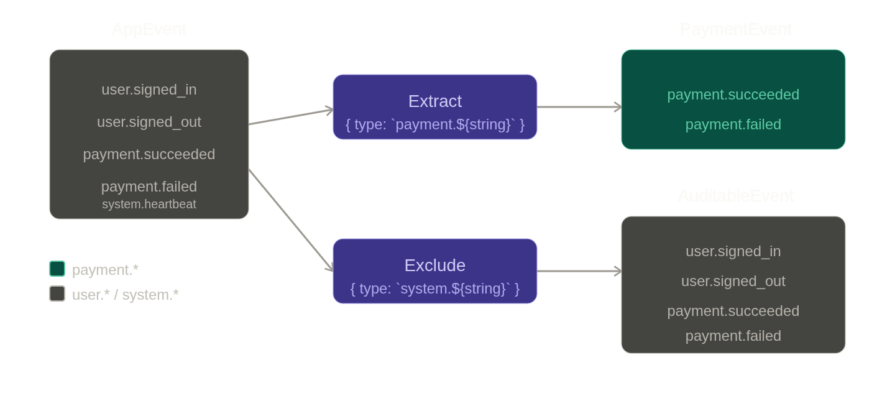
Extract and ExcludeExtract<T, U> keeps the members of a union that are assignable to U. Exclude<T, U> keeps the members that are not assignable to U.
Both are useful with discriminated unions in TypeScript, where you often need a subset of a larger event or state type.
Consider an application event union:
// types/events.ts
export type AppEvent =
  | { type: 'user.signed_in'; userId: string }
  | { type: 'user.signed_out'; userId: string }
  | { type: 'payment.succeeded'; amount: number; userId: string }
  | { type: 'payment.failed'; reason: string; userId: string }
  | { type: 'system.heartbeat' }
A billing service only cares about payment events. You could define a second union manually:
type PaymentEvent =
  | { type: 'payment.succeeded'; amount: number; userId: string }
  | { type: 'payment.failed'; reason: string; userId: string }
That works until someone adds payment.refunded to AppEvent and forgets to update PaymentEvent.
Extract keeps the subset tied to the original union:
// services/billing.ts
import type { AppEvent } from '../types/events'

type PaymentEvent = Extract<AppEvent, { type: `payment.${string}` }>
Now every event whose type starts with payment. is included.
To make the compiler enforce future cases, add an assertNever helper:
function assertNever(value: never): never {
  throw new Error(`Unhandled event: ${JSON.stringify(value)}`)
}

export function handlePayment(event: PaymentEvent) {
  switch (event.type) {
    case 'payment.succeeded':
      return recordRevenue(event.amount, event.userId)

    case 'payment.failed':
      return notifyUser(event.userId, event.reason)

    default:
      return assertNever(event)
  }
}
If someone later adds this event:
| { type: 'payment.refunded'; amount: number; userId: string }
PaymentEvent includes it automatically, and the assertNever branch forces the missing case to surface during type checking.
Exclude handles the inverse problem. To remove system events from an audit log type:
type AuditableEvent = Exclude<AppEvent, { type: `system.${string}` }>
Use Extract when you want a subset. Use Exclude when you want everything except a subset.
NonNullable for reusable non-null guardsNonNullable<T> removes null and undefined from a type.
In older TypeScript versions, this was especially important for array pipelines because TypeScript did not reliably narrow filtered arrays:
const parsed = rawRows.map(row => tryParseRow(row)) // (Row | null)[]
const valid = parsed.filter(row => row !== null)
In TypeScript ≥v5.5, simple predicates like row => row !== null are inferred more precisely, so valid can narrow to Row[] automatically.
Even so, NonNullable is still useful when you want a reusable, named guard:
// utils/isNonNull.ts
export function isNonNull<T>(value: T): value is NonNullable<T> {
  return value !== null && value !== undefined
}
Then use it across pipelines:
const validRows = rawRows
  .map(row => tryParseRow(row))
  .filter(isNonNull)
This has three advantages:
Be careful with truthiness checks:
const scores = rawScores.filter(Boolean)
That removes 0, '', and false, not just null and undefined. When you mean “not nullish,” use an explicit nullish check.
Record for exhaustive lookup objectsRecord<K, V> creates an object type whose keys are K and whose values are V. It overlaps with index signatures, but the distinction matters.
A string index signature accepts any string key:
type Handlers = {
  [key: string]: (event: AppEvent) => void
}
That is flexible, but it does not guarantee that every known event has a handler.
A Record with a finite key union does:
import type { AppEvent } from '../types/events'

type EventType = AppEvent['type']

type EventHandlerMap = {
  [K in EventType]: (event: Extract<AppEvent, { type: K }>) => void
}

const handlers: EventHandlerMap = {
  'user.signed_in': event => {
    sendWelcomeBackMessage(event.userId)
  },

  'user.signed_out': event => {
    clearSession(event.userId)
  },

  'payment.succeeded': event => {
    recordRevenue(event.amount, event.userId)
  },

  'payment.failed': event => {
    notifyUser(event.userId, event.reason)
  },

  'system.heartbeat': event => {
    recordHeartbeat(event.type)
  },
}
This mapped type is slightly more verbose than Record<EventType, Handler<AppEvent>>, but it is more precise. Each key gets the correct event variant, so the payment.succeeded handler knows about amount, while the payment.failed handler knows about reason.
For a deeper explanation of this utility type, see LogRocket’s guide to TypeScript Record types.
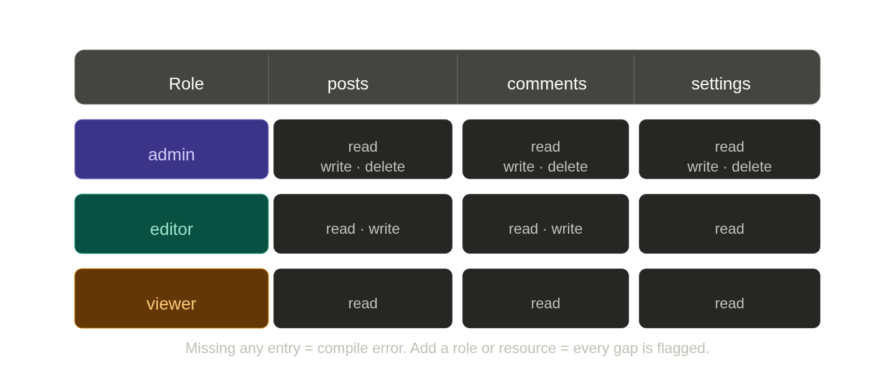
The same pattern works for permissions:
type Role = 'admin' | 'editor' | 'viewer'
type Resource = 'posts' | 'comments' | 'settings'
type Action = 'read' | 'write' | 'delete'

const permissions: Record<Role, Record<Resource, Action[]>> = {
  admin: {
    posts: ['read', 'write', 'delete'],
    comments: ['read', 'write', 'delete'],
    settings: ['read', 'write', 'delete'],
  },

  editor: {
    posts: ['read', 'write'],
    comments: ['read', 'write'],
    settings: ['read'],
  },

  viewer: {
    posts: ['read'],
    comments: ['read'],
    settings: ['read'],
  },
}
If you remove a role or resource, TypeScript points at the missing key. That makes Record useful for configuration that needs to stay exhaustive.
One caveat: Record<string, V> is broad, just like a string index signature. The most useful version of Record usually starts with a finite union of keys.
InstanceType when classes are valuesMost of the time, you do not need InstanceType. If you have a User class, you can write User as the instance type and move on.
InstanceType becomes useful when the class itself is passed around as a value.
type PluginConstructor = new (...args: any[]) => unknown

class PluginRegistry {
  private plugins = new Map<string, PluginConstructor>()

  register<C extends PluginConstructor>(name: string, plugin: C) {
    this.plugins.set(name, plugin)
  }

  create<C extends PluginConstructor>(
    plugin: C,
    ...args: ConstructorParameters<C>
  ): InstanceType<C> {
    return new plugin(...args) as InstanceType<C>
  }
}
This pattern shows up in:
The common thread is that the type system needs to understand the relationship between a class constructor and the instance it creates.
NoInferNoInfer<T> tells TypeScript not to use a particular position when inferring a generic. It is useful when one argument should define the generic, while another argument should only be checked against it.
This comes up in generic APIs where a fallback, default value, or configuration option accidentally widens the inferred type.
Consider a selector helper:
// Without NoInfer
function selectById<T extends { id: string }>(
  items: T[],
  fallback: T,
): (id: string) => T {
  return id => items.find(item => item.id === id) ?? fallback
}

const users = [{ id: '1', name: 'Ada', role: 'admin' as const }]

const getUser = selectById(users, { id: '0', name: 'Guest' })
Depending on the values involved, TypeScript may infer T from both items and fallback, producing a wider type than intended.
NoInfer pins inference to items:
function selectById<T extends { id: string }>(
  items: T[],
  fallback: NoInfer<T>,
): (id: string) => T {
  return id => items.find(item => item.id === id) ?? fallback
}
Now T is inferred from items, and fallback must be assignable to that already-decided type. If it is not, the error points at the fallback, which is where the mismatch actually lives.
NoInfer is available in TypeScript ≥v5.4. If your project uses an older TypeScript version, this type will not be available globally.
This is a more advanced generic pattern. For related concepts, see LogRocket’s guide to understanding infer in TypeScript.
TypeScript includes four intrinsic string manipulation types:
These types transform string literal types at compile time:
| Utility type | Example | Result |
|---|---|---|
Uppercase<T> |
Uppercase<'admin'> |
'ADMIN' |
Lowercase<T> |
Lowercase<'ADMIN'> |
'admin' |
Capitalize<T> |
Capitalize<'email'> |
'Email' |
Uncapitalize<T> |
Uncapitalize<'Email'> |
'email' |
These types only transform string literal types at compile time. They do not change runtime strings.
They become useful when combined with mapped types and template literal types. For example, you can generate setter names from object keys:
// hooks/useFields.ts
type Setters<T> = {
  [K in keyof T as `set${Capitalize<string & K>}`]: (value: T[K]) => void
}

function useFields<T extends Record<string, unknown>>(
  initial: T,
): [T, Setters<T>] {
  // Implementation omitted
  return [initial, {} as Setters<T>]
}

const [fields, setters] = useFields({
  name: '',
  email: '',
  age: 0,
})

setters.setName('Ada')
setters.setEmail('[email protected]')
setters.setAge(36)
The setter names are derived from the input keys:
name becomes setNameemail becomes setEmailage becomes setAgeIf you rename name to fullName, TypeScript replaces setName with setFullName at the type level. Any stale call sites fail during type checking.
This pattern also works for event handler props:
type EventName = 'click' | 'focus' | 'blur'

type EventHandlers = {
  [K in EventName as `on${Capitalize<K>}`]: () => void
}
That produces:
type EventHandlers = {
  onClick: () => void
  onFocus: () => void
  onBlur: () => void
}
For more examples of type-level transformations, see LogRocket’s guide to TypeScript mapped types.
Utility types are most helpful when they prevent drift. They are less helpful when they hide a simple shape behind a complicated type expression.
Use this table as a quick decision guide:
| Use this pattern | When it helps | When to avoid it |
|---|---|---|
Awaited<ReturnType<typeof fn>> |
The function is the source of truth | The type is a public API contract |
Parameters<typeof fn> |
You are writing a wrapper around a function | A simple explicit signature is clearer |
ConstructorParameters<T> |
You accept classes as values | You are instantiating a known class directly |
Extract / Exclude |
You need subsets of a union | The subset is unrelated to the original union |
NonNullable<T> |
You need reusable nullish guards | A simple inline check already narrows clearly |
Record<K, V> |
You need exhaustive keys from a union | The key set is truly open-ended |
InstanceType<T> |
You need the instance from a constructor type | You already have a concrete class type |
NoInfer<T> |
One argument should not influence generic inference | The generic is easy to infer from all arguments |
| String manipulation types | Names follow a predictable convention | Runtime strings need actual transformation |
TypeScript utility types are most valuable when they make the compiler enforce relationships that already exist in your code. If a component depends on a loader’s return shape, derive that type with Awaited and ReturnType. If a wrapper should preserve a function’s arguments, use Parameters. If an event handler map should cover every event variant, use a finite union with Record, Extract, or a mapped type.
The common theme is drift prevention. Utility types reduce the gap between runtime code and type declarations, which is where many TypeScript bugs begin. They are especially useful in application code that changes often: API clients, route loaders, state machines, plugin registries, permission maps, event systems, and generic helper functions.
They also come with a readability cost. A plain interface is often better when the shape is stable, public, and easier to understand directly. A nested utility type is better when the alternative is duplicating a type that will eventually fall out of sync. The right question is not “Can I express this with a utility type?” It is “Does this utility type remove a second source of truth?”
Used with that constraint, utility types make TypeScript codebases easier to evolve. They let you refactor functions, unions, classes, and configuration objects while keeping related types attached to the source of truth. That makes them less about advanced type tricks and more about long-term maintenance.
LogRocket lets you replay user sessions, eliminating guesswork by showing exactly what users experienced. It captures console logs, errors, network requests, and pixel-perfect DOM recordings — compatible with all frameworks, and with plugins to log additional context from Redux, Vuex, and @ngrx/store.
With Galileo AI, you can instantly identify and explain user struggles with automated monitoring of your entire product experience.
Modernize how you understand your web and mobile apps — start monitoring for free.

Explore how looping Transformers reuse layers and compare with traditional GPT models in reasoning tasks.

Learn how one solo developer used multiple Grok Bot AI agents to test, report bugs, fix code, and monitor deployments — hands-free, on a $30/month plan.

Keep the reasoning behind product decisions within reach. Build a clear system to track customer feedback, priorities, and project progress.

Compare the top AI development tools and models of October 2026. View updated rankings, feature breakdowns, and find the best fit for you.

 Learn more →