For most of software history, product teams have built designs around the assumption that their user is a human sitting in front of a screen. Whether that person shops online, manages projects, books trips, or analyzes data, the basic interaction model has essentially remained constant. Humans use interfaces to interpret information, make decisions, and perform activities within a product.
That assumption is starting to shift. As AI agents become more capable, they’re increasingly interacting with products on behalf of users rather than just helping them within a chat window. Instead of a user manually opening an application and completing a task, an agent can gather information, compare options, execute workflows, and coordinate actions across multiple systems.
For product managers, this presents a completely new design challenge. Human usefulness remains important, but it’s no longer adequate. Products now need to enable a second sort of user: autonomous or semi-autonomous agents that communicate via APIs, tools, integrations, and processes.
Because of this, the products that survive in the next generation of software may not always be those that people enjoy using. They may be the ones that agents can consistently understand, navigate, and operate.
Treating an AI agent as a user means designing your product so an agent can discover capabilities, retrieve information, and perform authorized actions on a person’s behalf.
The phrase “AI agent as a user” sounds abstract until you understand how agents actually function. Unlike traditional software automation, modern agents can reason about goals, select tools, collect information, and carry out activities based on context.
Consider a sales manager who instructs an AI assistant to identify at-risk accounts, summarize recent interactions, and set up follow-up meetings. The manager may never access the CRM directly.
Instead, the agent works with the CRM, calendar system, communication tools, and reporting software on the user’s behalf. From the product’s perspective, the principal actor is no longer the human, but the agent.
This distinction is important because agents interact with products differently than humans do. Unlike an agent, a person can tolerate ambiguity, deduce meaning from context, and navigate poorly designed workflows. An agent requires specific directions, predictable results, and well-defined boundaries.
When information is inconsistent or poorly structured, agents face challenges that humans do not. As a result, you need to consider factors other than the standard user experience concerns when developing for agents.
Many of the ideas that drive current product design were based on human cognition and behavior. We invest in visual hierarchy, onboarding flows, navigation systems, and interface design because humans require these components to fully understand and use software efficiently. Agents, on the other hand, operate with a completely separate set of standards.
An attractively designed dashboard that delivers information in the form of charts, colors, and visual signals may appeal to a human user. However, these elements provide little benefit to an agent. Instead, it requires access to the underlying data in a structured format that can be accurately interpreted and processed.
Similarly, many products use ambiguity in ways that humans can easily overcome. People can deduce meaning from context, so labels like “recent activity,” “priority,” or “health score” may make sense.
For an agent, interpreting these labels can be problematic if the underlying definitions aren’t clear. This leads to uncertainty, inconsistent behavior, and failure to finish tasks.
Error management is another difficulty. Human users can typically recover from unclear signals like “Something went wrong” by refreshing the page, trying again, or contacting customer service.
Agents require significantly more information. They need to know what failed, why it failed, if retrying is necessary, and what other options are available. Without that information, automated workflows become unstable and unreliable.
The transition to agent-driven interactions requires PMs to acknowledge that usability is no longer solely a human problem. Products must now be understandable to both humans and machines, and the two audiences often have quite different demands.
Just as UX frameworks help teams design for human users, PMs need a framework for evaluating whether a product is usable by agents. While the field is still evolving, several principles are already emerging as foundational requirements.
Human users can navigate menus, explore options, and understand a product through trial and error. Agents usually can’t. They require a solid understanding of what features exist, how they are accessed, and what each action does.
As a result, discoverability becomes an important product need. APIs, tools, actions, and resources should be documented and exposed easily for agents to find and use.
Agents may never locate features that are hidden behind undocumented procedures or only accessible through the user interface.
Agents thrive in structured environments. They work best when inputs adhere to defined formats, and outputs are predictable and machine-readable. Every inconsistency creates uncertainty and raises the risk of failure.
Consider a customer management platform that returns account statuses such as “active,” “enabled,” or “live” based on the context.
While humans may see these phrases as approximately equal, agents may view them as distinct states. Consistent schemas and defined forms decrease confusion, making automation more reliable.
Predictability is a key principle when it comes to agent usability. If the same action delivers different results under similar situations, agents can’t create reliable workflows around it. Predictability allows agents to make confident decisions while reducing the need for constant human control.
This requirement goes beyond APIs. Business logic, permissions, procedures, and system responses should all be consistent throughout time. Products that regularly change behavior without clear communication make it harder for agents to perform effectively.
Error messages should do more than notify users when something fails. They should assist agents in understanding the nature of the failure and developing an effective recovery strategy.
A machine-readable error system usually includes information about the failure type, the underlying cause, and if retrying is likely to succeed. This enables agents to recover intelligently rather than escalating every problem to a human user.
As agents gain the ability to perform increasingly powerful activities, permission management becomes more critical. Product teams want procedures that explicitly specify what an agent can access and what actions can be taken.
Users need to be confident that agents will fulfill delegated tasks without exceeding their authority or causing unwanted consequences.
When a human performs an activity, accountability is simple. When an agent does dozens or hundreds of activities across several systems, visibility becomes much more difficult.
Observability enables you to understand what an agent did, why it did it, and what transpired. Audit trails promote accountability by allowing teams to analyze failures, identify risks, and improve workflows over time. Without these capabilities, large-scale agent adoption is impossible to manage.
If there’s one principle that underlies all others, it’s trustworthiness. Human users may tolerate occasional errors, but agents frequently work at scale and require consistent execution. Small failure rates can add up quickly when thousands of automated processes rely on the same system.
In many respects, dependability is becoming the new usability. A highly reliable product will inevitably be more appealing to agents and the companies that use it.
One of the most common mistakes you can make as a project manager is treating agent and human usability as competing priorities. You need to create experiences that are suited for each audience.
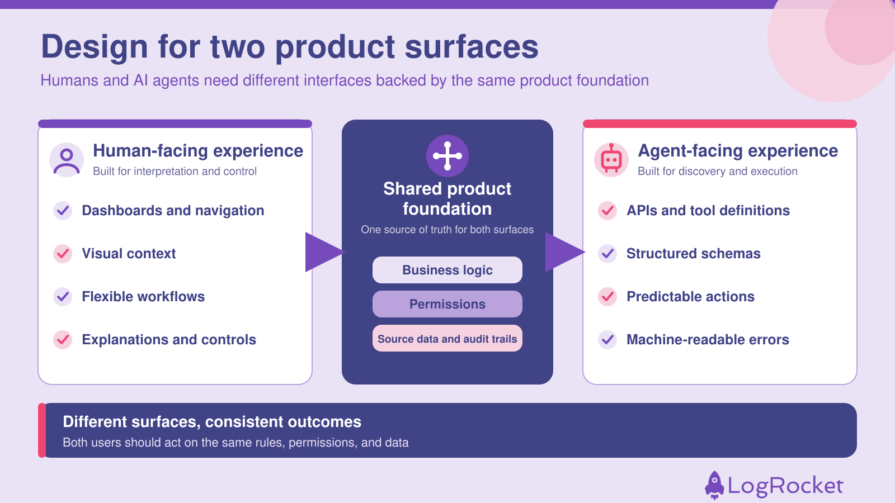
This typically requires treating products as having two unique surfaces. The first surface is the standard human-facing interface, which includes dashboards, forms, processes, visualizations, and onboarding flows. This layer enables people to process information, make decisions, and keep control over outcomes.
The second surface represents the agent-facing experience. This comprises APIs, tool definitions, integrations, workflow endpoints, and machine-readable resources. It allows agents to identify capabilities, retrieve information, and execute actions programmatically.
Historically, many organizations saw APIs as secondary concerns, existing only to support integrations. In an agent-driven future, this perspective becomes increasingly problematic. APIs and tools are now standalone product surfaces.
As product teams adapt to this shift, several recurring mistakes are likely to emerge.
One common failure mode is when key activities are only accessible via the UI. A user may be able to execute a task manually, while an agent has no programmatic path to the same result. This provides an artificial barrier to delegation and restricts automation capabilities.
Another common issue is inconsistent API behavior. Responses that change format abruptly, undocumented edge cases, and unstable schemas require agents to rely on weak solutions. What appears to be a minor engineering issue can quickly escalate into a significant product limitation.
Ambiguous schemas pose similar issues. Fields with ambiguous definitions, irregular naming rules, or overlapping meanings increase agents’ cognitive load. Humans usually compensate for these issues using context and intuition, whereas agents can’t.
Poor error handling is another recurrent flaw. Generic messages offer no insight into what went wrong or how the problem should be fixed. As a result, workflows fail abruptly and require more human intervention than they should.
Permission models are becoming more and more important. Overly permissive systems pose security and governance problems, while overly restrictive systems limit the usefulness of delegation.
Finally, many products don’t provide useful audit trails for agent activities. Without precise records of what actions were taken and why, organizations struggle to build trust in automated workflows.
As agents assume greater responsibilities, visibility and accountability become increasingly important.
If AI agents start to use your product, your product requirements documents (PRD) must adapt to reflect this. Many PRDs still presume that every interaction will be handled by a person. That assumption leaves substantial gaps in planning and execution.
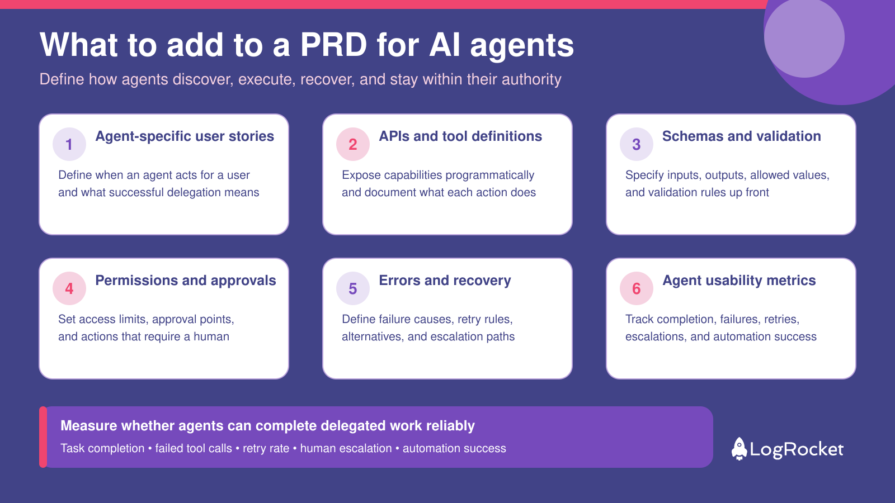
One of the simplest adjustments you can do is to include agent-specific user stories. Alongside traditional user stories, include scenarios where an agent executes activities on behalf of a user. These stories help to reveal requirements that would otherwise go unnoticed during planning.
PRDs should also specify precise API and tool requirements. Instead of focusing exclusively on interface functionality, you should describe how capabilities are exposed programmatically and what constraints control their use. This guarantees that agent access is viewed as a product consideration rather than an afterthought.
Structured response requirements demand similar consideration. Set up expected formats, validation rules, and schema standards up front. This removes ambiguity and provides a more stable platform for automation.
Error handling and recovery criteria should become standard product requirements. As a PM, you should indicate how failures are reported, what recovery paths exist, and when it is appropriate to escalate matters to a human. These details have a direct impact on an agent’s ability to function autonomously.
Finally, product teams should broaden the criteria used to assess performance. Traditional measures such as engagement and feature adoption are still useful, but they should be reinforced by agent-specific indicators. Metrics such as failed tool calls, retry rates, task completion rates, human escalation frequency, and automation success rates give a more complete picture of how well a product supports delegation.
AI agents haven’t replaced human-centered product thinking. People continue to set goals, define success, exercise critical thinking, and finally choose whether a product provides value. What is changing is how those users interact with the software. Users will increasingly assign jobs to intelligent systems rather than carrying out each activity themselves.
For product managers, this change adds a new product surface that requires the same level of attention as the UI. Historically, project managers concentrated on assisting users in navigating interfaces and completing tasks.
Moving forward, you must also explore how agents may discover, learn, understand, and execute workflows. The most successful products will not only be simple to use, but also simple to delegate.
Featured image source: IconScout
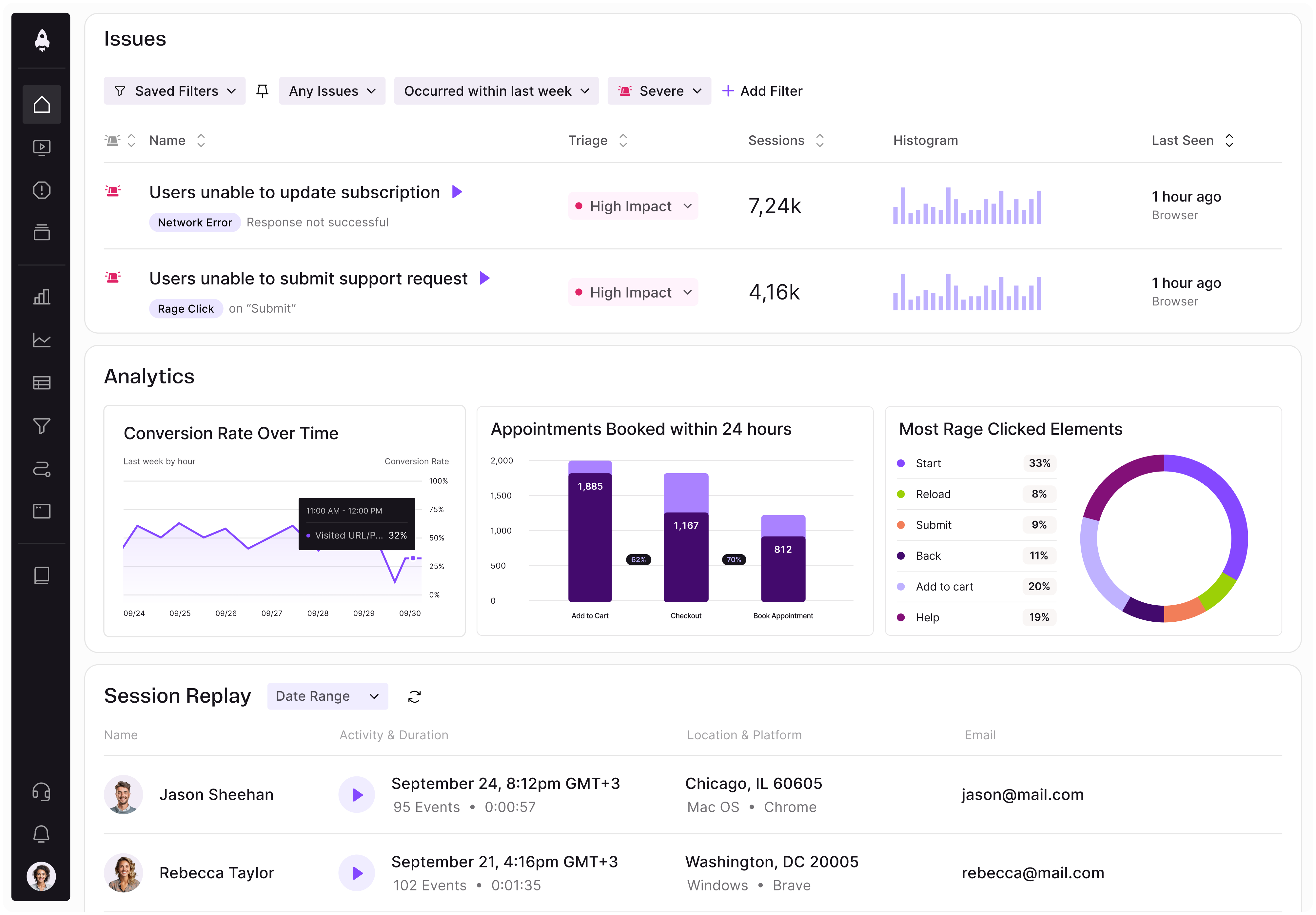
LogRocket identifies friction points in the user experience so you can make informed decisions about product and design changes that must happen to hit your goals.
With LogRocket, you can understand the scope of the issues affecting your product and prioritize the changes that need to be made. LogRocket simplifies workflows by allowing Engineering, Product, UX, and Design teams to work from the same data as you, eliminating any confusion about what needs to be done.
Get your teams on the same page — try LogRocket today.
Is the foldable iPhone true product innovation? See how PMs can assess user needs, weigh costs, and separate real value from technical hype.
Explore agentic AI security trade-offs product managers must own before launch, from permissions and human oversight to memory and recovery.

See how to define AI features that deliver user value. Validate needs, assess costs, and set reliability requirements before the team builds.

Learn how to read a P&L statement, assess product costs, build stronger business cases and align product roadmaps with financial priorities.


 Learn more →