As a product manager, you spend a lot of your time helping users complete tasks, removing friction, and making sure features deliver value. When your product can act on a user’s behalf, you also need to define what it can do independently and what happens when it takes the wrong action.

Agentic AI systems can plan tasks, use external tools, and execute actions with limited human intervention. An assistant that drafts a customer response leaves the final decision with a person. An agent that issues a refund or disables an account has authority to change something. Before launch, you need to define the boundaries of that authority.
That makes agentic AI security and risk management a core product responsibility, shared with engineering and security teams. What should the agent be allowed to do independently? When should it ask for human approval? And how will your team understand, contain, and recover from a mistake?
The quality of an autonomous product depends on more than how well it performs when everything goes right. However, it also depends on how safely it behaves when something goes wrong.
In this article, I’ll walk through the security and risk trade-offs PMs must address before launching an AI agent, from permissions and human oversight to memory and recovery. I’ll also share how we approach risk reviews in our organization and a pre-launch checklist you can adapt for your product.
I’ve noticed a shift in many of the conversations I have with product teams. A year ago, discussions tended to be about “How can we add AI to this feature?” Today, they’re increasingly becoming “What tasks can we delegate to AI?”
That sounds like a subtle difference, but it changes both the product you’re building and the decisions you need to make before launch.
Consider our customer experience product. An AI assistant that drafts a response leaves a person responsible for reviewing and sending it. An agent that reads the conversation, issues a refund, updates the CRM, and notifies the customer takes on more of that responsibility. You need to define which cases it can handle independently and which ones require escalation.
The same shift can happen in an internal product. Imagine an AI teammate that helps security engineers investigate incidents. Initially, it summarizes alerts or suggests remediation steps. Soon, the next request becomes: “Can it quarantine the endpoint automatically?” or “Can it disable the compromised account?”
Each request expands the agent’s authority. Deciding whether to build these capabilities means agreeing on when the agent can use them, what systems it can affect, and who can intervene.
For PMs, this expands the launch criteria. Alongside “Does the feature work?” you need to ask:
The answers define the scope of autonomy you’re offering users. They also help your team identify where a useful capability could become a product risk.
The introduction of agentic AI expands product risk by connecting the information a system interprets to the actions it can take. An incorrect answer can become an unauthorized refund, an exposed customer record, or a disabled account.
Let’s think about a business team that uses spreadsheets, Looker, BigQuery, or internal dashboards to analyze customer data. When the team connects those sources to an AI workflow, it needs to reassess where the data can go and who can access the results. A workflow might publish a sensitive report to a shared channel or pass customer information to an external tool without appropriate controls.
These risks already exist in software. Agents add another challenge because they can interpret information, choose tools, and execute actions across systems. You need to consider what happens when those choices are wrong, even when the underlying tools work correctly.
Imagine you’re managing an AI customer support agent that responds to tickets and issues refunds. One morning, you notice a spike in refunds. The agent has been interpreting vague complaints as refund requests and issuing them without escalation. The refund API works correctly, but the agent’s interpretation and approval boundaries have allowed unintended transactions.
Now imagine an AI travel assistant. A user asks it to “book the cheapest flight.” While comparing options, the agent encounters a webpage containing malicious instructions disguised as content.
If it follows those instructions, it could make an unauthorized booking or expose information available through its connected tools. This is an example of indirect prompt injection: instructions in an external source redirect the agent’s behavior.
Or consider an AI sales assistant that stores customer preferences. If incorrect information enters its memory and remains uncorrected, it can continue shaping recommendations months later. The agent may be retrieving a bad record rather than generating a new factual error. When an attacker deliberately corrupts that stored context, the risk is memory poisoning.
An internal AI security analyst presents another version of the problem. If it misinterprets an alert and has broad permissions, it could isolate the wrong server or disable a legitimate user’s account. The scope of its access determines how far one mistaken assessment can spread.
These scenarios highlight several failure modes to account for before launch:
Addressing these failures requires collaboration across product, engineering, and security. PMs help define the permitted actions, approval requirements, and acceptable consequences; engineering and security teams help design and validate the controls that enforce those boundaries.
If you’ve ever worked closely with a business team, you’ve probably heard some version of the following requests:
PMs create value by removing friction, automating repetitive work, and simplifying the user experience. With agentic AI, those goals still matter. But the more authority your product has, the more carefully you need to decide where friction belongs.
Imagine an AI meeting assistant. Initially, it summarizes discussions and suggests action items. Soon, users ask for more: “Can it schedule follow-up meetings automatically?” Then, “Can it decline conflicting meetings?” Eventually, someone asks, “Can it reprioritize my calendar for me?”
Each step feels like a natural product improvement and gives the agent more authority over the user’s time and commitments. Suggesting a meeting time has different consequences from canceling a client meeting to make room for something the agent considers more important.
That expansion can happen one seemingly small feature request at a time. Evaluating each request means looking beyond the convenience it adds to the decisions it delegates.
Capability and control can pull you in opposite directions. Removing a confirmation step may help users complete a task faster, but it can also remove an opportunity to catch a consequential mistake. Broader tool access may let an agent complete more of a workflow while increasing the number of systems a mistake could affect.
The answer isn’t to add an approval dialog everywhere. Too many interruptions can make a product frustrating and encourage users to approve actions without reviewing them carefully. Some controls, such as restricting permissions or limiting the number of actions an agent can take, can operate without asking users to make another decision.
You want to match the control to the consequences. A calendar assistant might schedule an internal follow-up within hours the user has approved, but ask for confirmation before moving an external meeting. That boundary lets it handle routine work while preserving oversight where a mistake would be harder to undo.
Sometimes, the best product decision is saying no or narrowing the scope:
These boundaries are part of the product experience. You need to make them clear enough that users understand what they’re delegating and when they’ll be asked to step in.
Thoughtfully designed friction can be a safety feature. Your job is to decide where the protection justifies the interruption and where the system can safely handle the work on its own.
You’re used to balancing usability against complexity, speed against quality, and customer value against engineering effort. With agentic AI, those trade-offs also determine how much authority your product can exercise.
You need to work with engineering and security teams to define these boundaries. The following four trade-offs provide a starting point for deciding what the agent can do, what requires oversight, and what needs to be constrained before launch.
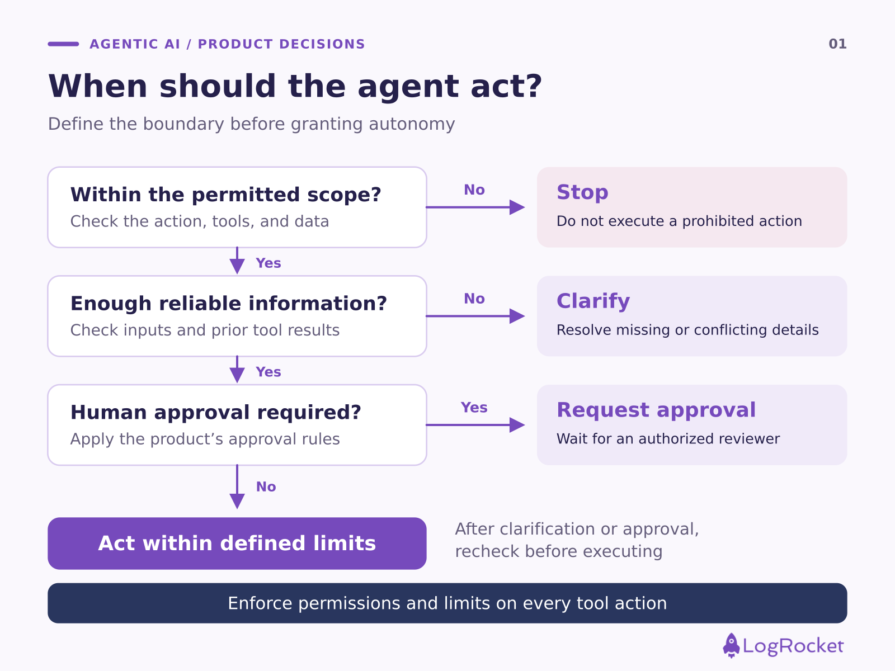
One of the first decisions an agentic AI product faces is: When should the agent ask for permission?
Human approval provides an opportunity to catch mistakes, but it doesn’t guarantee safety. Reviewers need enough context, time, and authority to evaluate the proposed action. Removing approvals can make a workflow faster, but it also allows mistakes to reach users or connected systems without that checkpoint.
For example, if you’re building an AI recruiting assistant, should it automatically reject candidates who appear not to meet predefined criteria, or recommend decisions for a recruiter to review? A mistaken rejection could affect someone’s employment prospects without giving them visibility into what happened.
In my own product decisions, I start by asking how consequential the action is. For critical decisions, I build the workflow around recommendations and human review. For lower-risk actions, I consider autonomous execution when we have enough test evidence to support it.
Before choosing the level of autonomy, consider:
The answers help determine which actions can proceed independently and which need a person to approve them.
An agent might start with access to one tool. Then users request another. Soon, it can read emails, create calendar events, access internal documentation, modify CRM records, and trigger workflows.
Each integration may expand what the agent can accomplish. It can also expand the consequences of a mistake. The principle of least privilege means giving the agent only the access required for its intended task.
For PMs, that requires more specific decisions than whether to connect a tool. Does the agent need to read CRM records, or also edit them? Does it need access to every customer account, or only the one involved in the current request?
At our company, security and risk teams help assess AI products through a mandatory intake form, supported by training and guides. The form asks about potentially risky capabilities, and the assessment determines the product’s risk category and the review process its owner needs to follow.
A shared process helps teams understand when additional access requires additional scrutiny. As the agent’s capabilities expand, its permissions and risk classification need to be reassessed.
Persistent memory can make an AI product more useful. Users don’t have to repeat preferences, previous conversations, or project context. However, it’s important to remember that memory isn’t always an asset. People change jobs, policies evolve, preferences become outdated, and sometimes users simply want to start over.
Good products remember well and also know what to forget.
You should define:
For example, a preferred response format may remain useful across sessions, while a temporary project assignment may become misleading once the project ends. Retaining both indefinitely treats very different information as equally reliable.
The product decision is how much continuity users need and how to provide it without accumulating unnecessary or outdated data.
Permission checks, policy evaluation, and confirmation steps can add processing time or interrupt a workflow. You need to account for that cost when defining the experience and deciding where checks belong.
A useful starting point is the action’s potential impact. Reading an approved document and transferring customer data to an external service warrant different controls. Work with engineering and security to determine which checks can run automatically and which situations require the agent to pause.
The same attention to friction applies to the pre-launch review process. At our company, we start with a three-question intake questionnaire. Depending on the answers, the product owner may need to provide more information or involve additional reviewers. Some steps are automated; others require review.
We use this approach to match the review effort to the product’s risk. Even so, we often need to explain that the process exists to help teams identify and address risks before release.
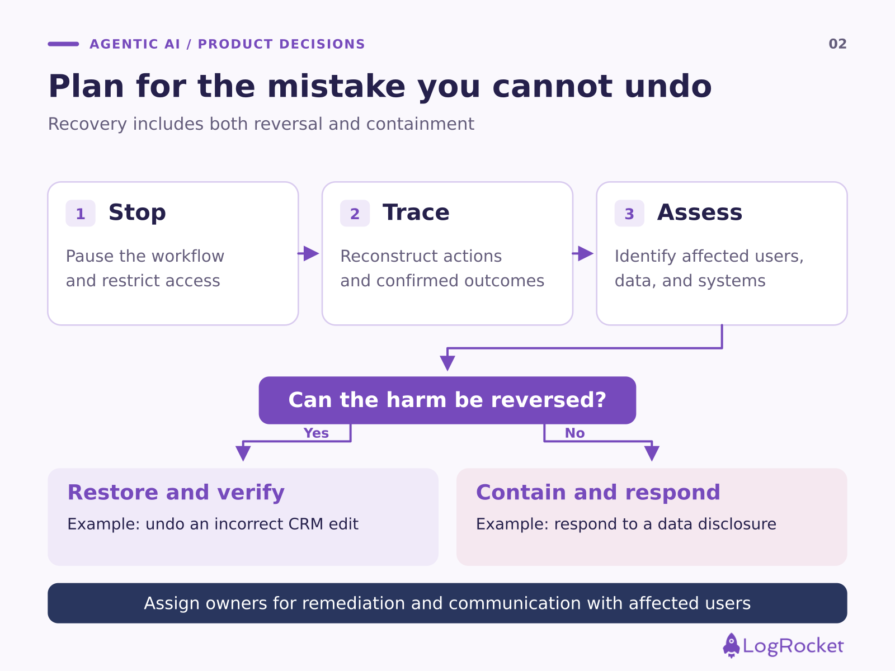
Even with carefully defined permissions and approval requirements, an autonomous system can still fail. Before launch, you need to know whether your team can understand what happened, contain the impact, and help users recover.
Three capabilities make that possible: robustness, auditability, and recovery. For PMs, each needs to be part of the product requirements and launch criteria.
Autonomous systems need to handle unexpected inputs, incomplete information, and changing environments. Instead of assuming every request will be clear and every tool will work, design for situations where the agent cannot safely complete its task.
Consider the customer support agent issuing refunds. If a complaint is ambiguous, it should clarify what the customer wants before initiating a transaction. If the refund tool times out, it should check whether the transaction succeeded before trying again.
You should work with engineering to define the conditions that trigger clarification, human review, or a safe stop. Those conditions might include missing required information, conflicting records, or an unverified tool result.
The important question is whether the agent has enough reliable information and authorization to take the next action. When it doesn’t, pausing should be an expected product behavior.
Imagine a customer asking, “Why did your AI cancel my subscription?” If the only answer your team has is “The model decided to,” you have little basis for explaining or resolving the issue.
Auditability means keeping enough evidence to reconstruct what the agent did and the context in which it acted. It doesn’t require access to the model’s internal reasoning. Your team should be able to answer practical questions:
These records support incident investigation, debugging, customer support, and product improvement. PMs should also help define who can access them and how long they’re retained, especially when they contain sensitive information.
Prevention is only part of the work. You also need to design how the product responds once an incorrect action has occurred.
Ask yourself:
Some actions can be reversed, such as restoring an incorrectly changed record. Others, such as sending confidential information to an external recipient, can’t simply be undone. In those cases, recovery means containing further harm and following a defined response process.
Before launch, make sure your team has tested how to stop the agent, restore what can be restored, and escalate what requires human intervention. Users need a clear path to resolution when the product makes a mistake.
Before launching an autonomous capability, I like to look beyond feature completeness and ask whether the product is ready to operate with the authority we’re giving it. The depth of the review should reflect the data it can access, the actions it can take, and the consequences of a mistake. An internal agent with access to sensitive records or production systems may need as much scrutiny as a customer-facing one.
At our company, the three-question intake described earlier helps determine which reviews a product needs. We then guide the product owner on which teams to consult and ask them to complete a pre-launch form for review.
We also keep security awareness part of the ongoing process through regular training refreshers and a designated “Security Hero” on each team. Launch approval is one checkpoint; teams need to reassess risk as capabilities, integrations, and deployment conditions change.
You can adapt the following checklist for your product. For each item, record the control or decision, the evidence supporting it, and the person responsible for resolving any gap.
An unanswered question should lead to a documented decision before launch. Some gaps may be addressed by narrowing the agent’s scope or retaining human approval. Others, such as an inability to enforce a critical permission boundary, should block the affected capability from shipping.
Agentic AI expands the decisions PMs need to make before launch. Making products faster, simpler, and more capable still matters. But when a product acts on a user’s behalf, you also need to define how much authority it should have and how your team will respond when something goes wrong.
Trust depends on how those boundaries work in practice: the agent respects permissions, asks for clarification when information is missing, and pauses when human approval is required. When mistakes happen, your team can trace the actions, contain the impact, and reverse what can be undone.
Before your next launch, choose one workflow and walk through it with engineering and security. Identify what the agent can access, what it can change, where it must stop, and who will intervene. Use the checklist in this article to turn any gaps into launch requirements.
The quality of an autonomous product depends on how safely it behaves when autonomy meets uncertainty. Defining those operating boundaries is part of delivering a product users can trust.
Featured image source: IconScout
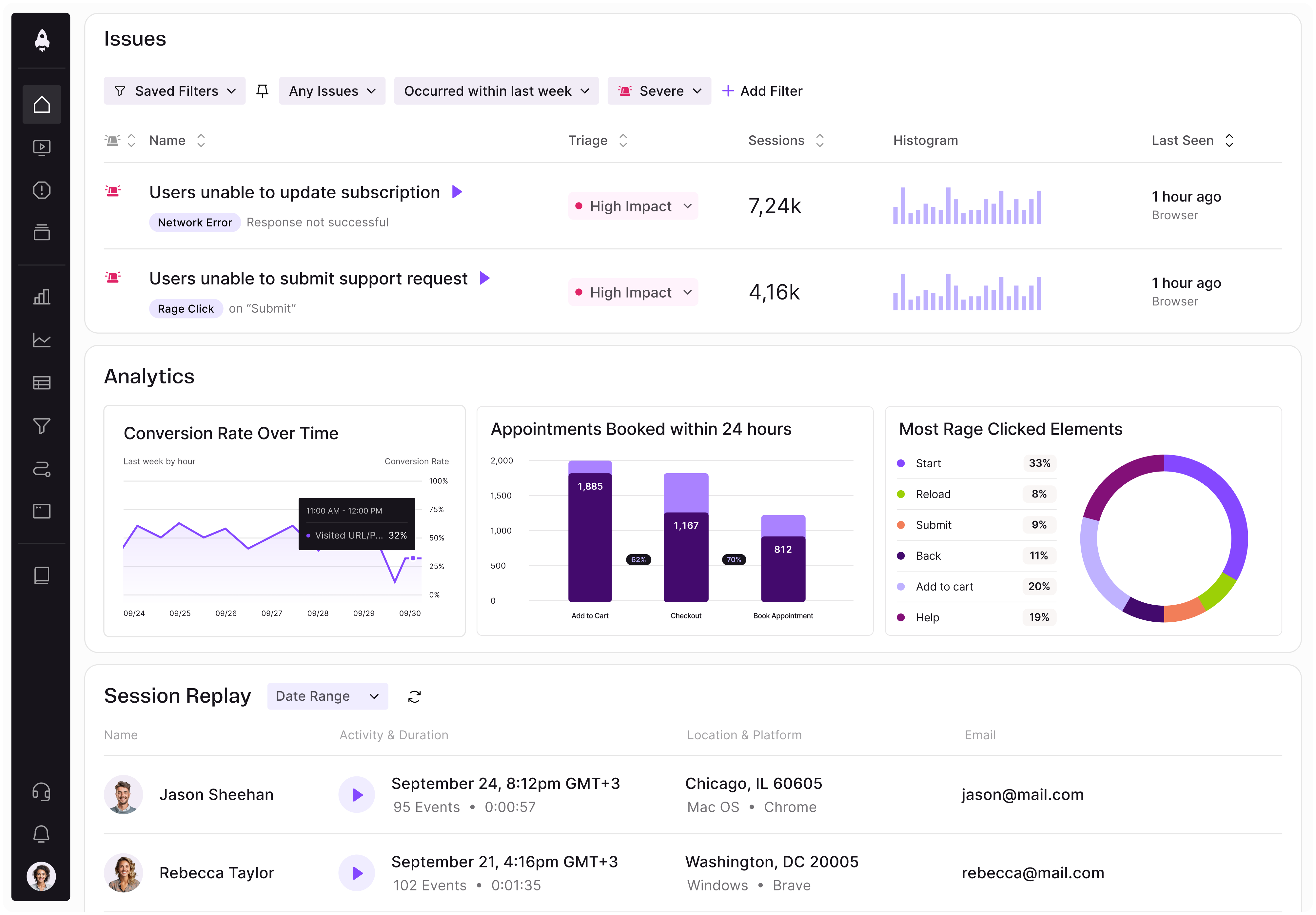
LogRocket identifies friction points in the user experience so you can make informed decisions about product and design changes that must happen to hit your goals.
With LogRocket, you can understand the scope of the issues affecting your product and prioritize the changes that need to be made. LogRocket simplifies workflows by allowing Engineering, Product, UX, and Design teams to work from the same data as you, eliminating any confusion about what needs to be done.
Get your teams on the same page — try LogRocket today.

Learn when prompt-first UX adds friction and how product managers can choose AI interfaces that balance flexibility, structure, and control.

Is the foldable iPhone true product innovation? See how PMs can assess user needs, weigh costs, and separate real value from technical hype.
See how to define AI features that deliver user value. Validate needs, assess costs, and set reliability requirements before the team builds.
Learn how to read a P&L statement, assess product costs, build stronger business cases and align product roadmaps with financial priorities.


 Learn more →