Every product manager talks about finding product-market fit (PMF). Frameworks, case studies, and podcast episodes all focus on the hunt.

What gets less attention is what happens when product-market fit starts to erode.
That makes sense. Admitting PMF is slipping means admitting that a product that once worked is no longer working as well as it used to. Teams often miss the signs because the problem rarely shows up clearly at first. It looks like a sales issue, a messaging problem, or a call to ship one more feature.
By the time teams name the problem correctly, they’re already in recovery mode.
I’ve seen this pattern first-hand working with early-stage teams through accelerators, supporting founders building their first products, and collaborating with growth-stage startups on product strategy. The sequence tends to look the same: gradual erosion, late recognition, then panic.
In this article, I’ll show you how to spot the warning signs of PMF breakdown earlier, diagnose the root cause, and decide what to do next to get your product back on track.
No product loses its market fit overnight. The decline is usually gradual, which is exactly why it gets missed. If you pay close attention, you can catch the erosion before it becomes harder to fix. As a PM, these are three warning signs to watch closely.
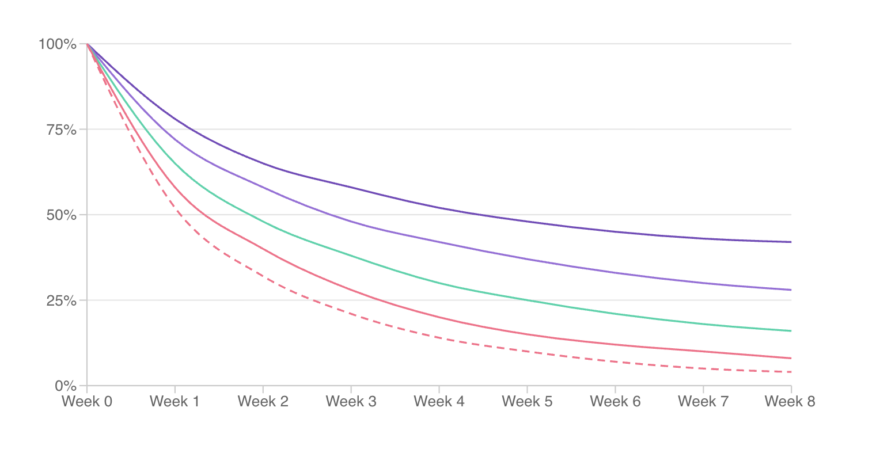
Pull your retention curves by signup cohort. Compare how newer cohorts perform against older ones at the same lifecycle points. One weak cohort isn’t necessarily a concern, but three in a row is a signal.
The product that pulled users in 18 months ago is landing differently today. Something shifted, either in the market, in your product, or in what competitors offer. Cohort data tells you it’s happening before the revenue does.
When you establish real product-market fit, referrals flow in without formal programs and sales cycles stay tight because prospects already believe before the first call.
When fit starts to erode, you notice it in the effort. Organic growth flattens while acquisition spend holds steady. Deals that should close in two weeks stretch to six. You find yourself working harder for the same result.
That extra effort is worth paying attention to because it’s a leading indicator. By the time revenue reflects the problem, you’ve usually already lost months.
“I love this” becomes “it’s fine” or “it does what I need.” Churn interviews start mentioning competitors casually, as reference points instead of direct objections.
The emotional intensity fades. Users sound indifferent. And indifference is worse than frustration.
Frustrated users still care. Indifferent users are already halfway out the door.
Once teams notice the symptoms, many make the same mistake: they immediately start building.
They assume they need to ship something, anything, to show progress.
The problem is that PMF erosion has different root causes, and each one requires a different response. Treating a market shift like an execution problem, or an execution problem like a competitive one, burns time and budget while the real issue keeps getting worse.
As a PM, you should be able to distinguish between these root causes:
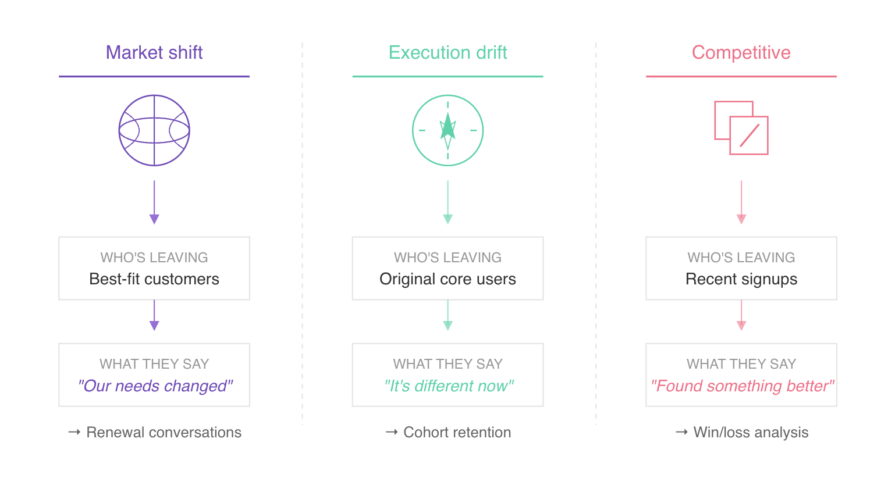
The table below unpacks how to tell them apart:
| Signal | Market shift | Execution drift | Competitive displacement |
| Who’s leaving? | Best-fit customers from past cohorts | Original core users | Recent signups and prospects |
| What they say | “Our needs changed” | “It’s different now” | “We found something better” |
| Where it shows first | Renewal conversations | Cohort retention, feature usage | Win/loss analysis |
Run this diagnostic before you touch your roadmap.
When product-market fit starts to erode, teams often respond quickly, but not always effectively. Avoid these common mistakes while trying to get your product back on track.
A user who left because their company got acquired is completely different from one who left for a competitor. Segment your churn by reason. The cause matters more than the rate.
The instinct is to build something, anything, to demonstrate progress. But jumping to solutions before understanding whether this is market, execution, or competitive means you’re guessing.
Run two weeks of focused discovery before any roadmap changes. Talk to churned users. Talk to recent non-buyers. Look at the data by segment.
Some users want more features. Others say the product has become too complicated. If you average those voices, you end up building for everyone and resonating with few.
Segment relentlessly, Who’s saying what, and are they your highest-value users or a distraction?
This is the mistake that really compounds the damage. PMF decay is often fixable, but usually only early. The longer you wait, the more your best customers leave, the more institutional knowledge walks out the door, and the more your positioning blurs in the market.
A few months of hesitation can turn a course correction into a full pivot.
Before you start firefighting, make sure you and your team have identified the source of the PMF erosion. Starting with the cause lets you tailor your response to the actual problem instead of reacting to symptoms. Here’s how I approach each of the core causes.
Go back to the problem itself. Skip asking churned users how to improve the product. Ask what they’re trying to solve now.
Talk to recent non-buyers. Understand the new context they’re operating in. You may need to evolve the core value proposition, not just the feature set.
Identify your highest-value segment and re-commit to them completely. Audit your product for features that dilute the core experience. This means disappointing some customers. That’s the point. Depth with your best users beats breadth across lukewarm ones.
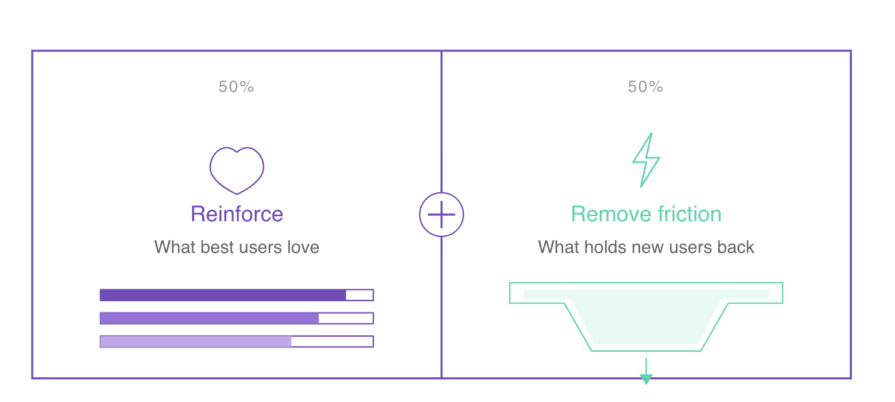
A useful frame is to split your roadmap in half. One half reinforces what your best users already love. The other half addresses what holds new users back. Both matter. Focusing on only one stalls your momentum.
Make a clear choice: close the gap or reposition.
Closing the gap means matching competitors on the dimensions where you’re losing. Repositioning means finding the segment or use case where you still win decisively, and going deeper there. Attempting both usually means accomplishing little of either.
Product-market fit isn’t something you find once and keep forever. It’s a condition you have to keep monitoring.
Build a simple operating rhythm around it: monthly cohort reviews, quarterly surveys that ask users how they’d feel if the product disappeared, ongoing win/loss tracking. When the signals start to drift, investigate before performance drops further.
The teams that treat PMF as a living signal catch erosion early enough to recover. The teams that treat it as a box they checked two years ago are usually the ones scrambling later.
PMF decay is often reversible. But only if you catch it early and respond with the right diagnosis.
Featured image source: IconScout

LogRocket identifies friction points in the user experience so you can make informed decisions about product and design changes that must happen to hit your goals.
With LogRocket, you can understand the scope of the issues affecting your product and prioritize the changes that need to be made. LogRocket simplifies workflows by allowing Engineering, Product, UX, and Design teams to work from the same data as you, eliminating any confusion about what needs to be done.
Get your teams on the same page — try LogRocket today.

Spot misleading KPIs, balance targets with counter-metrics, and keep your team focused on better product outcomes instead of dashboard wins.

Keep the reasoning behind product decisions within reach. Build a clear system to track customer feedback, priorities, and project progress.

Discover how Meilisearch uses LogRocket’s MCP and Galileo to improve free trial conversion and adoption of newly shipped features across its Cloud product.

Resolve cross-functional conflict in AI product development with a 3-step framework to clarify risks, assign owners, and align teams to act.


 Learn more →