In an ideal world, you’d inherit a product the way you’d inherit a tidy apartment. The product would come with clear documentation and a clean history of why each decision was made. Every task would be well established in the vision, strategy, and roadmap, awaiting only your input on whether to keep the existing product direction or establish a new one.
A fresh start with no real baggage.
However, what actually happens is that you’re given a mess and expected to understand it and restore order. Those 373 tickets will mostly never materialize into shippable updates, even if AI agents could, in theory, code it quickly. This can be overwhelming, even panic-inducing at first, but you have to tackle this like a proper PM: One small issue at a time.
So let’s do that. In this piece, I’ll cover why you keep ending up holding products you didn’t build, what to actually focus on in your first weeks, how to get the context nobody handed you, and how to clean up the mess without breaking anything. I’ll also cover why the inherited product backlog is often the first place where neglected decisions, stale assumptions, and hidden risk show up.
Let’s begin.
First, let me start by saying that inheriting a product is the norm, not the exception. Greenfield products, where you build from zero, are a rare and glamorous minority. Most PM work involves taking over something already in motion.
There are a few usual suspects behind how you got here:
Note that none of these are your fault, and none of them come with a good handoff process. That’s not a coincidence. Products that get cleanly handed over rarely need a rescue. The ones that land on your desk are usually the ones that didn’t.
So if it feels like a mess, chances are it’s because it is. The job isn’t to be upset about it. Look at it this way: It’s an opportunity for you to make a real difference.
I know “don’t panic” is the most useless advice ever, but bear with me, because there’s a real point here.
You already earned trust within your organization by getting hired or chosen for this. You beat a lot of other people to the role. It wasn’t just your resume. It was your judgment, your communication, and your ability to think on your feet under pressure. The company has paid a lot to get you here, and that investment doesn’t stop the day you start.
Which means this: nobody expects you to be at full speed in week one. A reasonable org gives you three months before it expects real output, and many give six. Some sane ones give twelve.
So the worst thing you can do in your first weeks is to jump headfirst into unknown waters. You simply know too little at this stage to effectively navigate the situation and guide the product ship to the right place. Instead, you need to carefully plan ahead before even having your knee caps wet:
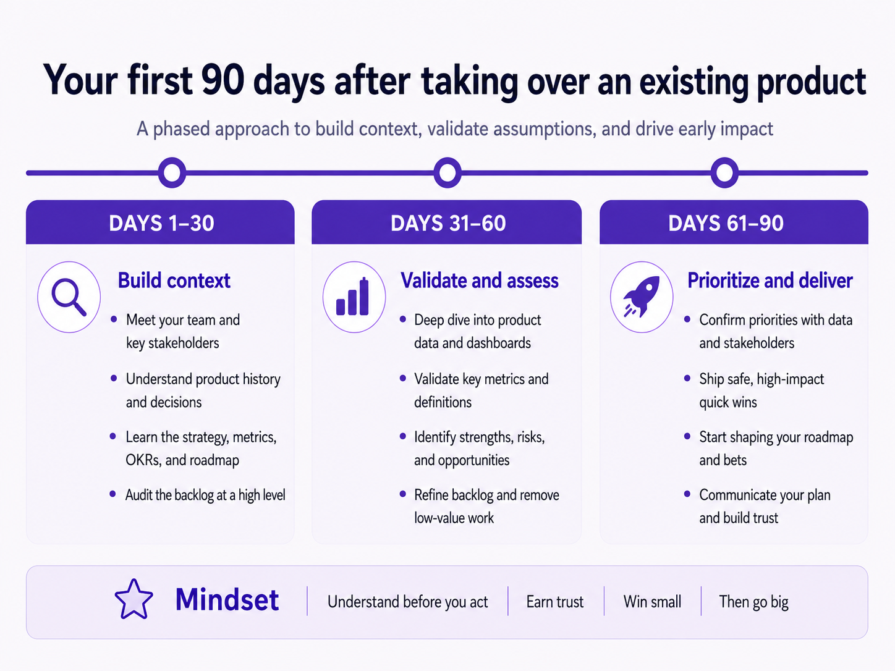
Your first job isn’t to act. It’s to understand. Everything below is about buying yourself the context to act well later.
Before you dive into the metrics and architecture diagrams, it’s critical that you talk to humans.
Start by connecting with your team on a personal level first. Learn what excites them, what frustrates them, and how they actually like to work. This isn’t soft fluff. The engineer who’s been on this product for four years is the single best documentation source you have, and they’ll open up far more if you treat them as a person than as a search engine.
Next, set up regular meetings with your manager. Initially, use those meetings to agree on the onboarding goals and have a fixed time to report back and ask questions. Without that guidance, you may find yourself consuming documents that’ll only add to your confusion, rather than provide clarity.
Then start mapping out and getting to know all the stakeholders vital to your future progress. That means both management and the people you’ll work with on a day-to-day basis. If you present yourself as an approachable partner, you’ll find it easier to operate in the future, as you’ll be surrounded by trusting allies.
You need to absorb as much context as possible. You should be able to easily recite the product’s mission, strategy, metrics, OKRs, history, and backlog. You cannot make a meaningful call until you understand the reasoning behind the product’s current state.
Pay special attention to history, because inherited products are full of decisions that look insane until you learn the context. That weird flow nobody likes? It might be there because of a contractual obligation, a regulatory requirement, or one very important customer. The feature that seems half-finished? Maybe it was deprioritized mid-build during a reorg. Ask “why is this like this?” relentlessly, and write down the answers, because you’ll forget them.
This is where curiosity is genuinely your superpower. You’re new, so you’re allowed to ask the dumb questions that veterans are too embarrassed to ask. Use that window before it closes. After a few months, “wait, why do we even do this?” stops sounding curious and starts sounding like you weren’t paying attention.
Once you understand who cares about what and why the product looks the way it does, dig into the actual data by asking more questions like:
Be careful here. Inherited dashboards lie more than fresh ones, because metric definitions drift, events break, and nobody notices when an owner leaves. Before you trust a number, find out who built it and whether it still measures what its label claims. A “conversion rate” that hasn’t been validated since the last PM left might be a rumor, not a metric.
While you’re soaking everything up, you may feel you need to make an impact soon. You probably don’t, but for your peace of mind, look for small, safe wins that demonstrate value without committing to large chunks of work early. Opportunities might include:
You really don’t need anything spectacular. Merely anything that moves the metrics in the right direction thanks to your end-to-end work. This is already a solid start.
The trap is committing to a quick win that turns out to be a quick loss. “I’ll just clean up this one flow” can quietly become a three-month migration once you learn what’s underneath it. Trust your team to help you tell a real opportunity from a grenade with a ribbon.
However, whatever you decide (tread lightly or make a statement early), eventually you’ll need to take initiative.
Opening an inherited backlog for the first time is genuinely overwhelming. Hundreds of items, half of them ancient, written by people who left long ago, in a format that may or may not have been a format.
Here’s how to make it yours without losing a week to it:
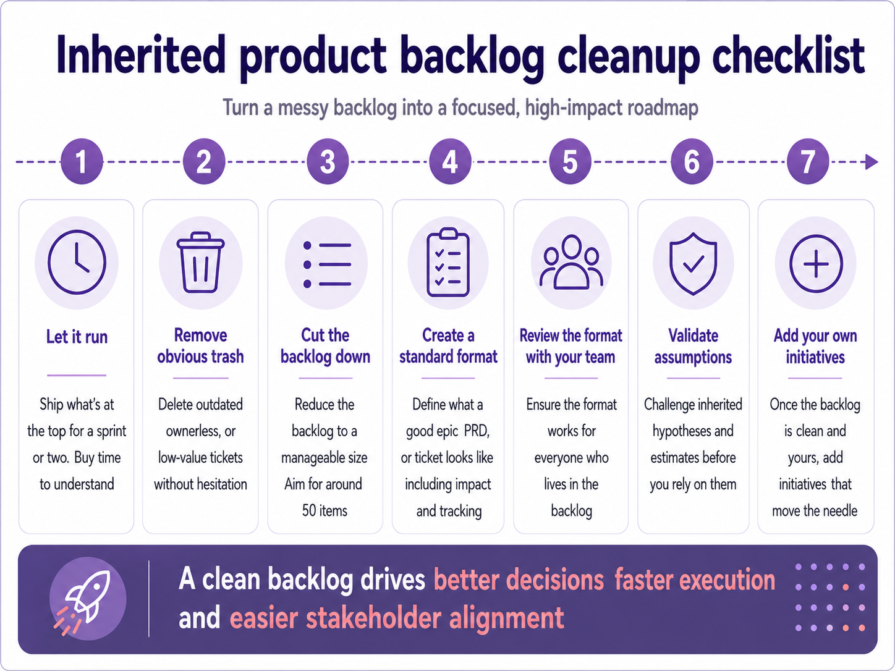
Don’t reorganize on day one. Just ship whatever’s at the top, because the top of a backlog is usually the most polished and the least risky. This buys you time to understand the rest.
Look for items that are months or years old, things like:
You can usually identify obvious garbage fast. Delete it without hesitation.
A backlog with hundreds of tickets is not a backlog; it’s a wishlist and an eye-rolling one at best. You need to lower it to something more manageable, somewhere around 50.
Even if, after removing obvious stinkers from the previous paragraph, you’ll end up with a big number, the exercise in cutting down the ticket number will be of a prioritization aspect. After all, you can only ship so many updates.
Now that the numbers are sane, work on quality. Decide what a good epic, PRD, or ticket looks like for you, and make sure it includes an impact hypothesis and tracking requirements. It usually needs to be more than just a description of the thing to build.
Don’t impose it. Ask whether it works for them. The team lives in this backlog, too, so they should be comfortable with the shape of it. Maybe tracking requirements belong in a subtask rather than the main body.
Here’s the one I’ll put in capital letters, because it matters: don’t assume your predecessor did a good job. I had burned myself on this assumption more than once.
Maybe there’s already an impact hypothesis and metric estimate attached to an epic, great. But if you’re going to make decisions based on it, you’d better be able to defend it as if you wrote it, because the moment it’s on your roadmap, it’s yours. Inherited assumptions have a way of quietly becoming your liabilities.
Once the backlog is clean and genuinely yours, you’ve earned the right to put your own bets in it. This is the fun part, and the part where stakeholders start to see the product turning a corner under you.
Inheriting a product isn’t a punishment, even though it can feel like one in week one. It’s a normal part of the job, and learning to do it well is one of the highest-leverage skills you can build as a PM.
The shape of it is always roughly the same. Don’t panic, because nobody expects miracles yet. Understand before you act. Talk to the people first, learn the why second, trust the numbers third.
Win small to earn the right to bet big. Make the backlog yours instead of resenting the version you were handed. And only when you find the neglected foundations that everyone before you ignored, fight for them in the only language that actually moves a roadmap: impact, numbers, and trust.
Be patient with onboarding. The more you focus on that, the better product decisions you’ll make later down the line. Although agile scrum might suggest otherwise, your work isn’t a sprint; it’s a marathon. Onboarding is hardly your first training session.
Thanks for reading. See you in the next one.
Featured image source: IconScout
LogRocket identifies friction points in the user experience so you can make informed decisions about product and design changes that must happen to hit your goals.
With LogRocket, you can understand the scope of the issues affecting your product and prioritize the changes that need to be made. LogRocket simplifies workflows by allowing Engineering, Product, UX, and Design teams to work from the same data as you, eliminating any confusion about what needs to be done.
Get your teams on the same page — try LogRocket today.
Keep the reasoning behind product decisions within reach. Build a clear system to track customer feedback, priorities, and project progress.
Discover how Meilisearch uses LogRocket’s MCP and Galileo to improve free trial conversion and adoption of newly shipped features across its Cloud product.
Resolve cross-functional conflict in AI product development with a 3-step framework to clarify risks, assign owners, and align teams to act.

Learn when prompt-first UX adds friction and how product managers can choose AI interfaces that balance flexibility, structure, and control.

 Learn more →