
Since its inception, the ecommerce industry has been built around one assumption: a human is looking at your screen. A typical product manager would optimize the graphics, shorten the funnel, push Hail Mary pop-ups to save the sale, etc. It was a balance of ease, optimized UX, and psychological trickery to ultimately land a sale.

But what if your client has no eyes to attract or mind to manipulate? What if it’s… an AI agent?
Agents don’t care that your design has been polished by a dozen different people for the last decade. They can’t be manipulated with true (or fake) urgency, and the color of the button is a meaningless number to them. They only care about product data, compare you against ten competitors in half a second on the facts alone, and make a decision you never got to influence with your frontend work.
Welcome to agentic commerce. It’s not sci-fi but the reality we’re stepping into right now. In January, Google used its NRF keynote to launch the Universal Commerce Protocol, an open standard for agent-driven shopping, co-developed with Shopify, Etsy, Wayfair, Target, and Walmart and endorsed by more than 20 other companies, including Visa, Mastercard, and Stripe.
This isn’t a niche tech nuisance, but an actual new type of stakeholder to optimize for. But should you? And is the AI buyer something to optimize for or something to protect your business from? Keep reading to find out.
Let me start by emphasizing that this isn’t something hypothetical. This isn’t a startup demo. Big tech, as just mentioned in the intro, has already created the technical groundwork to make it easier for agents to roam around e-commerce platforms and do their tasks.
This may feel like déjà vu to all the brands that insisted on keeping their business physical and avoided ecommerce. While one didn’t eliminate the other, it’s obvious that online-first companies have won in the long run. Perhaps this next wave will be the agentic versus human-driven ecommerce battle?
For now, the forecasts continue to be large. Morgan Stanley estimates that agentic shoppers could take 10 to 20 percent of US ecommerce by 2030. While this might feel like a finger-in-the-air prediction, the same Morgan Stanley also estimates that roughly 23 percent of Americans already bought something using AI in the past month. So, again, the AI client is here already.
All right, but what about the conversion of such synthetic buyers? As alluded to in the opening, it’s more complicated than encouraging them to buy using frontend magic alone.
Adobe, which tracks over a trillion visits to US retail sites, found that AI-referred traffic went from converting noticeably worse than other channels to converting meaningfully better within about a year. This points to the trend that customers are increasingly turning to AI to help them shop, which means some of your traffic is already arriving this way, whether you’ve optimized for it or not.
So, since the traffic is here and is projected to grow, it seems like a logical step to be an early “adopter.” And the work done to become one won’t only benefit your AI buyers. You see, when an agent does the shopping, it builds its shortlist before any human sees a thing.
If your product data is clean and complete, you make that shortlist. If a competitor’s data is thin, they don’t. For once, the foundational work pays off as a genuine first-mover advantage instead of invisible hygiene, because the agent simply skips whoever it can’t read.
Not adapting means you could be left behind in the near future. Of course, that assumes this trend keeps growing and the synthetic stakeholder group becomes more significant with every passing year. However, what if this isn’t the case?
Before we commit many hours to brainstorming, let’s examine the opposite prediction: What if the synthetic shopper stays a niche, and all that frantic adapting turns out to be optimizing for a not-all-that-profitable corner case?
There’s a solid argument for keeping your cool, and it starts with an awkward fact: the purest version of this future already crashed once, in public. In September 2025, OpenAI launched Instant Checkout inside ChatGPT, letting you discover, compare, and buy without ever leaving the chat. The full agentic dream.
By early March 2026, OpenAI had quietly pulled the plug. Fewer than 30 Shopify merchants had ever gone live, and the numbers were grim. Walmart’s product chief told Wired that buying inside ChatGPT converted roughly three times worse than just sending the same shopper to Walmart.com.
So the very company supposedly leading us into this future walked back its boldest bet on it. Hardly a ringing endorsement for gutting your product around the idea tomorrow morning.
Then there’s the small matter of nobody agreeing on how any of this should actually work. We have Google’s UCP. We also have OpenAI’s own Agentic Commerce Protocol. And a handful of others elbowing for position.
It’s a classic standards war, and we all know how pleasant it is to be stuck in the middle of it. Build deeply for one protocol today, and you might just be the person who proudly backed HD DVD rather than the Blu-ray format. Picking the winner before the dust settles is always a move with a high degree of risk.

And let’s not forget who’s still actually buying your product: humans. Overwhelmingly, stubbornly, humans. Even the aforementioned Morgan Stanley forecast tops out at a fifth of US e-commerce by 2030, which means four-fifths are still good old carbon-based shoppers, today and for years to come.
Ripping apart an experience that works for that 90-plus percent in order to charm the bots is, to put it gently, optimizing for the wrong crowd. And here’s the kicker: even when the agent does its thing, it usually hands the human right back to your site to close the deal. So your page still has to do its job regardless.
Finally, there’s the sneaky risk: the one you don’t notice until it’s too late. When an agent wedges itself between you and your customer, you can win the sale and still lose the customer. The shopper chatted with the agent, not with you.
No email, no account, no loyalty signup, none of the lovely behavioral data you’ve grown used to. You quietly become an interchangeable supplier, filling an order routed by someone else’s AI.
It’s precisely why eBay moved to ban unauthorized buy-for-me agents on its marketplace, and why Google’s UCP went out of its way to promise retailers they keep their “merchant of record” status. The whole industry is arm-wrestling over who owns the shopper, and that match is not even close to over.
Every marketer will tell you how important it is to build an email list and a relationship with your clients so they keep returning. Handing that to bots gives away all the opportunities you can gain this way, not to mention all the promotions and recommendations users see once on the website.
The flashiest version of agentic commerce has already face-planted, the rules of the game aren’t written yet, your real customers are still overwhelmingly human, and rushing in can quietly cost you the very relationship that makes a customer worth having in the first place. Not to mention, investing development time into AI buyers has to come at the expense of updates that could lead to more sales from the traditional, ape-originating customers.
So which is it? Charge in, or sit tight? As usual, the honest answer lives somewhere in the messy middle. Now, let’s get practical.
Here’s where all that back-and-forth turns into something you can act on. One thing is obvious. The logical conclusion is that it isn’t the time (yet) to rebuild your product for bots.
That doesn’t mean you should stay idle and ignore the potential future group of buyers. Here’s a scene you’ll recognize. Some senior someone reads one breathless article, walks into the room, and declares that we’re going all in on AI buyers because “it’s the future.”
Your job at that moment isn’t to argue about the future. You need to show up with the numbers that prove it’s too soon to bet the product on it, and then redirect all that nervous energy into something sensible. So instead of a rushed, risky rebuild, hand that manager these four moves:
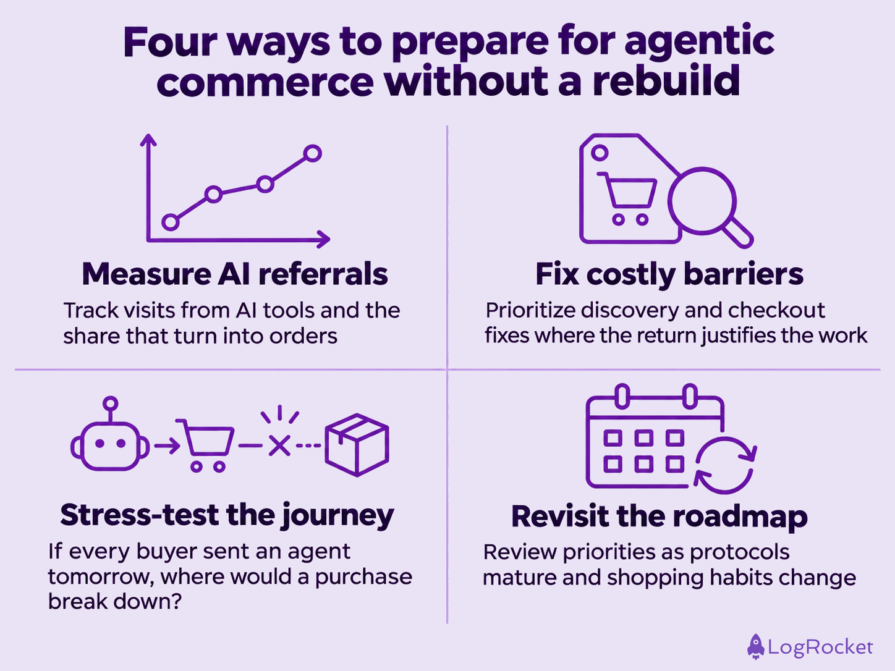
You can’t manage what you don’t measure, and right now most teams aren’t measuring this at all. The good news is that adding a new stakeholder to your dashboard is close to free. A bit of work to tag and track traffic coming from AI sources, and you’ve got eyes on the thing everyone’s wondering about.
What you’re really watching for is the trend, not today’s number. If AI traffic is a flat, tiny sliver, you have your evidence that going all in would be wasteful. If it’s quietly doubling every quarter, you’ll see it coming with enough runway to act in time and grab most of it instead of scrambling late.
Either way, you’ve replaced an argument about feelings with a line on a chart. That alone is worth the afternoon it takes to set up. But there’s more you can do without much effort:
While you’re at it, go and look at what the AI buyers that are already here actually experience. Even in small numbers, these AI buyers may already be hitting barriers. If they can already bring in revenue, you might as well remove unnecessary barriers.
Make sure to run the numbers, and if the ROI is there, do it. And here’s the happy accident worth hunting for: this work often overlaps with some maintenance ticket that’s been rotting at the bottom of the backlog for years. Suddenly the boring structured-data cleanup that nobody would fund has a shiny new justification. Use it.
You don’t need to build for the extreme scenario, but you should have thought about it before it arrives. So run a workshop around one deliberately provocative question: What if every single one of our buyers were an AI tomorrow?
It’s a thought experiment, not a roadmap. But forcing the team to actually sit with it surfaces the real weak points fast. Where does our product become invisible? What would we lose? What would we have to build?
Write all of it down. Act on the one or two things that are cheap and obviously smart today, and file the rest as a plan you can pull off the shelf the moment the data says it’s time. Panic is expensive. A folder labeled “if this gets real” is cheap.
Finally, stay wary. The AI landscape rewrites itself roughly every week, which means the forecasts and lessons in this very article could age like milk, and fast. The protocol that looks dominant today might be a footnote by next quarter.
So treat this as a standing habit, not a one-time project. Keep half an eye on where agentic commerce is heading, who’s winning the standards fight, and what new behavior is actually sticking.
The goal is to not be the team that slept through the next big shift in how people and robots buy things. Being early is an advantage. Being surprised is a potential closing sentence.
To circle back to the original question: do you need to build your product for a robot? My honest answer is: Be ready for it, but don’t rush to act just yet.
The agent is a real new stakeholder, but it mostly changed the discovery half of the journey, not the whole thing. The breathless crowd is wrong that the website is dead. The dismissive crowd is wrong that nothing changed. The truth is in the middle, where, as a good product manager, you need to attempt to keep everyone happy with the product, human and AI buyers alike.
However, as always, act with common sense and an analytical prioritization process. 20 percent of AI buyers who convert poorly is a call to action to update the product so they convert better. It’s not the same if this number falls below one percent. Of course, those numbers are made up, but I presume you understand what I’m getting at.
Thanks for reading!
Featured image source: IconScout
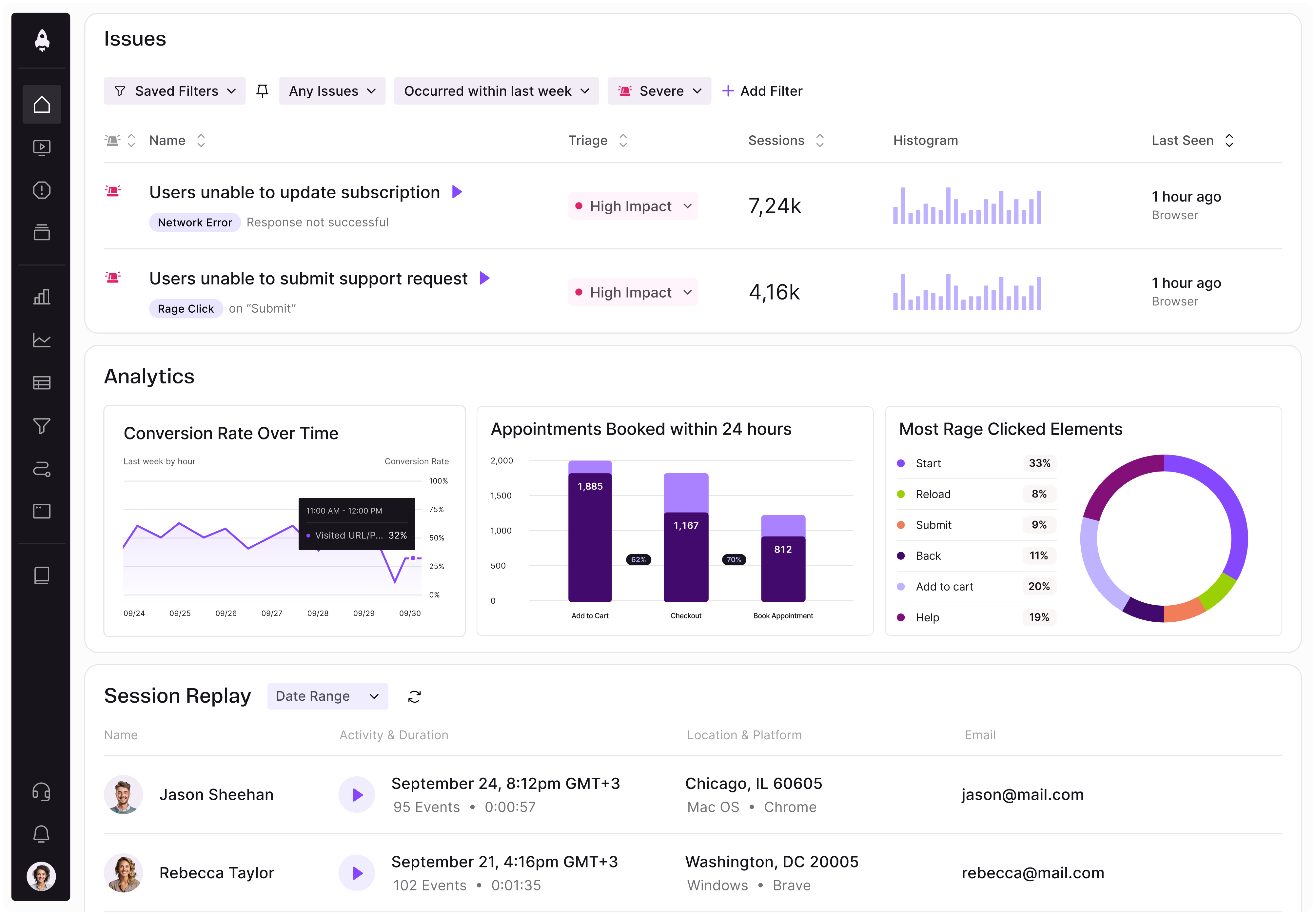
LogRocket identifies friction points in the user experience so you can make informed decisions about product and design changes that must happen to hit your goals.
With LogRocket, you can understand the scope of the issues affecting your product and prioritize the changes that need to be made. LogRocket simplifies workflows by allowing Engineering, Product, UX, and Design teams to work from the same data as you, eliminating any confusion about what needs to be done.
Get your teams on the same page — try LogRocket today.

Build a product management AI agent in 2027. Start with feedback triage, compare no-code tools with the Responses API, and test whether it saves time.

Move AI pilots toward production with PM playbook for ownership, funding, and readiness. Learn when to scale, revise, or stop your AI pilot.

Learn how to spot cognitive debt in AI products, preserve critical user skills, and measure outcomes beyond speed with helpful tips for PMs.

Learn how to turn regulatory requirements into clear product requirements, define acceptance criteria, and keep your compliance work current.

 Learn more →