
As a product manager, you can build an impressive AI demo with your team in days and win enthusiastic stakeholder approval. However, without the right due diligence, you may discover that the route to production is blocked, leaving your pilot in a never-ending cycle of testing.

In Zapier’s 2026 AI pilot survey, 38 percent of respondents said their longest-running active AI pilot had been stuck in evaluation for more than a year. The challenge goes beyond whether a model can generate a useful response in a controlled setting. You need to know whether you can safely, reliably, and affordably put that capability into a real workflow.
This playbook helps you reach one of two good outcomes faster: a deployment-ready pilot with a credible path to scale, or an informed decision not to proceed.
The process has three stages. First, define the pilot in a short charter. Next, assess four conditions that make production plausible: dedicated ownership, executive sponsorship, adequate budget, and a viable systems and data path. Finally, run the pilot to validate your assumptions and decide whether to scale, revise, or stop.
Before going through the four gates, set up a pilot charter: a short, strategic document that defines the pilot’s purpose, expected value, scope, stakeholders, and decision criteria. In many cases, one or two pages are enough.
The most important part is making success criteria measurable enough to support a decision. “Users like it” is a useful signal, but it’s not a production threshold. Stronger criteria combine quality, adoption, and workflow impact with safeguards the pilot must meet before deployment.
For example, an internal support copilot might need:
These thresholds are illustrative. You should set targets that reflect your workflow’s baseline performance, expected value, and consequences of failure. Specify how you’ll measure each criterion and which safeguards are mandatory.
A model that produces plausible outputs can make an AI pilot look ready for deployment. However, organizational blockers such as unclear ownership, insufficient funding, disconnected systems, poor data quality, and unresolved governance requirements can still prevent it from reaching production.
With your pilot charter in place, assess four gates that help you determine whether the pilot has a realistic path to production:
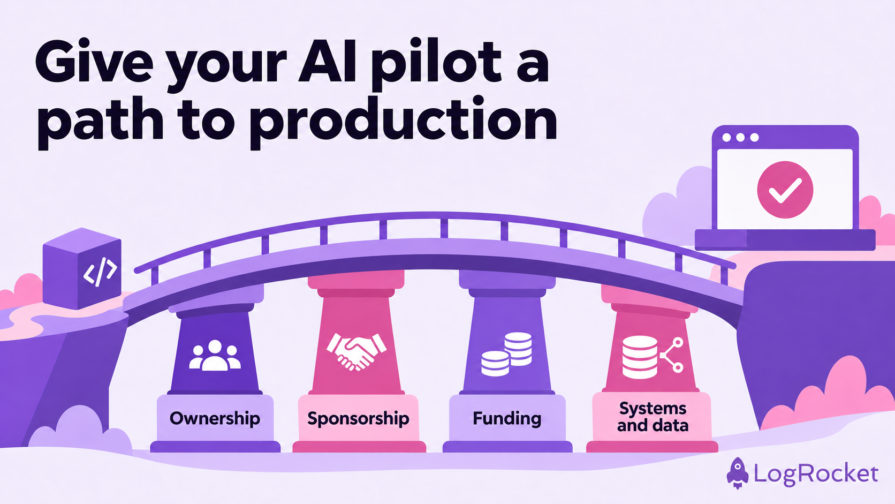
Together, these gates help you assess whether your organization can own, fund, govern, and integrate the AI capability in the workflow where people will actually use it.
Clearing the gates doesn’t guarantee that a pilot will ship or eliminate technical, adoption, or market risk. However, it does help you identify dependencies, investment decisions, and access requirements that could otherwise leave a promising pilot stalled.
Your pilot doesn’t need every production detail finalized before it begins, but if you can’t clear a gate, establish a credible plan to address it, with an accountable owner and a deadline. Without that plan, narrow the scope or postpone the pilot until the necessary conditions are in place.
Every pilot needs one accountable owner, usually the product manager, with time allocated to lead the work. This person keeps information from falling through the cracks, maintains the charter, decision log, and blocker log, and keeps stakeholders informed. They also escalate unresolved decisions to the person with authority to make the final call.
Without clear ownership, blockers become everyone’s problem and no one’s priority. What looks like a technical delay may be a coordination problem. A lightweight ownership map helps clarify who is responsible for each part of the pilot.
| Function | Primary responsibility |
| Product manager | Owns pilot outcomes, scope, stakeholder coordination, evidence, and the recommendation to scale, revise, or stop |
| Engineering | Builds the workflow, evaluates technical feasibility, monitors reliability, and documents dependencies |
| IT or platform team | Provides identity, access, integration, infrastructure, and operational support |
| Security | Reviews threat model, controls, access, logging, and incident requirements |
| Legal, privacy, or compliance | Reviews data use, vendor terms, regulatory constraints, and retention requirements |
| Business owner | Defines workflow value, recruits users, validates impact, and owns adoption |
| Executive sponsor | Resolves cross-functional conflicts, protects the pilot’s priority, and makes scale, revise, or stop decisions with the relevant approvers |
Assign a named person to each responsibility and confirm their commitment. One person may cover several functions, depending on the team’s size and the pilot’s scope.
This gate is cleared when the pilot has an accountable owner, the necessary contributors have committed time, and the escalation path is agreed. When a blocker emerges, everyone should know who owns the next action, who makes the final call, and when escalation is required.
Executive sponsorship is more than a kickoff endorsement. Look for an explicit commitment that the sponsor will remain engaged throughout the pilot and help resolve decisions that require their authority.
Zapier’s survey found that organizations that deployed most or all of their AI pilots were more than twice as likely to have secured director-level sponsorship or above before launch as those that deployed only a small number.
When priorities shift, an active sponsor can preserve momentum and help the team complete the cross-functional work required to ship. A useful sponsor understands major dependencies and tradeoffs, steps in when blockers threaten progress, and helps secure timely decisions about ownership, funding, scope, or risk.
When pitching an AI pilot, use your charter to prepare a one-page sponsor brief that covers:
Once the pilot is approved, schedule three meetings with the sponsor:
Agree on how to escalate urgent blockers between these meetings so decisions don’t wait for the next scheduled review.
This gate is cleared when a named sponsor has agreed to the decision schedule, clarified which decisions they can make or escalate, and committed to helping resolve cross-functional blockers.
A pilot budget isn’t the same as a production budget. Teams often fund model experimentation but overlook the work needed to deploy and maintain a dependable service.
A pilot can demonstrate potential value, but value alone doesn’t pay for the systems work that turns a prototype into an operational product.
Before the pilot launches, agree on how the team will seek deployment funding if it meets its success criteria. You don’t need every production dollar approved upfront, but you do need to identify who owns the next investment decision, what evidence they require, and when they’ll make it.
Build an initial cost estimate that separates one-time deployment work from ongoing operating expenses. You should include:
Estimate how ongoing costs will change at expected production usage, including model calls and human review time. Use the pilot to test whether the cost per completed task is justified by the value it delivers.
This gate is cleared when the team has an initial deployment cost estimate, a credible funding path, and a named investment decision-maker with agreed evidence requirements and a decision date.
If the team can’t identify a credible funding path, narrow the scope or stop before the pilot creates a larger unfunded commitment.
Zapier identified IT infrastructure, data quality, and system integration issues as the most common barrier to deployment, reporting that they blocked 41 percent of stalled pilots.
This gate tests whether the use case has a realistic path to production within your organization’s technical and regulatory environment.
Before the pilot starts, map the likely production path and identify the major constraints:
This gate is cleared when the team has mapped a feasible production path and documented the major constraints, with an owner, a next action, and a deadline for each unresolved dependency. Any approvals required to run the pilot must be in place before it begins.
Once the pilot begins, test whether the production path mapped in Gate 4 holds up under realistic working conditions. Track results against the charter’s success criteria, including output quality, adoption, workflow impact, cost, and required safeguards.
Alongside those measures, validate the technical and data assumptions that could prevent deployment:
Maintain a shared blocker log throughout the pilot. For every blocker, record the issue, its impact on the success criteria or deployment readiness, the accountable owner, the next action, the target resolution date, and when to escalate.
Review the log in routine cross-functional meetings. Involve your executive sponsor when a blocker requires their authority to resolve ownership, funding, scope, or competing priorities.
If a critical issue makes continued testing unsafe or invalidates the pilot’s assumptions, pause the affected work rather than waiting for the final review. Any unresolved critical issues should directly inform the scale, revise, or stop decisions.
At the agreed decision date, bring stakeholders a concise decision memo that summarizes results and recommends a next step based on evidence. Build it from the charter, evaluation results, and blocker log. Your memo should cover:
Use the evidence to distinguish between three outcomes:
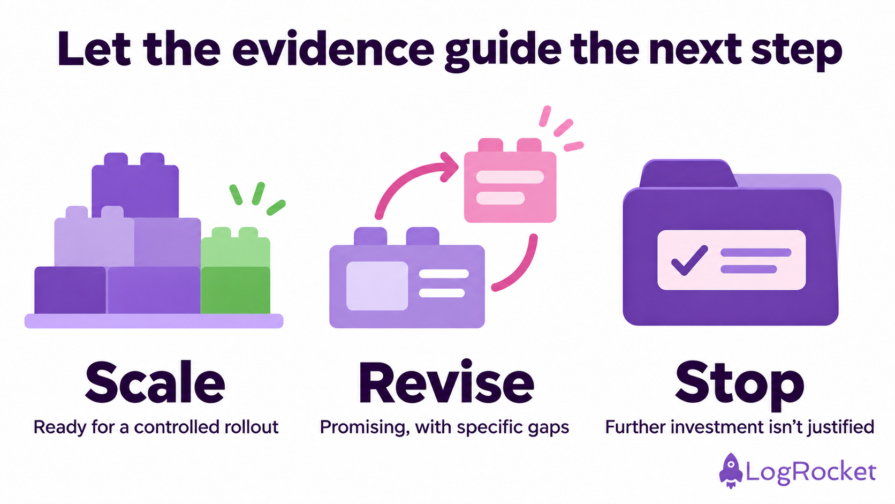
Record the decision, accountable owners, and next actions. A recommendation alone doesn’t close the pilot.
By bringing this evidence into one document, the decision memo gives stakeholders a shared basis for deciding what happens next. It helps shift the conversation from whether the pilot produced an impressive demo to whether the organization has enough evidence, capacity, and readiness to proceed.
These hypothetical examples show how the gates can help teams narrow a pilot’s scope or identify conditions that must be met before testing begins.
An internal support copilot will help agents find answers in policy documents. While preparing the pilot charter, the team discovers that policies live across a knowledge base, shared drive, and legacy case-management system.
The team narrows the pilot to one curated policy repository and assigns a knowledge owner to maintain it. During the pilot, agents evaluate whether responses accurately reflect and cite the current policies. Requests outside the repository’s scope follow the existing support process.
This gives the team a manageable way to test value and reliability before requesting broader integration work. Success would support expansion to additional sources, subject to resolving their access and content-quality requirements.
A customer-facing AI feature will recommend next steps in a financial workflow. Before the pilot begins, the team defines quality thresholds, human-review rules, prohibited advice categories, audit requirements, and a decision date.
If these conditions are met, the team runs a limited pilot within the agreed boundaries. It measures recommendation quality, workflow impact, and the volume and cost of human review before recommending a broader release.
If the conditions cannot be met, the team narrows the use case or stops before investing further in a feature with no safe or affordable path to production.
A successful AI pilot gives your organization enough evidence to make a responsible decision: scale a viable use case, revise a promising but blocked one, or stop before more time and budget are lost.
By establishing dedicated ownership, executive sponsorship, a credible deployment funding path, and workable systems and data access early, you give the pilot a realistic route to production.
Before your next pilot begins, write the charter, assess the four gates, and set a decision date. Use the pilot to test your assumptions, then let the evidence guide whether you scale, revise, or stop.
Featured image source: IconScout
LogRocket identifies friction points in the user experience so you can make informed decisions about product and design changes that must happen to hit your goals.
With LogRocket, you can understand the scope of the issues affecting your product and prioritize the changes that need to be made. LogRocket simplifies workflows by allowing Engineering, Product, UX, and Design teams to work from the same data as you, eliminating any confusion about what needs to be done.
Get your teams on the same page — try LogRocket today.

Learn how to spot cognitive debt in AI products, preserve critical user skills, and measure outcomes beyond speed with helpful tips for PMs.

Learn how to turn regulatory requirements into clear product requirements, define acceptance criteria, and keep your compliance work current.

Spot misleading KPIs, balance targets with counter-metrics, and keep your team focused on better product outcomes instead of dashboard wins.
Keep the reasoning behind product decisions within reach. Build a clear system to track customer feedback, priorities, and project progress.

 Learn more →