In digital product design, you’ll often have to do usability tests and A/B tests to improve overall UX quality. These common UX tests usually involve real user traffic and real users, so traditional, human-oriented UX testing can consume more time and be costly. A/B or multivariate testing on real traffic can negatively affect product reputation when a specific design version performs poorly, wasting precious incoming traffic. Usability test failures and pain points can frustrate real users who often volunteer for usability tests.
What if you can do UX testing without real traffic and real users? AI agent simulation is a futuristic UX testing technique that helps designers do A/B tests and usability tests using AI-simulated users.
Let’s understand how AI agent simulation for UX testing works and compare it with human-centered, traditional UX testing to decide when to use each to evaluate UX effectively by balancing accuracy and cost.
AI-simulated users are virtual digital product users created through an AI model. They have predefined UX personas that interact with digital product interfaces to achieve goals by mimicking real human user behavior.
An AI-powered A/B testing or usability testing automatically spawns AI-simulated users during a test based on UX persona configurations:
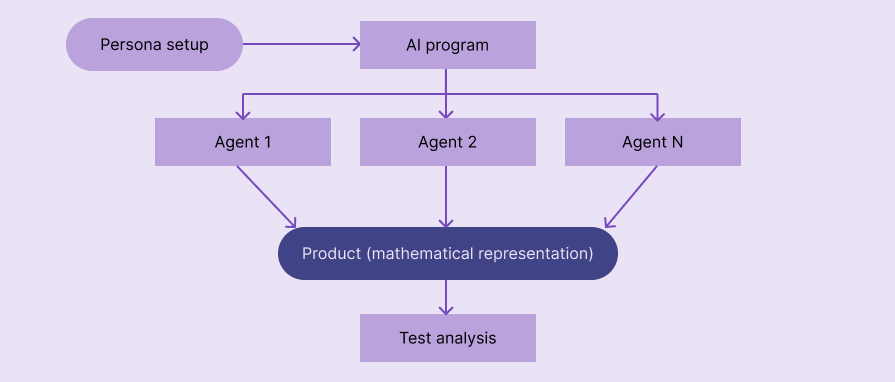
AI-powered UX testing tools use the following generic steps to create and use AI-simulated users:
Using AI-simulated A/B or usability testing has the following benefits:
While AI-simulated users bring benefits, it also comes with the following noticeable drawbacks:
Both simulated and real users are helpful in different test scenarios. Let’s understand when to use each. Here is a quick summary of the AI-simulated vs. real users comparison:
| COMPARISON FACTORS | AI-SIMULATED USERS | REAL USERS |
| Evaluation speed | Extremely fast | Slow |
| Affects product reputation scores | No | Yes |
| Scability | Very high | Depends on traffic and user availability (usually low) |
| Decision-making reliability | Low | High |
| Suitable for | Early-stage, low-risk design evaluation | Later-stage, high-risk design evaluation |
AI-simulated users are so fast but have accuracy issues, so they can be trusted for testing low-risk test scenarios where you need a design direction — not accuracy, like the early UX tests or running pre-tests (tests before real tests). Real users represent actual user interaction, so they can be trusted for high-risk test scenarios like the final UX tests
AI agent simulation in UX testing is a new UX evaluation trend that helps designers make early design decisions without affecting the real user base. It can also be used to conduct pre-A/B or multivariate tests to create better variants for real tests.
Not exactly, AI-simulated users will go through user flows, but inside the AI model by interacting with a mathematical representation of the product — not the real product
No, an AI-simulated A/B test isn’t a replacement for a real A/B test since pre-trained AI models can’t create your exact user base virtually
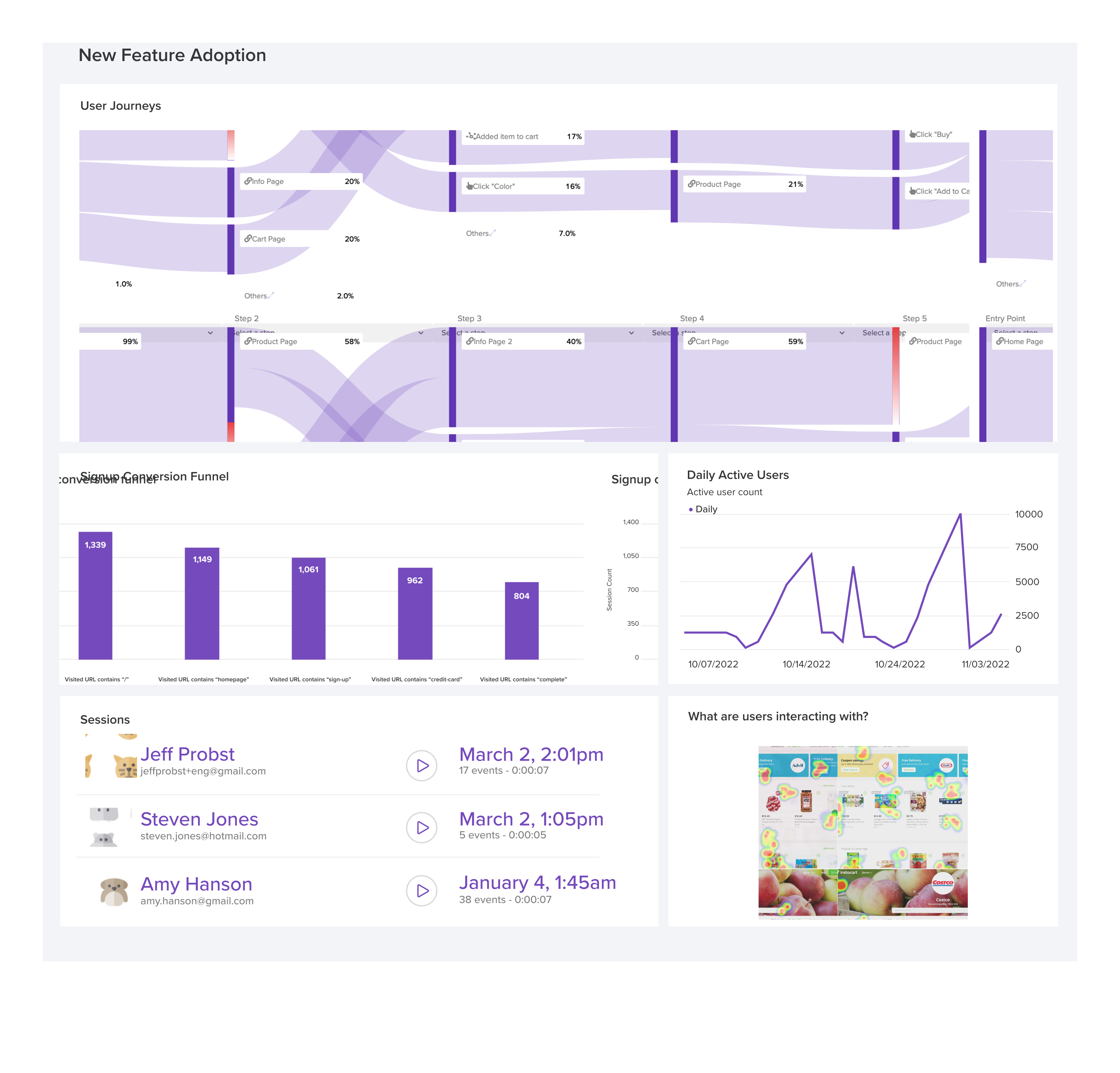
LogRocket's Galileo AI watches sessions and understands user feedback for you, automating the most time-intensive parts of your job and giving you more time to focus on great design.
See how design choices, interactions, and issues affect your users — get a demo of LogRocket today.
Your UX copy documentation isn’t just for human writers anymore. Here’s how to build a copy ecosystem that AI tools and agents can understand too.

Colors in UI aren’t just decoration. They’re the key to emotional impact, readability, and accessibility. This blog breaks down how to pick colors that don’t just look good — they work for your users.
For when you’re stuck in a UX design rut next, bring in lateral thinking. Lateral thinking will take your designs in fresh directions, solving tricky problems with unexpected creativity.
Giving designers AI tools is the easy part. I share how our team used office hours, small experiments, hackathons, and shared failures to build better AI habits together.

 Learn more →