AI products and features bring on more challenges than just adapting to the latest technological trends. As a product manager, you also have to handle the unique hurdles that AI products bring. Legal needs reassurance of compliance, engineers want more time to fine-tune, and executives pressure you to ship before your competitors do.
With so many competing AI priorities, PMs need to develop their cross-functional collaboration skill set to prevent legitimate concerns from becoming delay blockers. In this article, I go through a simple conflict-diagnosis framework designed to help move AI products forward.
The goal posts have moved on launch-readiness for AI products. There’s a host of issues to consider from compliance, data quality, and integration problems. Every team will need their hurdle addressed. You may mistake this as a feature prioritization issue, but it’s really a matter of how much risk a team is willing to take on.
Familiar PM instincts like alignment meetings, consensus-building, and pushing toward a deadline can fail when the team is facing unpredictable outputs and unevenly distributed risk. Many teams face trying to decide what’s safe enough to release.
Given the multitude of layers to releasing a secure AI product, it’s essential for you to use a framework to get to the heart of the disagreement before trying to solve it.
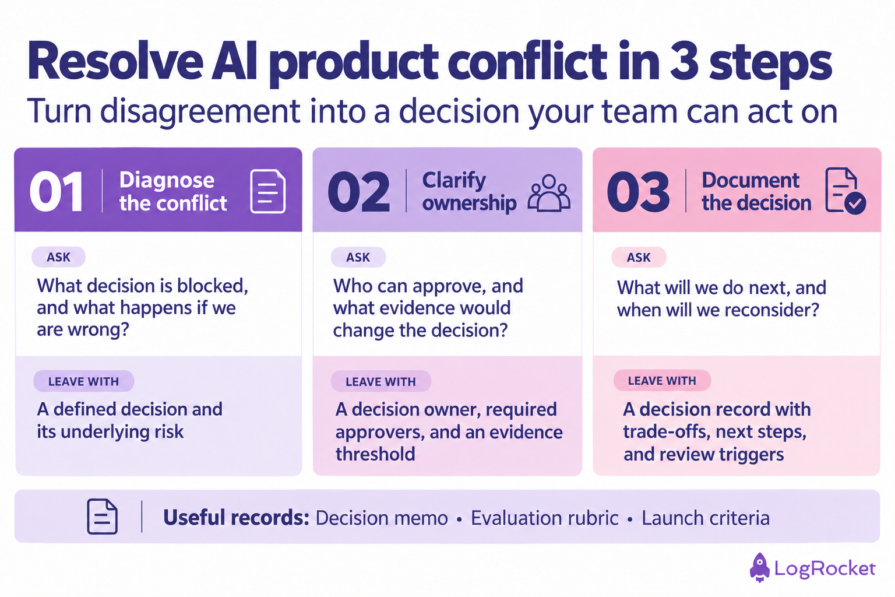
When faced with AI disagreement, I use the following three step framework.
In traditional product management, cross-functional conflict may have stemmed from different personalities and politics clashing with each other. But now there are competing priorities from several different teams.
To get to the root of the problem, start by asking these questions:
Once you diagnose the conflict, move on to naming the associated risks, potential solutions, and approvers for the next action step. You can also pick which artifacts to use to help make your case and ensure alignment.
Here’s what that could look like based on the conflict:
| Conflict type | The decision the team is really making | Who owns the risk decision? | What evidence or condition moves it forward? | Useful artifact |
| Speed | Is a smaller, limited, or delayed launch worth the tradeoff? | The product leader responsible for release scope, with required input from engineering and any affected risk owner | Evaluation results, rollout limits, monitoring plan, and rollback conditions | Decision memo and launch criteria |
| Quality | Is the model reliable enough for this use case? | The product leader responsible for release scope, with required input from engineering and any affected risk owner | Evaluation thresholds, known failure modes, human-review requirements, and customer-impact limits | Trade-off table and evaluation rubric |
| Ownership | Who can make the final call when functions disagree? | The designated decision owner | A clear decision-rights model, required approvers, and escalation path | Decision-owner map and meeting script |
| Expectations | What does “ready” mean for this feature? | The product leader responsible for launch readiness | Shared success metrics, launch requirements, support plan, and post-launch monitoring | Definition-of-done or alignment document |
| Privacy | Can the product collect, process, store, or share this data as designed? | The privacy owner or designated legal approver | Data classification, retention rules, user disclosures, vendor terms, and required controls | Data map and privacy review |
| Security | Does the feature create an unacceptable exposure or abuse risk? | The security owner or designated security approver | Threat model, access controls, testing results, incident triggers, and mitigation plan | Threat model and security review |
| Legal | Does the feature create regulatory, contractual, or consumer-protection risk? | The legal owner or designated legal approver | Legal review, required disclosures, contractual restrictions, and customer-communication plan | Legal review and launch checklist |
| Post-launch incident | Should the team patch, restrict, pause, or redesign the feature? | The incident commander or designated product owner, based on the incident process | Severity criteria, affected-user scope, customer harm, root-cause findings, and rollback options | Escalation criteria, incident meeting script, and decision-owner map |
By naming the real issue, you can choose the right tool to move the team toward a decision with less confusion.
PMs need an artifact that captures the decision in a form people can review and act on. The goal is to make the known risks, decision owner, evidence threshold, and the next step visible to everyone involved.
Each artifact can answer a different question:
A useful artifact makes a disagreement concrete enough for the right person to make a decision.
Regardless of the situation, start by identifying the root conflict, assessing the risks, and choosing artifacts that help your teams make a clear decision and gain visibility into tradeoffs. Here are some scenarios that show what the process could look like.
In the classic case of launching fast or maintaining a quality product, you’re often trying to balance the best of both worlds.
In this scenario, a PM is handling an AI feature that summarizes customer support tickets set to launch by the end of the quarter. Engineers are requesting additional time to work on the model since it occasionally produces inaccurate outputs.
One of the biggest issues facing AI-driven product development is compliance concerns and data security.
For this scenario, a new AI feature is proposed that will allow users to upload documents and ask questions about the content. However, it raises red flags with the privacy team since the documents could contain personal and confidential information.
Even with the best of planning and testing, sometimes an AI feature doesn’t work as intended.
In this scenario, an AI support feature was successfully implemented weeks ago, but customers have started sharing screenshots of inaccurate answers. The problem is annoying for customers and could create serious trust issues with the product.
AI product development has shifted the importance of cross-functional collaboration. Besides aligning teams, PMs now also have the responsibility to help teams make a decision when they’re in conflict with each other.
No single team can ever have the full context to make decisions alone when it comes to building an AI product. By helping teams understand trade-offs and finding a solution, an AI-driven product can keep moving forward instead of getting stalled perpetually.
Featured image source: IconScout
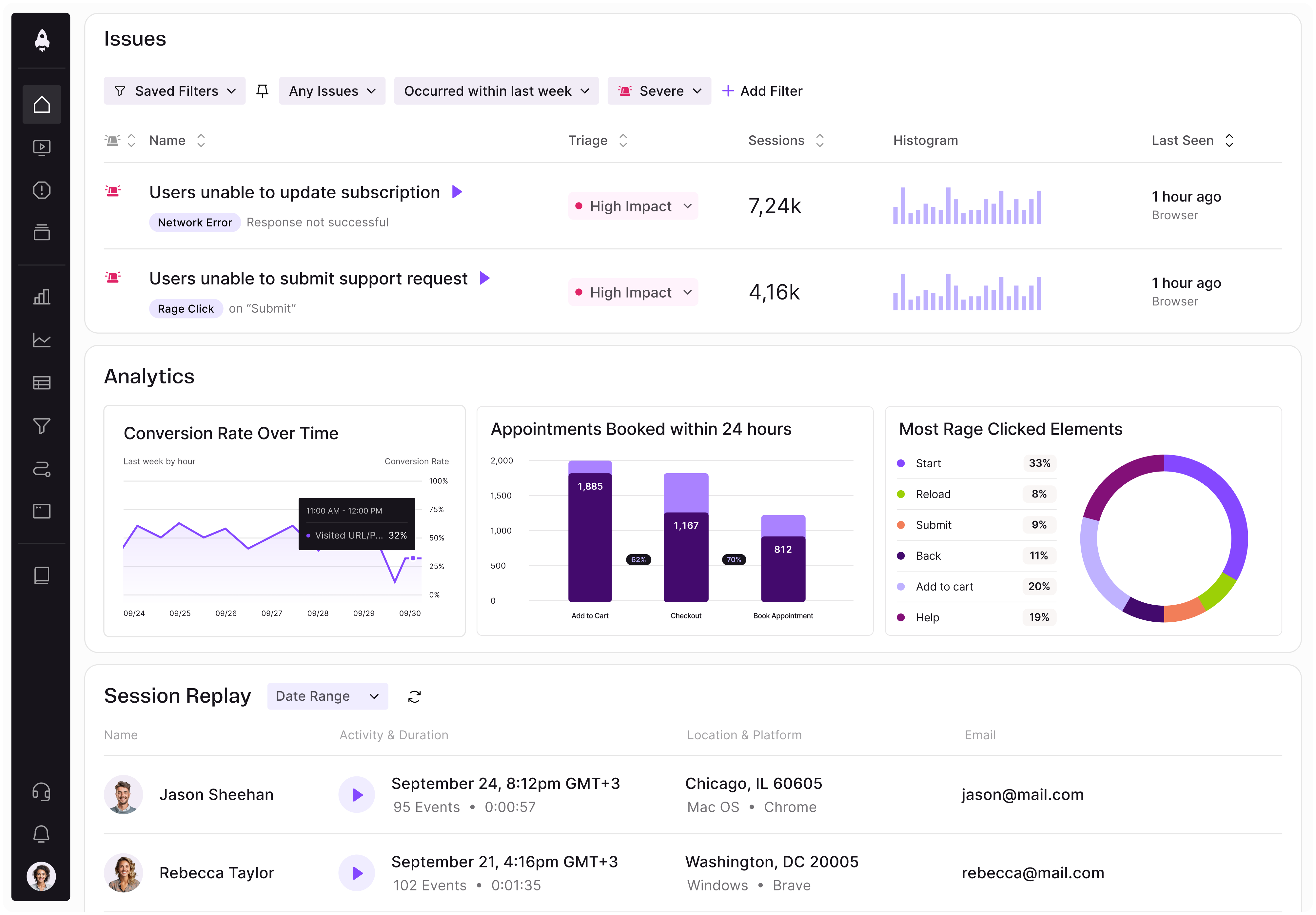
LogRocket identifies friction points in the user experience so you can make informed decisions about product and design changes that must happen to hit your goals.
With LogRocket, you can understand the scope of the issues affecting your product and prioritize the changes that need to be made. LogRocket simplifies workflows by allowing Engineering, Product, UX, and Design teams to work from the same data as you, eliminating any confusion about what needs to be done.
Get your teams on the same page — try LogRocket today.
Learn when prompt-first UX adds friction and how product managers can choose AI interfaces that balance flexibility, structure, and control.
Is the foldable iPhone true product innovation? See how PMs can assess user needs, weigh costs, and separate real value from technical hype.
Explore agentic AI security trade-offs product managers must own before launch, from permissions and human oversight to memory and recovery.
See how to define AI features that deliver user value. Validate needs, assess costs, and set reliability requirements before the team builds.


 Learn more →