
As a product manager, you can use AI to get a head start on product requirements documents (PRDs), user stories, and meeting notes. But when a research summary recommends a redesign without showing where users struggled or what they were trying to do, you have to go back to the session notes before you can make a decision. This phenomenon is known as AI workslop.
BetterUp Labs and the Stanford Social Media Lab surveyed 1,150 U.S. desk workers and found that 40 percent had received workslop in the previous month. Respondents spent about two hours per incident on average. In a separate Zety survey, 85 percent of respondents said receiving workslop from a manager would reduce their trust in leadership.
In this article, I’ll walk you through a 60-minute workshop you can run with your team to help prevent workslop. By the end, you’ll agree on what makes a draft ready for handoff, what the author needs to check, and who owns revisions.
When you receive a polished draft, it can make a quick scan feel sufficient for review. However, suppose AI-generated meeting notes list a proposed scope change as a decision. The summary reads clearly, and the distinction is easy to miss until an engineer starts planning around a change the team never approved.
Now someone has to revisit the discussion, confirm what the team agreed to, and correct the record. If your team hasn’t agreed on who handles that revision, the work can fall to the person who spotted the error. This is an example of why it’s critical to validate AI outputs.
Unclear expectations, skills gaps, and pressure to produce more can all contribute to AI workslop. Setting up an AI workslop prevention workshop helps your team agree on what “ready” means and identify what people need to meet that standard.
Atlassian tested this approach with 31 employees in a 60-minute workshop. Participants discussed what made a good Confluence page and practiced using AI to create one.
Two weeks after the workshop, 67 percent of respondents said their team’s AI-generated pages met high standards, up from 40 percent before the workshop. The small pilot’s self-reported results weren’t statistically significant, but they offer an encouraging example of how teams can start building a shared understanding of quality.
The agenda below adapts Atlassian’s 60-minute workshop for product teams. Start by choosing one deliverable your team hands off regularly, such as a product requirements document (PRD) or research summary.
| Activity | Suggested time |
| Introduce the goal and the handoff scenario | 5 minutes |
| Phase 1: Score the weaker draft and identify gaps | 15 minutes |
| Phase 2: Identify what makes the stronger draft usable | 5 minutes |
| Phase 3: Write an acceptance standard for the deliverable | 15 minutes |
| Phase 4: Practice requesting revisions and assigning ownership | 15 minutes |
| Choose a handoff to try the standard and set a follow-up date | 5 minutes |
Before the workshop:
Open the workshop by explaining that you want everyone to agree on what makes work ready for handoff. Introduce the handoff scenario, the intended recipient, and the decision they need to make.
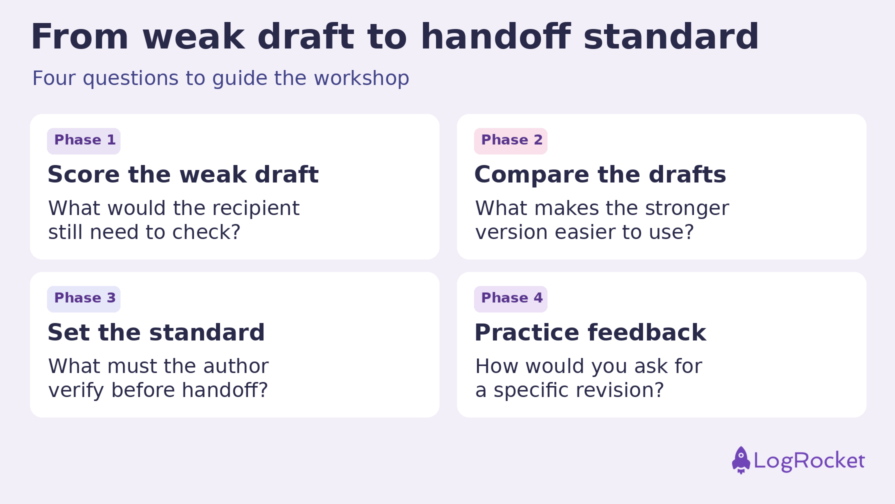
Give participants the weaker draft and its source material. Ask, “If this landed in your inbox today, what decision could you make from it? What would you still need to check?”
Have everyone give the draft three scores, one each for clarity, evidence, and usefulness. Use a scale from one to five, where one means “needs substantial revision” and five means “ready to use.”
If a score is low or participants disagree, ask them to point to the passage that shaped their rating. Annotate it with what the recipient would need to verify, clarify, or redo before using the draft.
Share the stronger draft and ask participants to score it using the same rubric. Which changes made it easier to decide what to do next?
Ask participants what decision or action the stronger draft supports. If their answers differ, discuss what still needs clarification. Mark the details that helped participants reach a decision so the team can refer to them in the next phase.
Use the two drafts to agree on what the deliverable must include before handoff. Start with the decision the recipient needs to make.
Which details in the stronger draft would help the recipient make that decision? Turn those observations into requirements an author can check.
Give the team 15 minutes to agree on four things:
Capture the agreement in a few sentences the team can use at its next handoff:
Before handing off [deliverable], the author includes [essential content] so the recipient can [make a specific decision or take a specific action]. The author checks [claims or recommendations] against [source material]. If the reviewer finds a gap, they flag it and explain which decision it affects. The author makes the revision by [agreed time].
Ask participants to work in pairs, taking turns as the author and reviewer of the weaker draft.
Have each reviewer name a requirement the draft falls short of, explain why the gap prevents a decision or next step, and request a specific revision. Vague instructions such as “add more depth” leave the author guessing.
Before switching roles, have the author summarize the change, confirm when they’ll make it, and ask for any clarification or support they need.
When AI contributes to a gap, ask what went unchecked and what would help the author catch it before the next handoff.
Now, let’s suppose participants are reviewing a fictional AI-generated research summary. A PM will use it to decide what change to test next. The summary reads, “Users find the dashboard unintuitive. We recommend a comprehensive redesign.”
The usability session notes show that three participants looked for invoices under Billing, while the invoices were under Account Settings. Participants reviewing the draft flag the leap from that observation to a dashboard-wide recommendation.
The facilitator then reveals the stronger version:
Three participants looked under Billing for their invoices. The invoices were under Account Settings. We recommend testing whether adding an invoice link under Billing makes invoices easier to find.
From that comparison, the team agrees that research summaries must link findings to evidence and keep recommendations proportionate to those findings. Before handoff, the author checks the finding against the session notes and makes sure the recommendation follows from it.
A reviewer practicing with the weaker draft might ask, “The notes show that three participants looked under Billing for their invoices. What evidence supports redesigning the whole dashboard? Could you revisit the notes and revise the recommendation so we can decide what to test?” The author confirms the requested change and agrees on a deadline.
Use the final five minutes to choose the first handoff where you’ll try the standard and set a date to review how it went. Pick a comparable handoff from before the workshop as a point of reference.
At the follow-up, compare how many rounds of clarification each handoff took, how much time the author and recipient spent on corrections, and whether any errors affected a decision.
Ask the recipient, “What did you still have to check or fix before you could use the draft?” Their answer can reveal suggestions the author might not have considered.
If the recipient still had to fill in gaps, use a specific example to decide what needs to change:
Agree on one change and revisit it after the next comparable handoff. Over several handoffs, look for a consistent drop in clarification rounds and correction time while checking that recipients can still make the decisions the work was meant to support.
Featured image source: IconScout
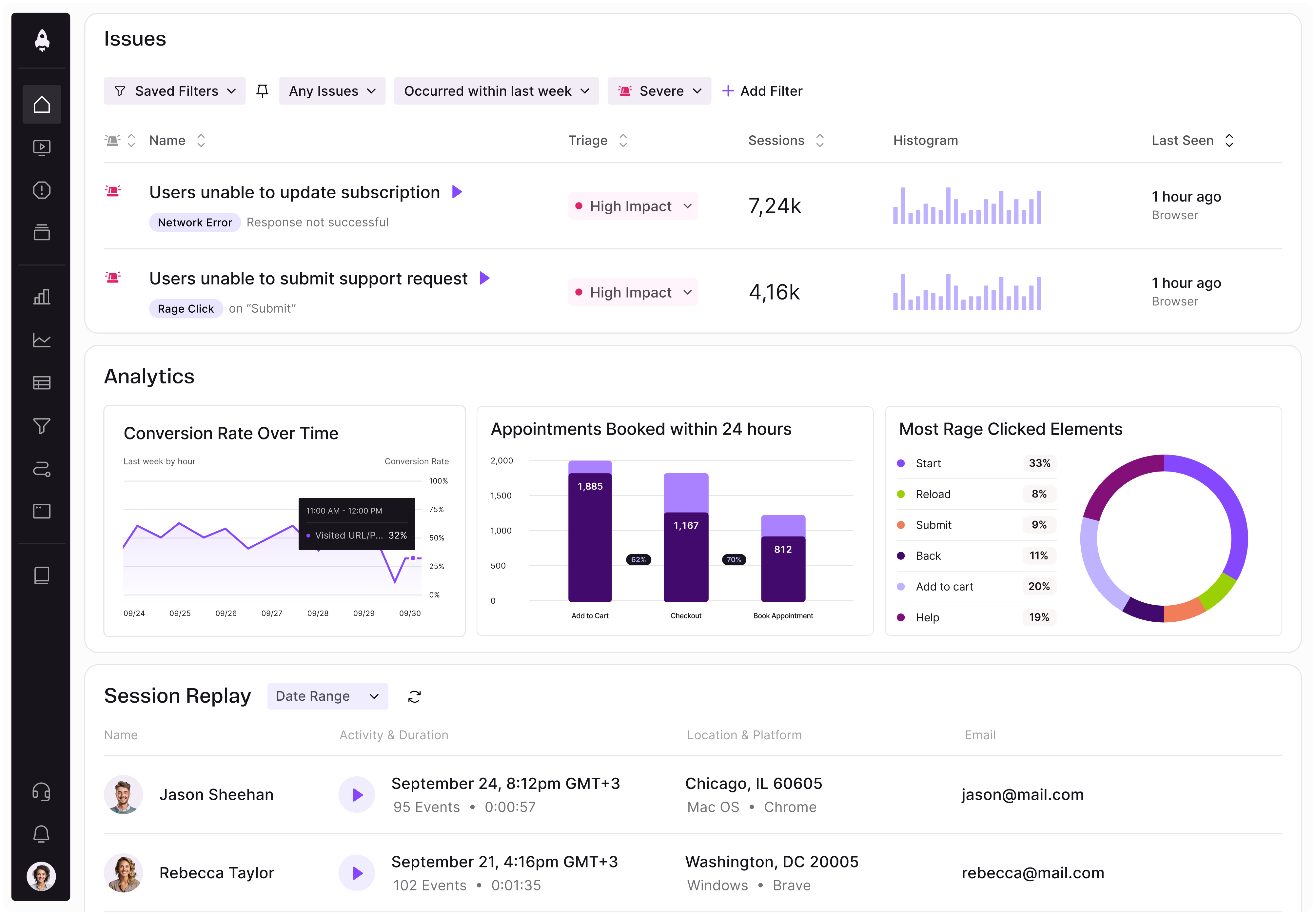
LogRocket identifies friction points in the user experience so you can make informed decisions about product and design changes that must happen to hit your goals.
With LogRocket, you can understand the scope of the issues affecting your product and prioritize the changes that need to be made. LogRocket simplifies workflows by allowing Engineering, Product, UX, and Design teams to work from the same data as you, eliminating any confusion about what needs to be done.
Get your teams on the same page — try LogRocket today.
LogRocket is now available in ChatGPT and Codex as an OpenAI plugin. Learn how to use it to answer product questions.
Track AI referrals, see where shopping agents miss your products, and use conversion data to decide which fixes earn a place on the roadmap.
Build a product management AI agent in 2027. Start with feedback triage, compare no-code tools with the Responses API, and test whether it saves time.
Move AI pilots toward production with PM playbook for ownership, funding, and readiness. Learn when to scale, revise, or stop your AI pilot.

 Learn more →