Imagine a world where every product manager has the same perspectives and ideas. Every product goes in the same boring direction without promising guaranteed success.
Could this be the future if product people become overly reliant on AI?
You probably already use AI every day. All the AI research, images, presentations, and prototypes can save you hours of work. And as a result, some tasks are compressed into a prompt and a response.
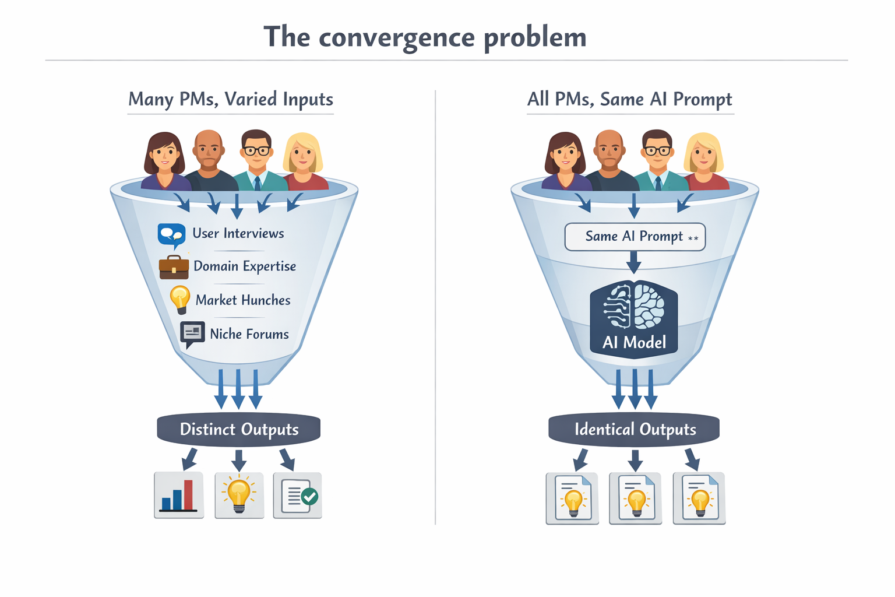
On the surface, this looks like a superpower. In practice, it’s eroding the very thing PMs are paid to deliver. It’s not that AI is wrong — it’s consistently average, uninspired, and blind to nuance.
This sounds a little like a doomsday prediction. Are things really as bad? What can we do today to prevent the erosion of the product profession? All this, and more, in today’s piece.
Let’s begin!
There’s something worth acknowledging here: every PM using AI for competitive analysis is drawing from the same pool of information. Large language models are trained on the same public sources, like blog posts, product reviews, and analyst reports.
So when you ask AI to summarize your competitive landscape, you get back a confident synthesis of what’s already widely known and discussed. In many cases, it reflects conclusions your competitors have likely already reached.
That’s consensus, not insight.
It’s a bit like a group of students writing essays using the same book in the university library. The wording might differ slightly, but the underlying thinking ends up remarkably similar.
You usually don’t notice it immediately, but give it some time and the pattern becomes obvious. Products start to resemble each other more and more. They might have different colors and slightly different wording, but they’re fundamentally the same thing underneath.
Differentiation in product comes from original insight, intuition, and experience (so-called “product sense”). These could be things you learned that your competitors hadn’t or connections you made that required unusual domain knowledge and user proximity.
AI doesn’t have that.
It gives you an average of what’s already out there. And it does so in a way that sounds authoritative enough that most PMs don’t push back. This is how entire product categories drift toward sameness. Not because anyone decided to copy each other, but because everyone outsourced their signal detection to the same system.
Let’s imagine a scenario. You’re running behind, you have a customer interview backlog sitting in your notes tool, and you need to make a decision before a roadmap session. So, you drop the transcripts into an AI tool and ask for a summary.
It works. You get the key themes, a few resonating quotes, and a clean bullet list of pain points. Time saved.
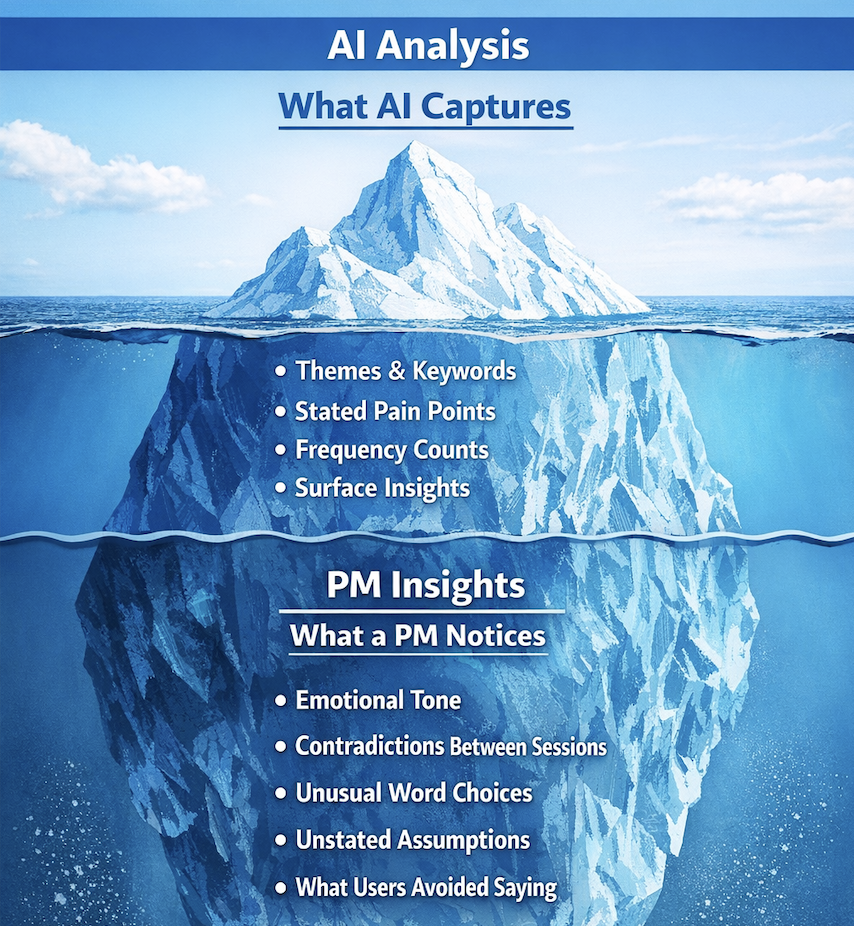
But here’s what you also gave up: if you had spent thirty minutes actually reading the interviews, you would have noticed that one customer used a phrase three different times in a strange way, or that two completely different user types were describing the same symptom for opposite reasons.
The AI summary smoothed over those nuances because nuance doesn’t fit an overall consensus well. While product management is about finding the right compromise that makes it to production, it’s also about finding inspiration and opportunity from the obscure, even hateful, comments or feedback.
So the risk is clear: over time, PMs who rely on AI-generated summaries may miss out on many opportunities and unique insights, simply navigating surface-level comments. Their understanding of users is filtered, compressed, and pattern-matched into what the model thought was relevant.
For example, Slack emerged initially as an internal tool for a group of developers building a failed game. Do you really believe that AI would’ve said, “Ditch the game, the communication tool you built is the real gem here!” No, it would’ve focused on trying to fix a game doomed from its very conception.
AI won’t give you any out-of-the-box thinking. It won’t push you to take risks. Instead, it will lead to slowly and boringly polishing what you already know.
Here’s where things get interesting. AI won’t affect all PMs equally. For some, it’s a force multiplier that accelerates already strong judgment. For others, it’s a mirror that reflects the absence of it.
The PMs who are being elevated by AI are those who already know how to think about strategy, market positioning, and user psychology. They now use AI to stress-test those ideas, surface edge cases, and move faster through the mechanical parts of research.
On the other hand, the PMs who are being quietly exposed are the ones who are using busyness as a substitute for thinking. AI now does the busyness faster and better, and what’s left is the judgment.
These PMs produce roadmaps that look good on the surface, but only until people start asking questions. That’s when the shallowness of the proposal comes into the spotlight.
The emerging PM skill isn’t “using AI.” Every PM uses AI now. The skill is interrogating it by:
That last one is the hardest. Because AI answers are often good enough. And “good enough” is the enemy of great product strategy.
The failure mode people worry about is AI hallucinations leading to wrong decisions. That’s real, but it’s also detectable. You can fact-check a hallucination or catch a made-up competitor.
However, the failure mode nobody talks about is when AI is completely correct but completely unremarkable and boring. That’s how it’s designed to work.
Product leadership isn’t a regression problem. The whole point is to make the non-obvious call: the feature that users don’t know they need yet, the repositioning that looks risky until it doesn’t, the decision not to build something obvious, and instead double down on something strange and defensible.
AI doesn’t push you there.
The PMs who understand this use AI to pressure-test conservative instincts, not to confirm them. They’ll generate an AI roadmap recommendation and then ask: What’s the most interesting thing this output is missing?
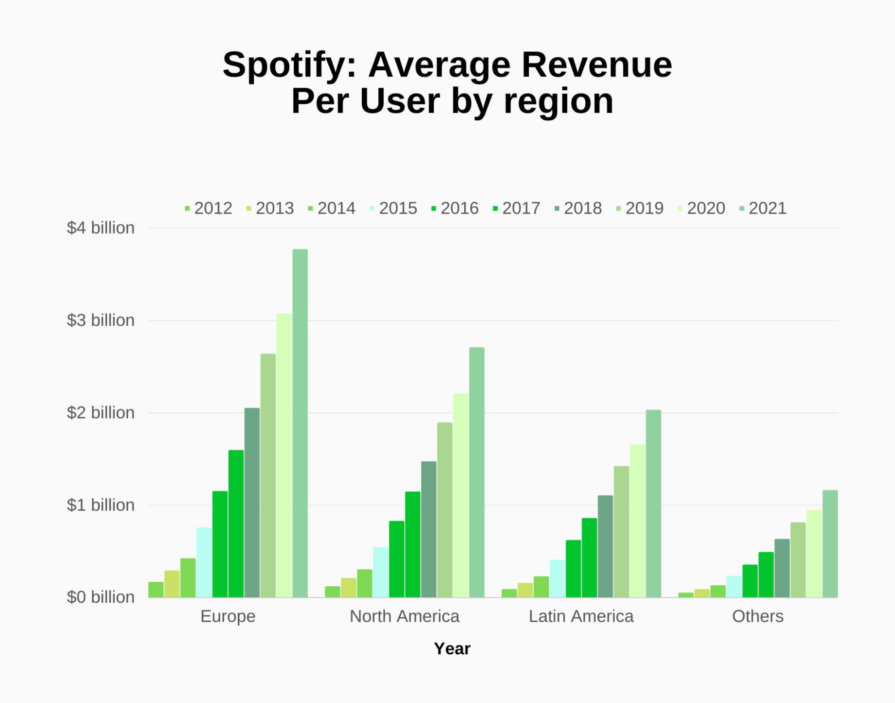
A good example of the kind of decision AI would almost certainly not recommend is Spotify’s early bet on the freemium model. At the time, the music industry strongly favored strict paywalls, and most conventional analysis pointed to subscriptions as the only realistic path to profitability.
Offering unlimited streaming for free looked reckless. It risked upsetting record labels, undermining paid plans, and attracting users who might never convert.
Yet Spotify’s leadership made a very different call. The idea was simple: bring millions of people into the ecosystem first, then figure out monetization once the scale was there. The same happened with Airbnb and Uber years later.
All of those worked, and each was a huge bet against what had worked in the past.
Listen, I’m not arguing against product managers using AI. There’s no doubt that there are some great tools out there that will save you time. That is, if the right tools are used by the right people for the right purpose.
What I am arguing is that intuition is no longer optional — it’s strategic.
For years now, the PM community has treated intuition as something soft and hard to defend. You back your decisions with data, run experiments, and cite user research. Intuition, especially when it contradicts the data, gets deprioritized or walked back.
That was already a problem before AI. Now it’s a bigger one, because AI produces outputs that look like evidence and carry the same social weight in a meeting. Also, there can be little difference between intuition and common sense when it comes to making product decisions.
The new bar for PM excellence is hybrid reasoning: the ability to work fluidly between algorithmic input and non-algorithmic judgment. That means knowing when to lean on an AI-generated signal and when to trust the thing you noticed in a user interview that no model would’ve weighted appropriately.
It means being comfortable saying “the AI summary says X, but here’s what I think is actually going on” and being able to defend that in a room full of people holding the AI summary.
While leaning fully on AI is a shortcut to mediocre product management, treating it as yet another input can be helpful; generate the AI answer, then argue against it. Use it as a starting point to push from, not a destination to arrive at.
AI isn’t making product managers obsolete. The biggest change is that AI is making mediocre product management much harder to hide and making the gap between a good PM and an average one much harder to fake.
If your entire workflow runs on AI-generated inputs, you’re building products out of public consensus. You’re optimizing for plausibility, not differentiation. And you’re quietly atrophying the judgment that, on your best days, is the thing that makes you worth having in the room.
The antidote isn’t less AI. It’s more you: a clearer, more confident, more questioning version of you that uses AI to sharpen its thinking rather than replace it. The market will reward the PMs who figures that out early.
Featured image source: IconScout
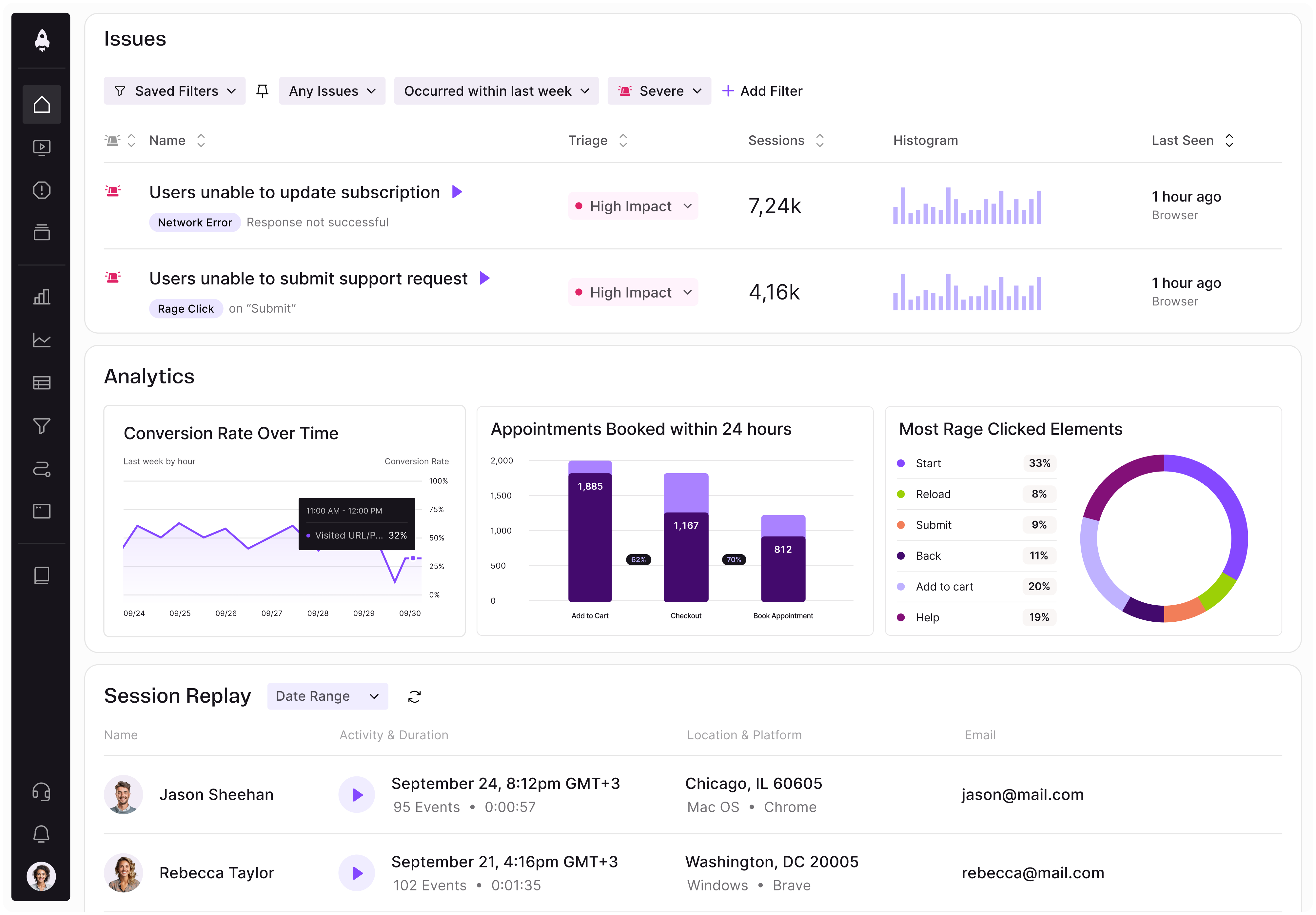
LogRocket identifies friction points in the user experience so you can make informed decisions about product and design changes that must happen to hit your goals.
With LogRocket, you can understand the scope of the issues affecting your product and prioritize the changes that need to be made. LogRocket simplifies workflows by allowing Engineering, Product, UX, and Design teams to work from the same data as you, eliminating any confusion about what needs to be done.
Get your teams on the same page — try LogRocket today.
Discover how Meilisearch uses LogRocket’s MCP and Galileo to improve free trial conversion and adoption of newly shipped features across its Cloud product.

Resolve cross-functional conflict in AI product development with a 3-step framework to clarify risks, assign owners, and align teams to act.

Learn when prompt-first UX adds friction and how product managers can choose AI interfaces that balance flexibility, structure, and control.
Is the foldable iPhone true product innovation? See how PMs can assess user needs, weigh costs, and separate real value from technical hype.

 Learn more →