In large organizations, multiple teams can end up working on the same problem without realizing it. This usually happens because of independent execution, not poor execution. Similar customer problems emerge across the business, and different teams rush to solve them from their own context.
As a PM, it’s important to know this can happen to your team, too. Even with visible roadmaps, teams often share what they plan to build, but not always the problem they’re trying to solve. As a result, similar problems get solved multiple times under different names, in different parts of the organization.
The core challenge is shared awareness. If teams only share defined solutions late in the process, duplication becomes harder to detect and even harder to resolve. AI can help by surfacing patterns across roadmaps, customer feedback, tickets, and documentation, but only if PMs know what signals to look for.
In this article, you’ll learn how to detect overlap early, validate whether teams are actually solving the same problem, and align without slowing down execution.
Visibility helps teams understand what others are building. On its own, it doesn’t prevent duplicate work. You can have visible roadmaps, shared dashboards, and quarterly business reviews, and duplication can still slip through the cracks.
Most teams share the work they plan to do, not the problem they are trying to solve. In large organizations, this creates a detection gap. Teams can look aligned on paper while still solving the same customer pain from different angles.
The main reason visibility fails is that teams usually share what they plan to build, not the problem behind it.
Imagine two roadmap updates: “Launch new subscription API” and “Update billing logic.” From the outside, those look like separate initiatives. Later, you may realize both teams were solving the same core customer pain point: customers cannot upgrade their plan mid-cycle.
Because both teams led with their solutions, they didn’t see the overlap until they were already deep into the development cycle.
At later stages, alignment becomes much harder. After engineers have committed code and PMs have promised delivery dates, “aligning” often means one team has to delete work, change direction, or explain why a committed initiative no longer makes sense.
That creates friction and resentment. It can also make finishing the redundant work feel easier than resolving the overlap.
To prevent this, you need to move your radar further upstream. Instead of waiting until the roadmap is locked, look for overlap while teams are still framing the problem, comparing customer pain points, and deciding what is worth building.
Early detection requires you to create better signals before work gets locked into a roadmap, PRD, or delivery commitment.
Ahead of bringing AI into the process, you can start by improving your organizational radar. The goal is to detect overlap while teams are still exploring problems, not after they have already committed to solutions:
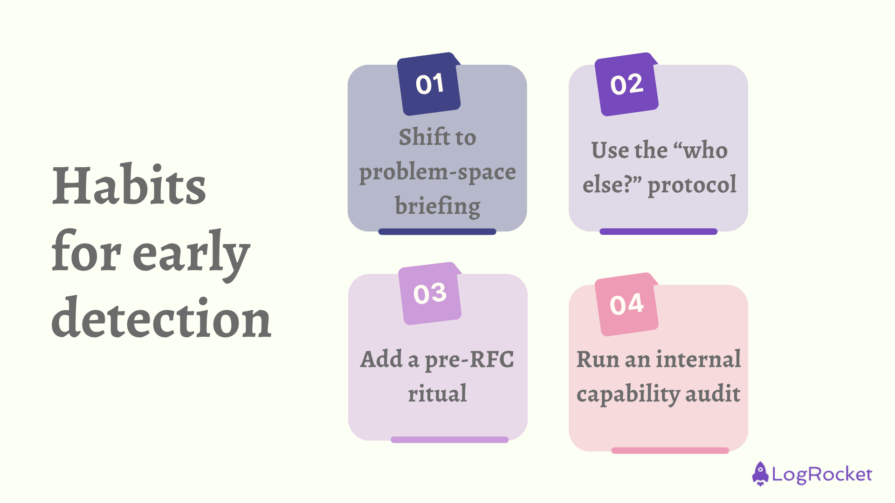
The easiest way to catch duplicate work is to share what problem you want to solve before you define exactly what you plan to build.
When you find a promising problem, it’s easy to assume you would already know if another team were working on it. In a large organization, you should assume the opposite.
RFCs are useful for aligning on technical architecture and preventing integration issues. The problem is that by the time you create an RFC, the team has usually already bought into a solution.
You need an earlier product version of this ritual.
As a PM, you’re probably used to looking outward at competitors, customer needs, and market trends. To prevent duplicate work, you also need to look inward at what your organization has already built.
By standardizing these habits, you move from accidental discovery to systematic detection. This allows you to make sure that when your team starts moving, it’s not running in a lane another team already occupies.
PM roles change as companies grow. In a large organization, you can’t only manage your own backlog. You also need to understand how your product, team, roadmap, and technical dependencies fit into a larger ecosystem.
That requires a different skill set than PM work at a smaller company. To prevent duplicate work, you need to move beyond the boundaries of your own squad and develop the soft skills of cross-team navigation.
PMs often resist regular alignment because they worry it’ll slow the team down. It can feel like another bureaucratic hurdle, especially when you’re already trying to reduce meetings and protect sprint velocity.
I understand that instinct. In my own day-to-day work, I also try to keep meeting counts low. However, I recently saw how much more expensive duplicate work can be.
By the time we realized another team already had a solution for our new product, we had spent three weeks developing our own version. Stopping, reassessing, and adopting the other team’s product was also difficult because our architecture had already started moving in a different direction.
That experience changed how I think about alignment. A small amount of early coordination can save weeks of redundant work later.
In an efficiency-first environment, PMs cannot measure their value only by what they ship from scratch. High-performing PMs also protect engineering capacity, reduce operational waste, and help the organization reuse what already exists.
That means you should stop measuring your impact only by what your team built. Start measuring it by the redundant development hours you saved.
Leaders don’t just ask what you’re building; they also want to know how you’re improving efficiency. When you show that you saved a month of engineering time by reusing an existing solution, you prove that you value organizational velocity over redundant new work.
That signals that your value comes from strategic efficiency, not just new lines of code.
Duplicate work often happens because teams describe the same problem in different languages. One team may talk about user friction, while another talks about latency. One team may frame the problem as a data pipeline issue, while another sees it as a syncing problem.
As a PM, your role is to recognize similarities across roadmap items that may not use the same words. That’s not always easy. You need to learn how to ask questions that reveal whether two teams are actually solving the same underlying problem.
When you hear a neighboring PM mention a data pipeline and your team’s building a syncing tool, your curiosity should trigger a conversation.
In many organizations, the platform team’s roadmap can feel like a black box. You may assume their work has nothing to do with your roadmap, or you may worry that working through the platform team will slow you down.
That is often where duplicate work begins. If you don’t know what the platform team is building, your team may create a workaround for something that already exists or is already planned.
In my company, we created a unified backlog with the platform team so we wouldn’t miss relevant platform work. We also set a regular monthly meeting to discuss upcoming items and identify overlap before teams committed to separate solutions.
In a multi-team environment, there’s usually too much documentation for one PM to read closely. Roadmaps, Jira tickets, PRDs, ADRs, Slack threads, user guides, and technical documentation all contain signals that could help you catch duplicate work earlier.
This is where AI can help. AI shouldn’t replace your judgment, but it can amplify your context. It can scan across disconnected sources, identify similar problems described in different languages, and surface potential overlap before your team commits to a solution.
One of the biggest reasons duplicate work goes undetected is language. One team may describe its work as a “merchant verification flow,” while another calls a similar effort “KYC onboarding.” To a standard search bar, those may look different. To an LLM, they may be semantically related.
For example, you could ask:
“Identify teams currently working on identity verification, account trust, onboarding risk, or compliance review. Flag any work that may overlap with our merchant verification project.”
In my company, we created documentation with AI tools and uploaded business rules, code details, roadmaps, ADRs, PRDs, user guides, and other product artifacts into a company-wide platform. Before we start implementing a solution, our AI tool checks for similar work across that knowledge base. If it catches a potential overlap, it can create an alert or Slack notification. We also link each domain to the responsible teammates, which makes it easier to know who to contact.
In a small company, you may be able to read most of the important PRDs, release notes, and roadmap updates yourself. In a large company, that becomes unrealistic.
For example, you could use a prompt like:
“Summarize the core customer problem defined in these three new PRDs from the payments team. Flag any potential overlap with our checkout optimization project.”
Instead of reading a 20-page document, you get a short alert that can trigger an early “who else?” conversation. In my company, we also created Slack-based AI tools so PMs can ask questions about internal documentation directly from one shared channel. You can schedule these summaries regularly or use them when you are starting a new initiative.
AI can also act as a passive signal layer across your communication stack. It can also help identify overlap while teams are still discussing problems.
For example, AI can flag when two different channels are discussing similar technical hurdles, API requirements, customer pain points, or integration risks. It acts like a digital connector by nudging you with a message such as:
“Team X also appears to be troubleshooting latency on the global config service. You may want to sync before creating a separate workaround.”
This can help you catch duplication before it becomes a roadmap item.
You need to be careful with this use case. Monitoring communication channels can create security, privacy, and legal concerns, so you should work with legal, security, and internal communications teams before implementing anything like this. Employees should also understand what the tool can access, what it is used for, and where human review still applies.
AI is a detection tool, not a decision-maker. It can tell you that two teams may be working on similar problems. It cannot decide who should own the work, whether one solution should replace the other, or whether the duplication is intentional.
That’s still your job as a PM.
You need to validate the signal, talk to the teams involved, understand the technical trade-offs, and decide whether the overlap is wasteful or useful. In some cases, two teams may be solving the same problem for different customer segments. In others, redundancy may be intentional because teams are testing different approaches.
AI can make that decision process easier by labeling related work, grouping similar roadmap items, and surfacing context you might have missed. Over time, those labels can also train the system to recognize patterns more accurately. However, the final decision still requires product judgment, organizational context, and human alignment.
Once you use your detection radar to find overlap, the harder work begins. You have to decide what to do about it.
Detection is a context problem. Resolution is a strategic one. To protect engineering capacity, you need a repeatable way to decide whether to reuse an internal solution, contribute to it, or proceed with a separate path.
When you find another team working on something similar, run through these three questions:
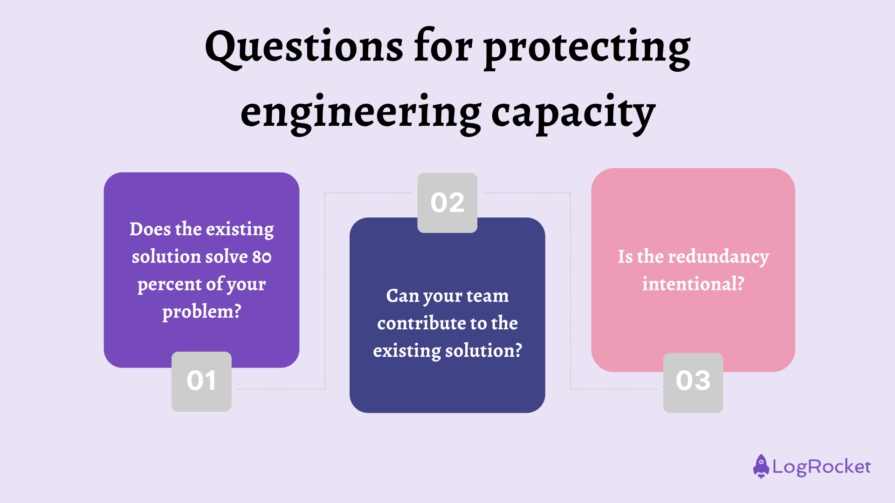
If an internal solution solves most of your problem, use it. Don’t build a fully custom version just to cover the remaining edge cases. Instead, negotiate the missing requirements as feature requests or extensions to the existing product.
This is one of the most useful checks because you can apply it almost anywhere. In one duplicate product case, a platform team started building a ticketing system even though our team already had one. Their argument was reasonable: They needed different features, and the work felt urgent.
We didn’t stop communicating. We kept showing them the features we were adding and where our product was headed. After a few months, they came back and asked whether the systems could merge. Improving their separate product had become more expensive than extending the one that already existed.
Eventually, we agreed that our product covered about 80 percent of their needs. For the remaining 20 percent, they would decide which features were truly required. If a feature mattered enough, they could build it into the shared product instead of maintaining a separate system.
If the existing tool is missing a critical capability, don’t immediately start a new repo. Ask whether your engineers can contribute that capability to the existing service instead.
This is where an InnerSource model can help. Your team gets the feature it needs, and the organization maintains one cleaner codebase.
This model has worked well for us. Sometimes, as a PM, it is difficult to get your needs prioritized in another team’s backlog. To solve that, we created a contribution model where one of our developers temporarily joins the other team, adds the needed capability, and then returns to our team.
The key is clear communication. The contributing developer needs to understand the scope, expectations, milestones, and decision rights. You also need close alignment with the other team’s PM so the work does not feel like an interruption or an unofficial side project.
When this works, both teams benefit. Your team gets the capability faster, and the company avoids another duplicate service.
Sometimes duplicate work has a valid reason. The important question is whether the redundancy is intentional, temporary, and clearly owned.
For example, we once duplicated data from another team into our own domain because the existing system was too slow. Customers were seeing a loading screen for one or two seconds during an important product flow, and we did not want that experience to continue while we improved the underlying algorithm.
In that case, the duplication protected the user experience. It also created extra work. Every time the other team developed a new feature, we had to account for it too. As soon as we fixed the performance issue, we removed the duplicate logic.
Preventing duplicate work requires more than visibility. You need habits that turn scattered context into shared awareness before teams commit to separate solutions.
In an efficiency-first environment, the PMs who thrive will not only be the ones who ship the most features. They’ll be the ones who help teams build with more context, reuse what already exists, and avoid wasting engineering effort on problems another team has already solved.
That means you need to:
The best code is often the code your team doesn’t have to write because it already exists. By building habits around detection, reuse, and cross-team communication, you do more than save engineering hours. You help create a leaner, faster, and more connected product organization.
Featured image source: IconScout
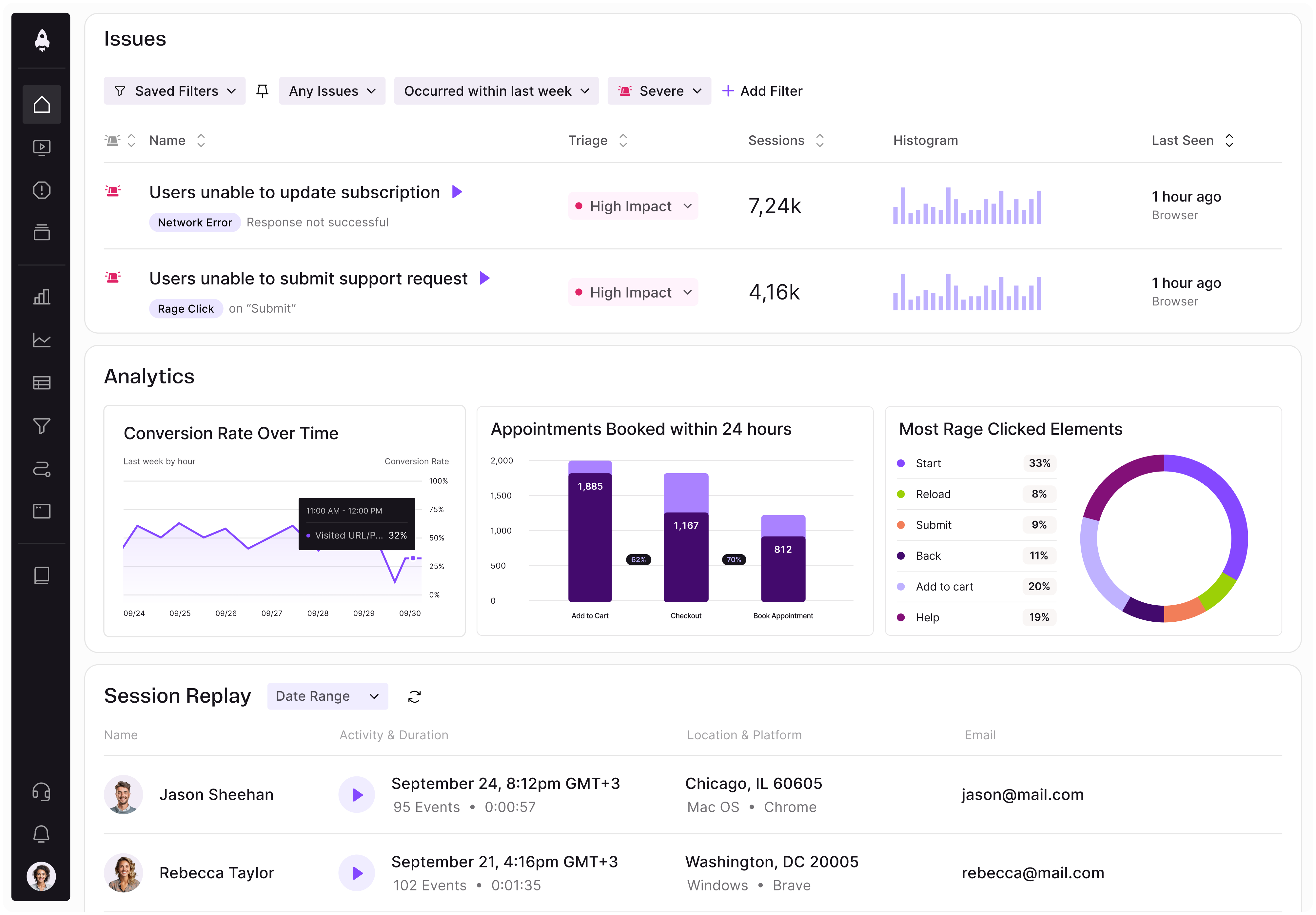
LogRocket identifies friction points in the user experience so you can make informed decisions about product and design changes that must happen to hit your goals.
With LogRocket, you can understand the scope of the issues affecting your product and prioritize the changes that need to be made. LogRocket simplifies workflows by allowing Engineering, Product, UX, and Design teams to work from the same data as you, eliminating any confusion about what needs to be done.
Get your teams on the same page — try LogRocket today.
Keep the reasoning behind product decisions within reach. Build a clear system to track customer feedback, priorities, and project progress.
Discover how Meilisearch uses LogRocket’s MCP and Galileo to improve free trial conversion and adoption of newly shipped features across its Cloud product.
Resolve cross-functional conflict in AI product development with a 3-step framework to clarify risks, assign owners, and align teams to act.
Learn when prompt-first UX adds friction and how product managers can choose AI interfaces that balance flexibility, structure, and control.

 Learn more →