Every product manager on the internet seems to have an opinion on whether the PRD, or product requirements document, is dead. AI-assisted coding, rapid prototyping, and faster engineering cycles have the traditional 20-page feel increasingly out of touch with how many teams build today.
But that doesn’t mean product teams no longer need documentation. It just means the role of documentation has changed. Instead of treating the PRD as a fixed document, you need to choose the right level of documentation for the decision, risk, team and stage of development.
Keep reading to learn how to adapt your documentation process for AI-assisted product development without slowing your team down.
With AI-assisted development, the lengthy product requirements document (PRD) has become a more visible bottleneck. Waiting for upfront requirements and stakeholder alignment can drag down the whole process. When documentation is too heavy, it can lead to issues like:
Many product managers reacted by skipping PRDs entirely. The traditional PRD was designed for a longer development lifecycle, and it started slowing down modern teams. Instead, some teams began to rely on tools like tickets and Slack. While this helped teams move faster, it also created new problems.
PRDs often feel like optional reading until something goes wrong. Then they turn into a valuable reference. Some problems that PRDs help prevent include:
Some form of documentation is needed to prevent these issues from happening. For your organization, the traditional PRD may still have value, especially if the product is complex or regulated. However, other organizations may benefit from lighter forms of product documentation.
Here are a few PRD alternatives that might work for your organization. You might use one or combine several. The important thing is to find what works best for your team.
The best PRD alternative depends on what your team needs most. Some teams need strategic alignment, some need a record of past decisions, and others need better ways to turn prototypes into clear requirements.
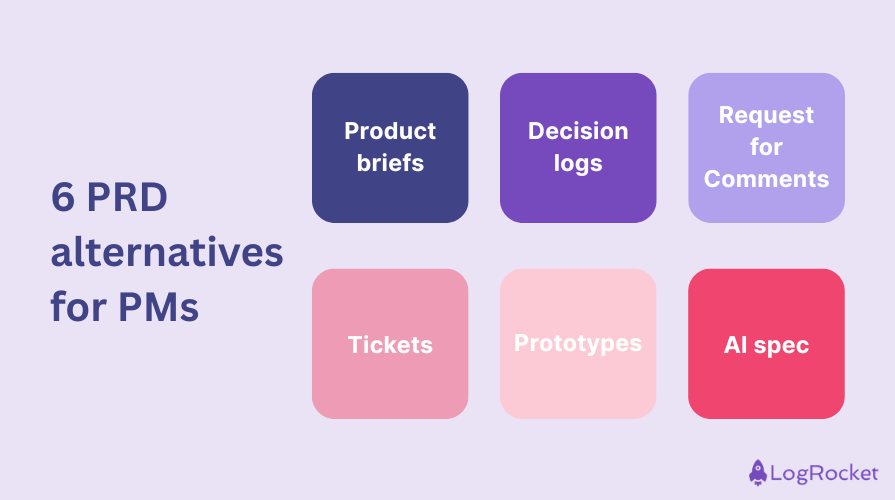
Product briefs are concise, strategic documents that focus on the problem and a high-level solution. “The product feature brief…is more like a summary of what we’re solving, who it’s for, and why it’s important now,” said Monique Piras, Senior Director of Product Management at Ironclad.
Piras also includes the following in briefs:
Unlike a traditional PRD, product briefs are intentionally lightweight. This leaves room for collaboration with design and engineering.
“It takes a lot of pressure off having those granular details upfront, so that way, you have more time to work collaboratively with your triad,” said Pira. “Each phase becomes an opportunity to go deeper – collaborating with design and engineering to define what needs to change and why. Only after this discovery work do we translate findings into detailed product requirements and user stories.”
A decision log is a running record of important decisions made during product development. Each entry contains:
This isn’t like meeting notes, where every word is transcribed. Decision logs focus on the outcome of discussions. Having a separate record ensures that a single source of truth remains, even when Slack messages get deleted, tickets get lost, or new team members join.
A Request for Comments (RFC) document proposes a change and submits it for collaborative review. It’s ideal for work environments that are open to discussing new ideas and can handle feedback. RFCs allow team members and different teams to share their thoughts on the idea. They pull from several perspectives to push an idea into a strategic feature.
RFCs usually address these points:
RFCs aren’t perfectly polished documents. The point is to share your idea and get collaborators to provide feedback on what works and what doesn’t. The RFC can provide a searchable record of decisions and their rationale. It also improves cross-functional collaboration.
Tickets are trackable work tasks. A ticket helps with execution and describes what someone needs to do. Tickets are great for breaking down large projects into smaller tasks, visualizing progress, and managing work.
Tickets are part of the PRD replacement, but they’re not strong enough to stand on their own. They don’t cover the “why” of product development. Tickets also don’t share how decisions were made. Ultimately, tickets are best paired with high-level strategy documents, like product briefs.
Prototypes are early designs of a product or feature. They range from clickable wireframes to high-fidelity interactions that mimic the final experience. Prototypes are great for validating usability, exploring ideas, and aligning on UI/UX.
Product teams like prototypes because they can turn vague requirements into a concrete experience quickly. This makes it easier to get feedback and “fail fast” on ideas that don’t work.
But, like tickets, prototypes don’t always address the “why” behind product or feature creation. Stakeholders still need a document that addresses the need to implement the prototype. While teams may not need a lengthy explainer, it still helps to have acceptance criteria that keep everyone aligned on expectations.
An AI spec is ideal for companies that are investing in AI prototypes. It’s a lightweight framework that can replace parts of the traditional PRD. Omar Mousa, a product leader, describes the AI spec as “part narrative, part prototype, but fully aligned.”
Here’s what an AI spec includes:
Like Goldilocks, you want just the right amount of documentation, not too complicated and not too simple. The big question product managers need to ask is “What’s the blast radius if something goes wrong?” Misunderstandings and wrong implementations can have varying levels of consequences.
Here are some other questions you want to consider before choosing a documentation process:
This modern PRD template focuses on aligning around problems, goals, and decisions. Unlike the traditional PRD, it’s not an exhaustive source for everything about the product or feature.
“Templates are templates. They’re starting points,” said Piras. Take this template and adapt it to your team. The main goal is to aim for clarity, not length.
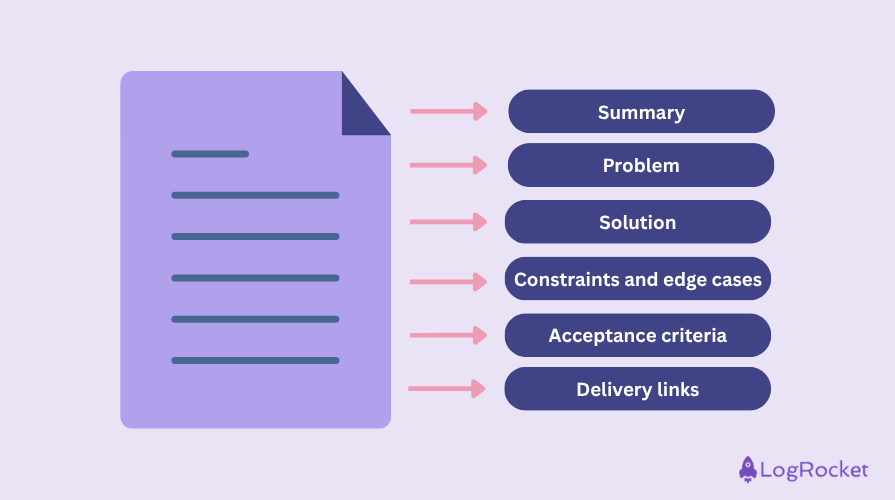
Add links if you have them:
The traditional PRD is a single place where everything about a product lives. AI, prototypes, and tickets can support product development, but they don’t replace the need to document why and how a product was created. Instead of forgoing documentation entirely, product managers should right-size the PRD or replace it with a simpler alternative.
A good first step is to audit your current documentation process. Here are a few questions to ask yourself and your triad:
Once you have your answers, you can cut documents no one reads and strengthen the documents team members actually use. You could also introduce a new documentation process like a lightweight PRD.
Featured image source: IconScout
LogRocket identifies friction points in the user experience so you can make informed decisions about product and design changes that must happen to hit your goals.
With LogRocket, you can understand the scope of the issues affecting your product and prioritize the changes that need to be made. LogRocket simplifies workflows by allowing Engineering, Product, UX, and Design teams to work from the same data as you, eliminating any confusion about what needs to be done.
Get your teams on the same page — try LogRocket today.
Spot misleading KPIs, balance targets with counter-metrics, and keep your team focused on better product outcomes instead of dashboard wins.
Keep the reasoning behind product decisions within reach. Build a clear system to track customer feedback, priorities, and project progress.
Discover how Meilisearch uses LogRocket’s MCP and Galileo to improve free trial conversion and adoption of newly shipped features across its Cloud product.

Resolve cross-functional conflict in AI product development with a 3-step framework to clarify risks, assign owners, and align teams to act.

 Learn more →