axios.all to make concurrent requests
axios.all is a helper method built into Axios to deal with concurrent requests. Instead of making multiple HTTP requests individually, the axios.all method allows us to make multiple HTTP requests to our endpoints altogether.

The axios.all function accepts an iterable object that must be a promise, such as a JavaScript array, and it returns an array of responses.
In this post, we’ll learn how to use the axios.all function to make HTTP requests, the difference between using Promise.all and axios.all, and making concurrent API requests in Axios.
axios.allTo begin using the axios.all method, let’s make an HTTP request to the following endpoints:
let endpoints = [
  'https://api.github.com/users/ejirocodes',
  'https://api.github.com/users/ejirocodes/repos',
  'https://api.github.com/users/ejirocodes/followers',
  'https://api.github.com/users/ejirocodes/following'
];

axios.all(endpoints.map((endpoint) => axios.get(endpoint))).then(
  (data) => console.log(data),
);
Here, we declare an array of endpoints we call endpoints and call the .all method on our Axios instance. This maps through each of the items in the endpoints’ array. Then, using the GET method on the Axios instance to make a request to our list of endpoints, we get each response from the server.
This request returns an array as a response and the data in the array is ordered according to our endpoints array, meaning Axios must first get data from the following endpoint:
https://api.github.com/users/ejirocodes
Then, the last data returned from the endpoint is the following:
https://api.github.com/users/ejirocodes/following
Now, let’s open the browser developer console and network tabs to confirm the order of the API response.
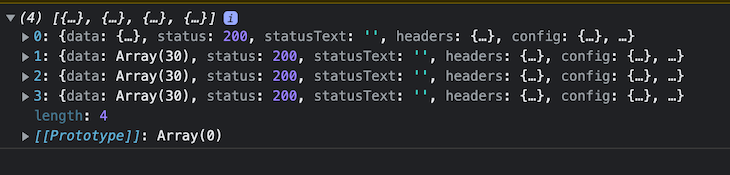

You may be thinking of sticking to making multiple API requests separately using the regular GET method. But, unlike the axis.get method where, if one promise resolves or rejects, it doesn’t affect the others. With the axios.all method, if one of our promises fails, the entire request fails.
This implies that for us to get a successful response from our endpoints when using axios.all, all the requests must be successful.
Now let’s refactor our code by adding the axios.spead method. This method accepts a callback and can destructure our array of responses, which makes our code more readable:
let endpoints = [
  'https://api.github.com/users/ejirocodes',
  'https://api.github.com/users/ejirocodes/repos',
  'https://api.github.com/users/ejirocodes/followers',
  'https://api.github.com/users/ejirocodes/following'
];

axios.all(promises.map((promise) => axios.get(promise))).then(
  axios.spread((user, repos, followers, following) => {
    console.log({ user, repos, followers, following });
  })
);
Notice how helpful the axios.spread helper function is: we can use it to get all the data at once and then use it in the callback.
By calling axios.spread((user, repos, followers, following) like this, we can say we want to name the first response from our Axios calls, user and repo.
Now, let’s take what we have at the top a little bit further; let’s pull out the data object that will be sent by the server:
axios.all(endpoints.map((endpoint) => axios.get(endpoint))).then(
  axios.spread(({data: user}, {data:repos}, {data:followers}, {data:following}) => {
    console.log({ user, repos, followers, following });
  })
);
We can do this with Axios’ response schema for every request that contains the following data object, which is the response provided by the server.
So essentially, we use object destructuring to unpack values, that is, unpacking data from the response objects into distinct variables, like user, repos, followers, and following.
Also, notice that we are destructuring data from each response and renaming it user, repos, followers, and following, respectively.
Promise.all vs. axios.allAs of July 15, 2020, Axios updated its GitHub README to reflect that the axios.all helper method has been deprecated and should be replaced with Promise.all.
Since there is an unofficial proposal to get rid of both the axios.all and axios.spread methods completely in v1 of Axios, let’s see how we can deprecate the axios.all methods using native JavaScript features like Promise.all and ES6 parameter destructuring.
Note that only the docs provide this depreciation, not the codebase/library. So, axios.all still works in the latest version of Axios, and many developers still use axios.all in modern codebase. Pointing out the deprecation is in anticipation that axios.all could be replaced at some point in the future.
There is one important thing we should consider at this point, however. The axios.all is a helper method built with the native Promise.all method in JavaScript. This implies we can easily replace the axios.all method with promise.all.
The Promise.all method returns a promise that resolves when all of the promises in the iterable argument resolve.
Now, let’s see this in action:
let endpoints = [
  'https://api.github.com/users/ejirocodes',
  'https://api.github.com/users/ejirocodes/repos',
  'https://api.github.com/users/ejirocodes/followers',
  'https://api.github.com/users/ejirocodes/following'
];

// Return our response in the allData variable as an array
Promise.all(endpoints.map((endpoint) => axios.get(endpoint))).then(
  axios.spread((...allData) => {
    console.log({ allData });
  })
);
The code above gives us the same results as using the axios.all method.
Notice that even if we’ve gotten rid of axios.all method, we are still using the axios.spread helper; the ES6 destructuring operator can easily replace this.
Also notice that we are using both array and object destructuring in one go to pull out only the data object sent by the server:
Promise.all(endpoints.map((endpoint) => axios.get(endpoint))).then(([{data: user}, {data: repos}, {data: followers}, {data: following}] )=> {
      console.log({ user, repos, followers, following });
});
And voilà! We’ve successfully used native JavaScript methods to make a concurrent HTTP request.
Promise.all and AxiosTo make simultaneous API requests in a React app using Axios and Promise, we must use React Hooks.
In this example, we will get both the followers and following data of a GitHub profile. The idea is that, if for some reason, the API request for the followers data for the user’s GitHub profile is unsuccessful, we can’t get the response for the followers data for the user’s GitHub profile.
This means the request for the user’s GitHub user profile following count will also fail.
This is because when we make concurrent requests, the response from one request depends on the other. So, essentially, we want both or all requests to fail if at least one fails.
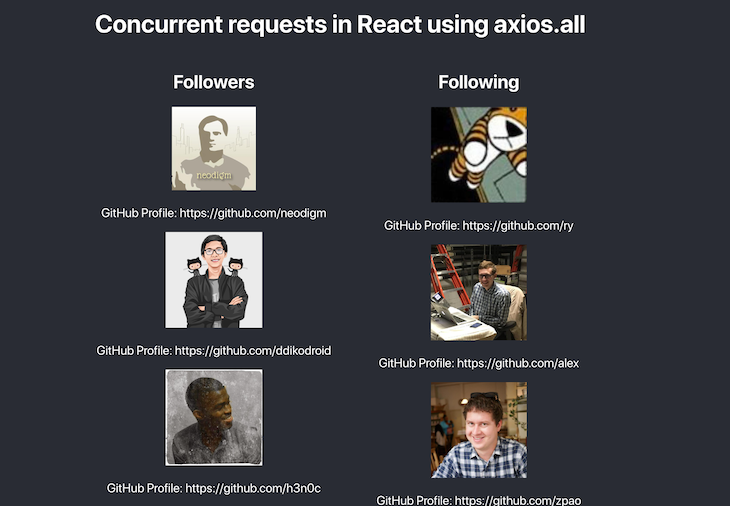
Using Promise.all and ES6 destructuring, let’s write a function that will perform multiple GET requests concurrently in our React app:
// In our component, we have to save both data in our state using the useState hook
  const [followers, setFollowers] = useState([])
  const [followings, setFollowing] = useState([])

  const getGithubData = () => {
    let endpoints = [
      'https://api.github.com/users/ejirocodes',
      'https://api.github.com/users/ejirocodes/repos',
      'https://api.github.com/users/ejirocodes/followers',
      'https://api.github.com/users/ejirocodes/following'
    ];
    Promise.all(endpoints.map((endpoint) => axios.get(endpoint))).then(([{data: user}, {data: repos}, {data: followers}, {data: followings}] )=> {
      setFollowers(followers)
      setFollowing(followings)
    });
  }
Next, let’s call the function when the page loads. To achieve this the React way, we’ll use theuseEffect Hook:
// remember to import useEffect from react
  useEffect(() => {
    getGithubData();
  }, []);
Then, render both the followers and following data we just received from the various endpoints to the DOM:
// Wherever your return statement is in your React app
      <section style={{ display: 'flex' }}>
          <section>
            <h2>Followers</h2>
            {followers.length > 0 && (
              <div>
                {followers.map((follower) => (
                  <div key={follower.id}>
                    <img src={follower.avatar_url} alt={follower.html_url} />
                    <p>GitHub Profile: {follower.html_url}</p>
                  </div>
                ))}
              </div>
            )}
          </section>
          <section>
            <h2>Following</h2>
            {followings.length > 0 && (
              <div>
                {followings.map((following) => (
                  <div key={following.id}>
                    <img src={following.avatar_url} alt={following.html_url} />
                    <p>GitHub Profile: {following.html_url}</p>
                  </div>
                ))}
              </div>
            )}
          </section>
        </section>
In this post, we’ve covered how to make concurrent HTTP requests using the axios.all method, which is built on top of the Promise.all JavaScript method underneath the hood.
We also saw how to unpack our response array using the axios.spread helper function and looked at how it can be replaced with ES6 parameter destructuring, specifically, the array and object destructuring methods.
And finally, we discussed how to use Hooks in React to make concurrent API requests using Axios and the native JavaScript Promise.all method.
I created a repository on GitHub containing all the methods we’ve covered in this post if you would like to see the source code.
That’s all for now! Let me know in the comments section below what you thought of this article. I am social on Twitter and LinkedIn. Thank you for reading and stay tuned for more.
Install LogRocket via npm or script tag. LogRocket.init() must be called client-side, not
server-side
$ npm i --save logrocket

// Code:

import LogRocket from 'logrocket';
LogRocket.init('app/id');
// Add to your HTML:

<script src="https://cdn.lr-ingest.com/LogRocket.min.js"></script>
<script>window.LogRocket && window.LogRocket.init('app/id');</script>

Compare five React toast libraries for features, bundle size, accessibility, performance, and React 19 compatibility.
See how Tecovas built a patching agent that turns LogRocket’s Galileo AI issue analysis into GitHub PRs, with a developer reviewing every fix before it ships.

Explore OctaneJS, a compiler-first alternative to React. Build a task dashboard and learn about rendering, hooks, asynchronous UI, and React compatibility.

Explore Vercel’s vgpu, a WebGPU library for AI agents. Learn to build a dynamic shader in Next.js and validate rendering output with headless testing in Node.js.
Would you be interested in joining LogRocket's developer community?
Join LogRocket’s Content Advisory Board. You’ll help inform the type of content we create and get access to exclusive meetups, social accreditation, and swag.
Sign up now
 Learn more →