

For a long time, perhaps too long, if the antitrust lawsuits are anything to go by, Google has dominated the search engine space. Recently, Alphabet issued a hundred-year bond to fund its AI ambitions, so the idea of Google still being around in a hundred years is apparently not that far-fetched.
At the end of 2022, OpenAI released ChatGPT to the public. The results were incredible. The idea that you could simply ask something in natural language and receive a direct answer felt like a game changer. The days of searching Google and manually flipping through results suddenly seemed a little dated. You could just ask your question, and the answer appeared. The flow-on effects for other industries, especially software development, were immense, and they are still being felt around the world.
For a brief moment, it seemed like what Google had set out to do had been rendered obsolete by ChatGPT. People could ask a specific question and get a specific answer. For many queries, this made Google’s approach, and by extension Bing’s and every other search engine’s, feel redundant.
Competition in this space was a good thing. Competition forces incumbents to move faster. It can even destabilize companies that have held a category for so long that their dominance starts to feel inevitable.
In the long term, though, people usually coalesce around one tool. Nobody tells you to Bing something. They tell you to Google it.
The same is often true of social networks. Facebook still owns a huge part of the social media game, while Instagram dominates a major share of image and video sharing. The only way to establish market dominance against platforms like that is to release something people actually want, then spend an absurd amount of money promoting it. For example, ByteDance reportedly spent nearly $20 billion promoting TikTok in 2021. TikTok became massive. Instagram is still here.
The current AI field feels reminiscent of the early search engine era, when people bounced between AltaVista, Yahoo, and Google. To get the best results, you had to try a few engines, until one became clearly and obviously better.
OpenAI, Anthropic, Google, Meta, and others are all in this race. But the question is not just who has the best chatbot today. It is who has the most data, who has the best tools, who has the strongest distribution, and who can subsidize the whole thing for the longest.
AI, and by extension large language models, are essentially probabilistic systems that generate one token at a time based on learned probability distributions. When things go well, they produce the right answer or outcome. But because they are probabilistic, their answers can sound plausible while being wildly wrong. That is why AI systems sometimes tell people to put glue on pizza or eat rocks. The model has seen enough text to produce a likely-sounding answer, but it has not necessarily classified that answer as nonsense.
To train the best possible model, you would ideally compile every useful word ever written by a human into a dataset. But only a subset of that data is freely available, and purchasing every piece of high-quality content ever written would cost more money than anyone has.
So how do companies get the data they need?
There are a few options, but one of the big ones is web scraping. Plenty of websites contain high-quality human-written information. Less than a year after ChatGPT was released, Stack Overflow announced that it would begin charging AI companies for access to its data. By that point, though, the horse had largely bolted. Huge amounts of data had already been scraped from sites like Stack Overflow, Reddit, and Twitter.
We also know that AI needs real, human-written data. Training AI on too much AI-generated material can lead to model collapse. At the same time, AI companies need enormous datasets to keep improving model quality.
So who has the most data?
Surprising nobody, it is probably Google. Google has been crawling and indexing the web for decades to power the most popular search engine in the world. It already has infrastructure built around discovering, categorizing, ranking, and storing web content. Why would it not also find ways to use that knowledge to improve its own AI systems?
But the open season on data is ending. Publishers have gotten smarter. Websites have firmed up their positions on AI training. When scrapers do not play nicely, they can get sent down an endless AI-fueled rabbit hole. More attention is being paid to how AI models are trained, and publishers are increasingly willing to sue providers for unlicensed use of their content.
So how do companies like Google keep training and improving their models when more of the web is being locked down?
In late November, Google announced Antigravity, a VS Code fork with integrated agentic coding abilities. While companies like OpenAI integrated into existing environments through VS Code extensions, Google chose to ship its own IDE with the AI tooling baked in.
Google shipped Antigravity with its own Gemini models, but also with Anthropic models like Claude Sonnet and Opus. Spinning up multiple agentic coding sessions was easy. Google’s generous access to its own models, plus access to Opus 4.5, made Antigravity an instant hit.
But unexpectedly, this IDE had another trick up its sleeve. It would not just test web apps to see whether they worked. When I was in the middle of a particularly tricky feature, Antigravity could not figure out what to do. So it opened Chrome, and what happened next kind of blew my mind.
The LLM could not quite figure out how to use the library I had chosen. So it opened GitHub and navigated to the repository. Then it retrieved the DOM for the browser, which gave it the layout of the web page and the content on it. It kept moving through each page, occasionally asking to run JavaScript to grep for a specific thing.
Eventually, it began leafing through the tests for the library. From those tests, it found up-to-the-minute information on how the function worked and was able to use it correctly in the app.
That is genuinely interesting because AI is trained on fixed sets of information, and every training set has an end date. The idea that an agent can open a browser, retrieve a website in real time, and use that information to solve a problem changes the dynamic.
It also has implications for Google’s broader AI strategy.
We know that not all websites allow scraping. Some explicitly prohibit AI companies from using their data. Sometimes scrapers ignore those preferences anyway, which is why companies like Cloudflare are building ways to confuse them.
So let’s play out a mental exercise.
Website A has the information we need, but it does not allow scraping or AI training. In theory, that data cannot be added to an LLM training set, and the information stays out of reach.
At the same time, we know that AI IDEs like Antigravity can search Google and browse websites to find information. A browser on your local computer can interact with websites like a normal user, but under the control of an AI agent. If something like a CAPTCHA or Cloudflare challenge appears, the user can complete it, and the agent can go back to work.
We also know that AI products often log conversations and interaction data, and that providers may use some of that data, depending on settings and policies, to improve or tune their systems. At scale, this kind of analysis would almost certainly be automated.
So imagine that same website, the one that never allowed scraping. It had the answer to our problem. The AI agent navigated to the site. The user solved the bot challenge. The agent parsed the page contents to decide where to look. Some version of that session may then become telemetry, training feedback, or product improvement data.
Technically, did Google scrape the website to get the data? Not in the old-fashioned sense. But a Google-controlled tool may have accessed the site’s content through a user’s browser, summarized it, and sent portions of that interaction back to Google.
Does that mean that even websites that expect AI companies to license their data, such as Stack Overflow, could still end up indirectly contributing to AI systems through agentic browsing sessions?
Uh, did Google just turn us into web scrapers, or at least into accessories to the process?
It is hard to say. But it is also hard to believe that a company racing to build better models would ignore valuable interaction data simply because it came from a user’s browser under agent control.

So Google has decades of access to human-written web information from running the world’s biggest search engine. It also appears to have a path into content that may be harder for traditional crawlers to access. That answers part of the data question.
But what about the tooling?
Annoyingly, when AI companies decide to make AI development tools, many of them seem to do the same thing: fork VS Code and jam their AI features on top.
I am not a billion-dollar company, but let me tell you, forking VS Code just so you can integrate your AI tools into it is usually the wrong thing to do.
Why? For starters, the moment you fork VS Code, you lose access to arguably its biggest asset: the VS Code Extension Marketplace. You wind up using something like Open VSX, which is good and useful, but not as well-stocked as the proper marketplace. It has also been compromised before, introducing a supply chain risk through the extension ecosystem.
Then there is duplication. VS Code is a fairly large app for a text editor. If a user has VS Code installed and then installs a second VS Code-like app with some AI code-assist features sprinkled through it, the setup quickly becomes unwieldy.
Unfortunately, this is what Google did with its first attempt at an AI coding tool. Antigravity arrived, and, surprise surprise, it was a VS Code fork. The case for doing this was not always clear. Antigravity users effectively had an inferior copy of VS Code on their computers with Gemini features added. The AI tooling would sometimes break mid-task, wasting credits and time. Reddit filled up with people complaining about it.
OpenAI’s approach was different. It did not fork VS Code. It wrote an extension for it. Users could keep the same VS Code instance with all their existing plugins. It was less resource-heavy. It broke less. OpenAI did not have to keep merging upstream VS Code changes into a fork over time.
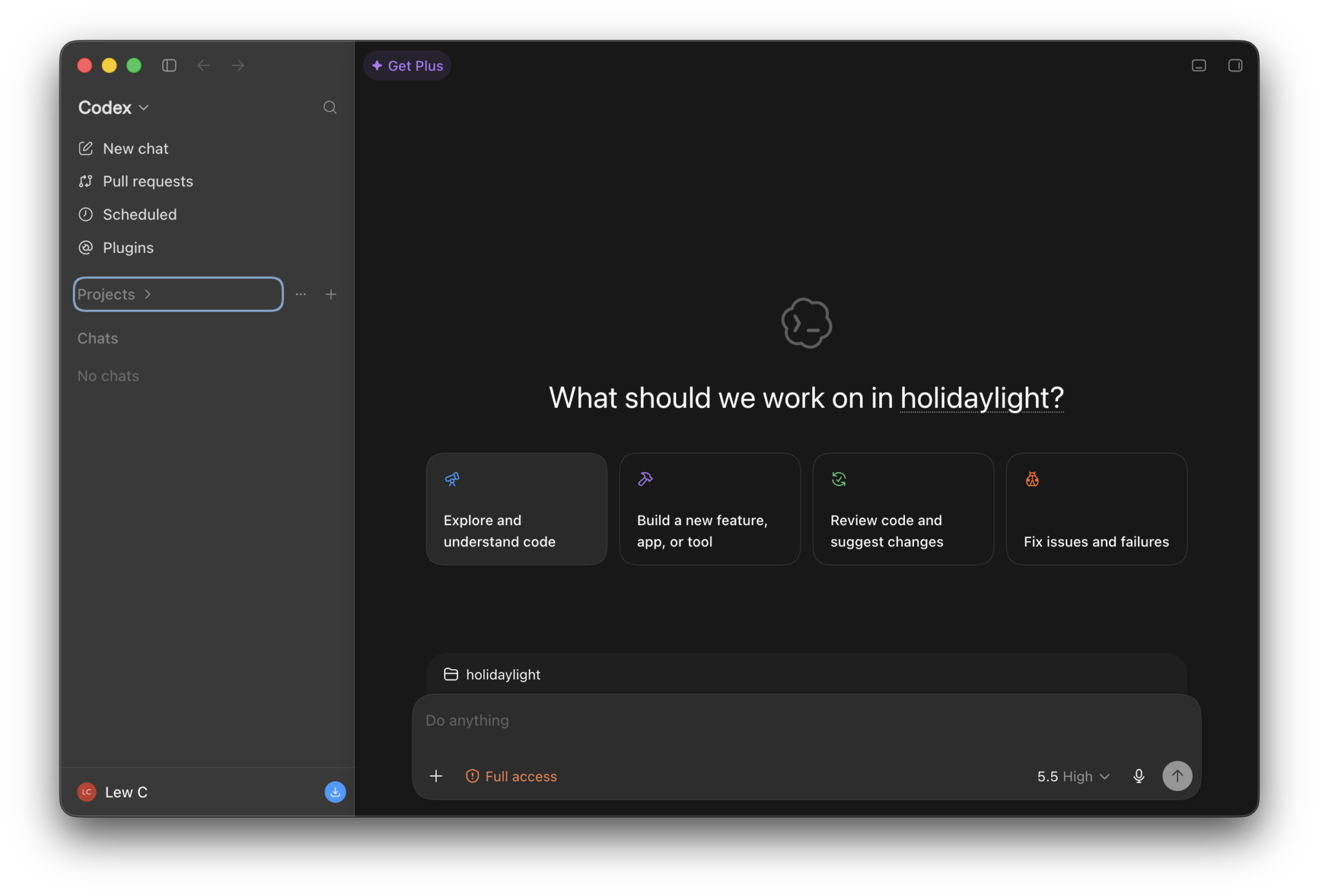
Then OpenAI made the Codex app, which was standalone from VS Code altogether. Basically, it is a chat app with a frontend.
And in the time it has taken me to write this article, Google has re-released Antigravity. Let’s look for any hints of inspiration from what OpenAI did.
For starters, here is Codex:
And here is the new Google Antigravity:
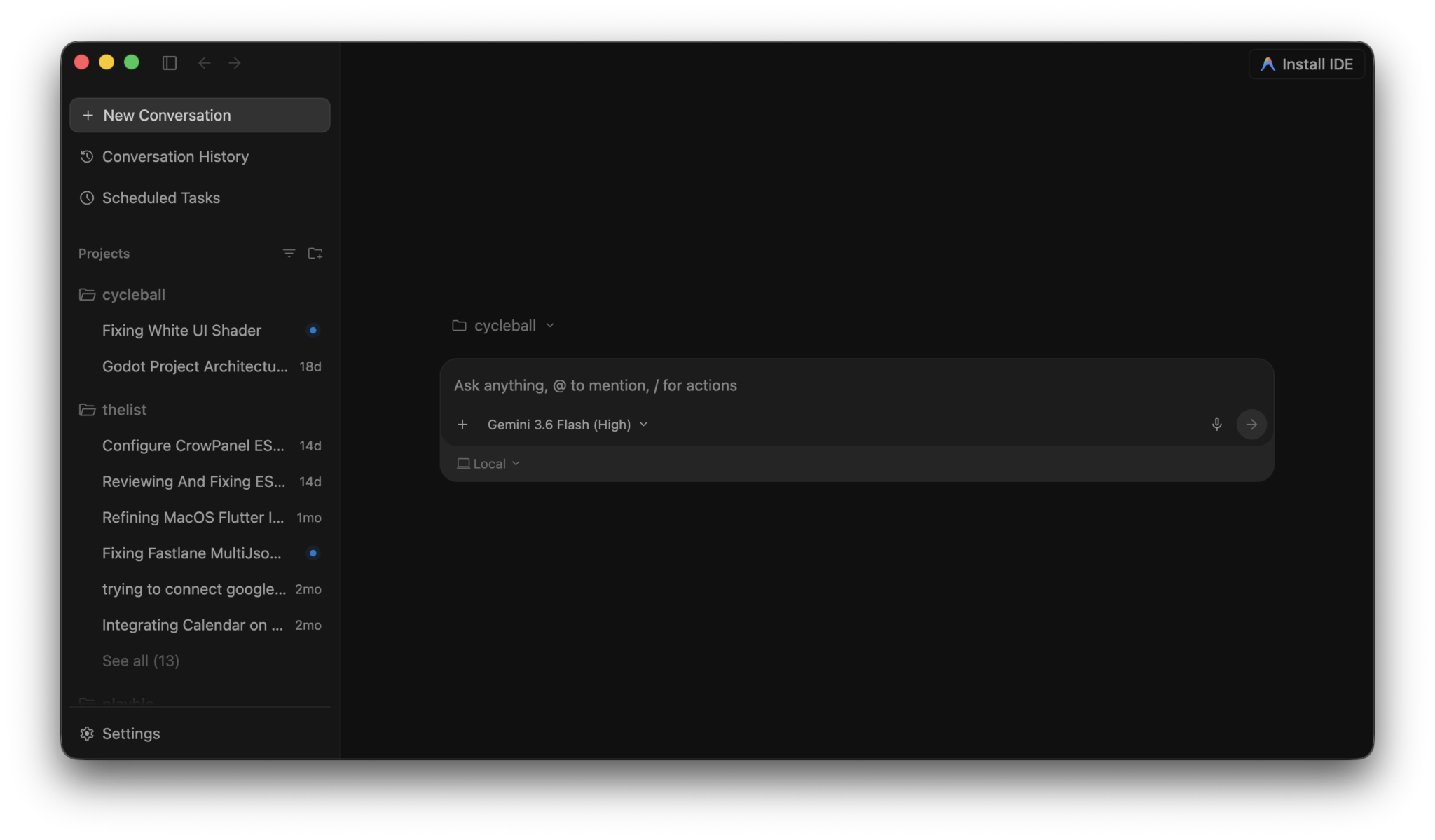
How brave and unique. The sidebar is an entirely different color.
But seriously: the AI industry is coalescing around the thing that works. Google has not abandoned its VS Code fork altogether, as suggested by the “Install IDE” button in the top right of Antigravity. But OpenAI was right about the Codex desktop app design, and Google has more or less lifted that pattern wholesale.
Better still, many of the earlier errors around agents dropping out mid-conversation seem to be resolved in this version of Antigravity. That was by far its biggest problem.
Google has access to more of the web than almost any other company because of its search engine. And, as we have covered, Antigravity can browse websites and use live content to help solve coding problems.
The missing piece is the model.
From my own experience, Google’s models are still not that crash-hot. Gemini Flash, even on high thinking, is frequently the model that gives me code that is needlessly obtuse or does not compile. When I ask Gemini to make an app and then ask Opus or Grok to review it, the latter models often find multiple bugs that need fixing. Shipping AI-generated code without careful review can introduce subtle bugs that are easy to miss.
Speaking of Grok, Grok 4.5 was recently released to the public after xAI/SpaceXAI merged its efforts with Cursor and trained the model. I have been using it a lot lately, and while it is not quite as good as Opus 4.6 or 4.8, it is definitely in the same ballpark.
Grok is designed to be a top-tier frontier coding model. Gemini Flash, by contrast, is supposed to be a faster, cheaper model. The only non-Flash model from Google currently available is Gemini 3.1 Pro, which was released in February 2026, making it roughly 80 years old in AI years. Still, in my experience, it is not great as a coding companion. It frequently makes mistakes and runs quite slowly.
Google does not have a publicly available Opus-level model yet. But it certainly has the compute available to train a gigantic new model if it chooses to do so. Given the hype around AI, that is almost certainly what it is working toward.
The point is that Google did not ship Gemini Flash and call it a day. Its models are being worked on constantly. Eventually, it may produce something that feels truly Fable- or Sol-class.
Every other major AI company, from OpenAI to SpaceXAI and Anthropic, relies heavily on people paying subscriptions for AI services. They also have income from other sources, including government contracts and commercial customers. That income can be substantial.
But people change providers. Governments come and go. If everyone stopped paying for Anthropic tomorrow, and if it lost its commercial contracts, where would the money come from? Investors will only last so long.
These companies lack one thing that still prints money for Google: AdSense.
AdSense pulls in a lazy $8 billion each quarter in revenue. That matters because, at this stage, AI companies have to develop models and then sell access at a loss to get people onboard. For example, I subscribed to Grok for three months for the price of one. Elon is going to lose money on that, guaranteed. The hope is that, after three months, I stay subscribed and pay the increased rate.
With huge revenue and enormous compute, Google can afford to develop a true frontier model and sell access at a loss long enough for a substantial number of users to migrate. Whether individual users subscribe immediately or not, AdSense can help subsidize the cost for a long time. Without that kind of cash machine, competitors will have a much harder time eating the cost of training a model and subsidizing its use at Google’s scale.
Then, possibly years down the track, after some bigger players have run out of money or the will to continue, Google can stop subsidizing its own AI and charge closer to what it actually costs, without worrying that someone else can keep outperforming it at a loss.
Maybe that sounds a little dire. But think about how Google became the number one search engine in the world. That position was not handed to it. Google fought for it with billions of dollars in deals to make Google the default search engine, with the development of Chrome, and with payments to Apple to keep Google as the default search engine on iOS, to name just a few examples.
We tend to trivialize the complexity of those deals and the scale of that strategy. You might drive around to a few different gas stations to find cheaper gas, but you probably do not bounce between search engines looking for results. You Google it, and if it is not there, you move on.
Google has more of the web to train on than almost any other player. It has an OpenAI-level coding interface, or at least something moving in that direction. It has the AdSense money machine. The last missing piece is a truly killer model.
If you Google something and it does not show up, you probably assume the answer is not worth finding. You do not go to Bing and try again. It is hard to imagine the same thing not happening with AI if Google can produce a model good enough to make that behavior stick.
So, yes: Google won the search engine race, and it is not hard to imagine it winning the AI race, too. The broader consolidation happening across the AI industry only reinforces how high the stakes are for every player involved.
In the meantime, we can all use some subsidized AI coding. That part, at least, is kind of neat.
React 19.3 and modern CSS make several common patterns unnecessary. Here are 10 features that let you delete old React code and simplify your apps.
Explore the top AI agent frameworks in 2026 and compare how they handle tools, memory, structured output, streaming, and step limits.

Tailwind CSS component libraries provide pre-built components to streamline the process of developing aesthetic, user-friendly interfaces.
Jev is a TypeSafe AI decision model that classifies messages using typed questions. Learn how to use it for routing to reduce unnecessary LLM calls.
Hey there, want to help make our blog better?
Join LogRocket’s Content Advisory Board. You’ll help inform the type of content we create and get access to exclusive meetups, social accreditation, and swag.
Sign up now
 Learn more →





