Earlier this year, I used Claude Code to help me operationalize a few early ideas. I moved so fast that I hit usage limits twice. But after my initial burst of progress, I never went back to use what I had built.
That experience made it clear that in a world of constant inputs, generating more output isn’t the same as making meaningful progress.
Unless I consciously add a task into my routine workflow, it usually doesn’t get done. Lately, I’ve heard versions of that same struggle from other business leaders that I talk to. Everyone is moving faster, producing more, and yet still feeling buried.
One founder told me he built an entire fleet of AI agents to handle DevOps and software engineering work because he wasn’t allowed to hire. A product leader told me she had said yes to so many stakeholder requests that her roadmap started to resemble a junk drawer.
These examples point to the same underlying problem: too many priorities, too few resources, and constant pressure to deliver. That combination creates an environment where teams stay busy but lose sight of what actually matters.
AI is changing how we work, but a lot of teams are using it to multiply output without improving focus, judgment, or decision-making. The result is more activity, more noise, and often less clarity.
So how do product leaders cut through the noise? And how do you avoid getting buried in AI-generated output, stakeholder demands, and endless competing priorities, while still making room for the kind of thinking that drives real progress?
This article unpacks a framework for thinking about prioritization at an organizational, team, and individual level so that you can spend more time on what actually matters.
In most organizations, saying yes feels safer than saying no. Yes earns political capital, signals collaboration, and helps you avoid the discomfort of disappointing stakeholders or defending hard trade-offs.
However, the best product managers don’t just say yes to everything. Strong PMs demonstrate their ability to impose strategic constraints by deciding what not to do.
That’s why deprioritization deserves more attention than it usually gets. If everything is urgent, nothing is strategic. Teams need to measure progress not only by what they ship, but also by what they deliberately leave out.
In chaotic environments, daily drama can easily become the work itself. Resist that pull by stepping back and asking why the chaos exists in the first place.
One useful way to think about prioritization is as a pyramid:
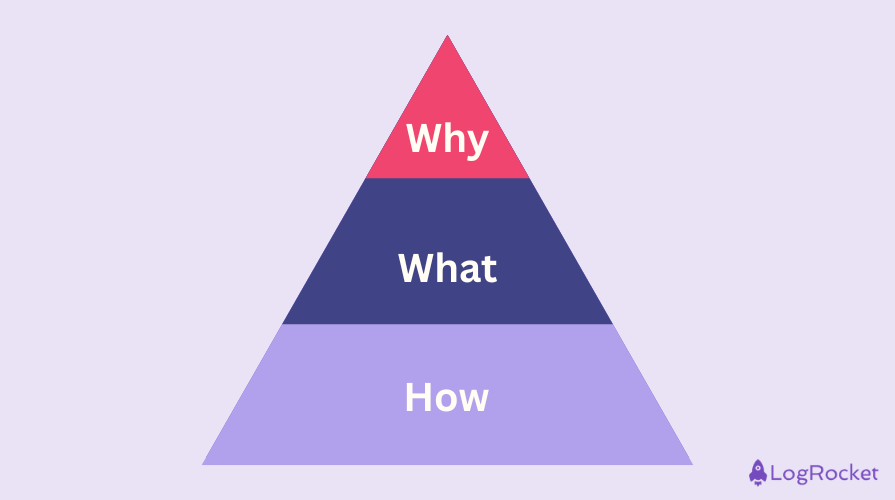
At the top is the why. This is the smallest section because your strategy shouldn’t change every week. Leadership defines the outcome the organization wants to drive and answers the following core questions: What are we trying to achieve? Why does it matter? Why are these the goals worth pursuing now?
The middle of the pyramid is the what. Once the why is clear, the organization can define what needs to be delivered to move those outcomes forward. What work matters most? What does success look like? What needs to happen now, and what can wait?
At the base is the how. This is where execution happens. Teams have to make decisions about people, money, and time. It’s also where trade-offs stop being theoretical and become operational.
The order matters. When teams jump straight into the how without aligning on the why and the what, they often end up reactive and overloaded.
A former leader of mine once explained annual planning using the idea of big rocks. Picture your company’s capacity as a glass jar. The rocks inside represent projects, goals, and ambitions.
If you put the big rocks in first, the smaller rocks and pebbles can settle around them. But if you let small and medium priorities fill the jar first, there may be no room left for the few initiatives that actually matter.
Teams that struggle with prioritization tend to spend too much time on small and medium priorities while losing sight of the bigger picture. That’s why it’s always critical that you ensure focus and alignment from the beginning.
For most teams, this means setting no more than two or three real priorities at a time. These should be initiatives that shape the long-term success of the team. You can pursue smaller opportunities later, but they shouldn’t compete with the priorities that matter most.
Agile teams call this principle limiting work in progress.
In Kanban, work moves through a queue in a controlled way. A team picks up an item when capacity is available, works until it’s completed or blocked, and then moves on to the next. The system works because it helps you resist the temptation to start everything at once.
The same logic applies at the organizational level. When leaders narrow the team’s focus, they give people permission to narrow their own. That doesn’t eliminate day-to-day fires or operational work, but it creates space for meaningful progress on the most important goals.
Saying not right now is often more valuable than saying yes. It protects the team’s attention, reduces fragmentation, and increases the odds that the big rocks actually get finished.
When a team understands the goals, aligns around key milestones, and focuses on executional excellence, performance improves and trust tends to deepen with it.
If leadership did its job, the team already understands the big rocks and feels empowered to apply their expertise to achieve those goals. But those big rocks could be fairly broad and require agreement on how to meet them.
This is where the golden triangle of scope, time, and resources must be applied diligently. In evaluating the options, a team can plot its ideas on a value/effort matrix with four to nine boxes.
In a quadrant setup, you have low and high value on the y-axis and low and high effort on the x-axis:
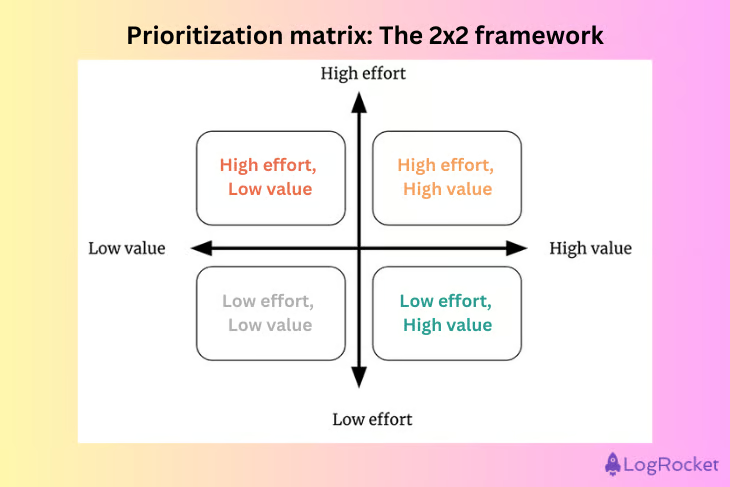
You can also flip the axes if you prefer. In a nine-box grid, you have the same setup, except you add a medium category on both axes for a 3×3 matrix.
Now, plot your potential work items on the chart. If you’re not sure where to plot them, consider using a framework like RICE: reach, impact, confidence, effort. Evaluate each item you’re considering on each of those criteria.
Reach is the estimated number of end users and stakeholders who may be impacted by the item. Impact measures the relative impact each item will have on that population. Confidence measures your confidence in your estimates of the prior two metrics. And effort measures the amount of resource bandwidth required to achieve the item.
Do a little research on the measurements to use for these and test it a few times to make sure it works for you. Once you’ve completed a methodical evaluation like this for your items, you can better plot them on a high-level grid.
You might be wondering why we’re only talking about planning if teams are responsible for executing the work. While that’s true, if you skip this step, you risk focusing your time and resources on the wrong things.
By diligently evaluating your options and executing this process with the right stakeholders at the table, you demonstrate your commitment to doing the right things, even if the entire team doesn’t agree with the end result. It’s more about applying discipline in planning before execution than building 100 percent consensus.
Now you can prioritize the items that are lower effort but higher value first. Measure the impact of those things on your top company objective (or big rock), and, if it is achieved, congratulations. Move to those medium or smaller rocks, which, ironically, might look like higher-effort, high-value items.
Plan some buffer for unexpected work that’ll inevitably arise, and focus on achieving those top goals that’ll have the highest impact on the company. This drives intrinsic motivation and allows everyone to feel proud of their accomplishments along the way.
Applying focused discipline at the company and team levels sets the tone for how individuals are expected to manage their own workload. Just as the company identifies its top objectives and the team applies frameworks to decide where to spend time and resources, you have a similar responsibility as an individual.
It all starts with understanding the company and team goals. If you disagree with them, say so. Leadership should hear your perspective and consider it seriously. However, once a decision is made, there comes a point where you have to stop debating and start committing.
Amazon has a well-known leadership principle often summarized as disagree and commit. Even if you would have made a different call, your responsibility is to commit to the outcome the team is trying to achieve.
Once you’re aligned, the next challenge is managing how you prioritize your day. Distractions will inevitably show up, which is why building the muscle memory to say no, or at least not now, matters so much.
The same logic applies here as it does at the company level. The company puts the big rocks in the jar first and says not now to the medium and pebble-sized ones. As an individual, you have to do the same with your own time. What you choose to focus on today ladders up to your week, your month, and your quarter.
Every day is a series of choices about how you spend your time and attention. The goal is to make those choices in a way that supports company priorities while also moving your own work forward.
The prioritization crisis isn’t really a skills gap – it’s a courage gap. Most organizations are drowning in frameworks but missing the willingness to make trade-offs, disappoint people, and say no when no is the right answer.
So the real question is whether you’re willing to take the steps to prioritize better.
At the company level, that means identifying the big rocks and making sure teams have the clarity and permission to focus on them first. At the team level, it means choosing a practical method for evaluating competing ideas instead of chasing the perfect framework. Use something that works, apply it consistently, and refine it over time.
At the individual level, the same principle applies. Much of the discomfort around saying no is self-imposed. Challenge yourself to move away from silence, vague agreement, or overcommitment followed by missed expectations.
Learn to negotiate your bandwidth the same way your company negotiates scope, time, and resources. In many ways, you’re the product manager of your own capacity.
Featured image source: IconScout
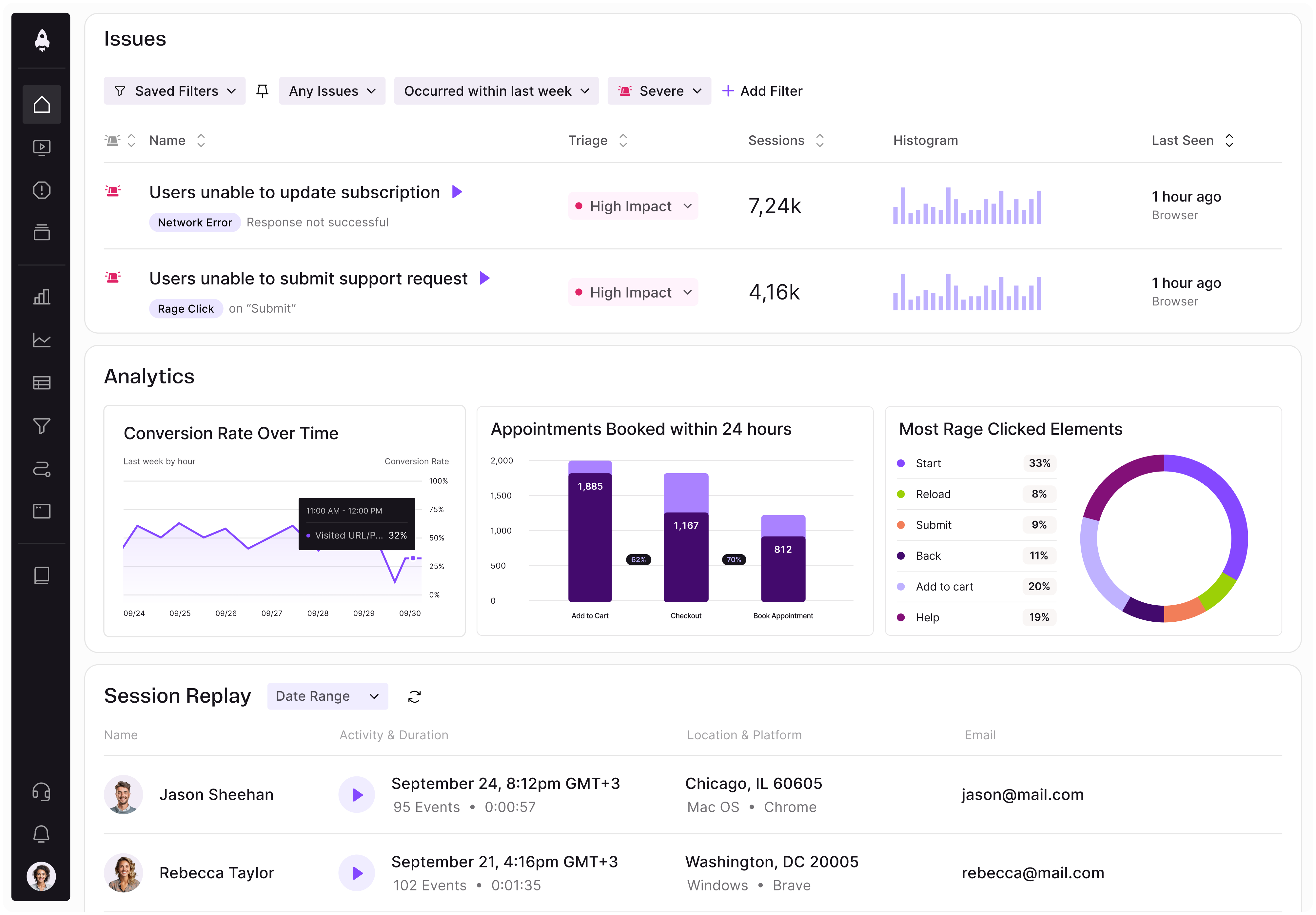
LogRocket identifies friction points in the user experience so you can make informed decisions about product and design changes that must happen to hit your goals.
With LogRocket, you can understand the scope of the issues affecting your product and prioritize the changes that need to be made. LogRocket simplifies workflows by allowing Engineering, Product, UX, and Design teams to work from the same data as you, eliminating any confusion about what needs to be done.
Get your teams on the same page — try LogRocket today.

Explore agentic AI security trade-offs product managers must own before launch, from permissions and human oversight to memory and recovery.

See how to define AI features that deliver user value. Validate needs, assess costs, and set reliability requirements before the team builds.

Learn how to read a P&L statement, assess product costs, build stronger business cases and align product roadmaps with financial priorities.

Learn how product managers can design products for both humans and AI agents with reliable APIs, permissions, errors, and workflows.


 Learn more →