A big part of UX research is obviously the people who participate in it. These people are extremely important because they’re far less biased than we are and the only people who can really tell us about themselves, the problems to be solved, and the effectiveness of the solutions that we’re building. But after all these years, finding quality research participants at an affordable price is still a tremendous challenge, but we keep hearing that research doesn’t have to be expensive, so how are UX designers actually going about it?
In this article, you’ll learn about the three methods of recruiting participants for UX research, their benefits and downsides, and how to go about them.
Editor’s note: We updated this article in September 2026 as generative AI makes it increasingly difficult for UX researchers to know who — or what — is behind a research response. The update covers the growing use of synthetic participants, AI-assisted screening responses and participant fraud, and practical ways to verify that your research is still grounded in real users and real experiences.
In short, no:
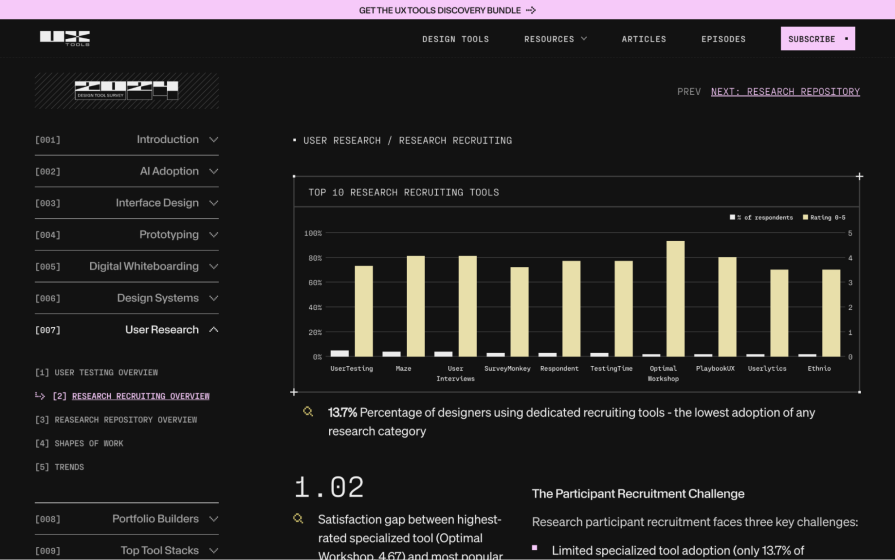
Not using dedicated research participant recruitment tools such as UserTesting anyway. According to the 2024 Design Tools Survey, only 13.7 percent of designers are using dedicated tools for recruiting research participants, a statistic that sharply declined from 28 percent the year before. 47.2 percent of designers (48 percent according to The Future of User Research Report 2025) say that finding qualified participants is the issue, but they also need to be paid for their time, right? It’s simply not cost-effective.
But what are the alternatives? Let’s find out.
This method requires a lot of time but provides great and sometimes unique benefits, not to mention the fact that if you don’t have users yet, this might be what it takes to find and research them. Simply put, this is a space for customers, users, visitors, or just people interested in your product’s space:

Starting the process of building a community for UX research should be a high-priority, day-one task, because it won’t fully pay off for a while.
The first benefit of building a community for UX research is that you’ll be able to reach a wider audience that includes potential users. The only other way to reach this segment is with on-site/in-app surveys and the like, but these people are more fleeting, so getting useful insights from them is harder.
On the flip side, you’ll be missing out on those that aren’t interested, which is fine if they’re not your target market, but if we’ve given them the wrong impression or the wrong information, we want to know about that, right? That’s why every method that I’ll outline today is vital — it’s not an either/or situation — always capture as much data as possible from as many contexts as possible, and document it in detail (more on that in a bit, though).
The second benefit is that these will be your most eager participants, and while there are some biases that come with that (that might disqualify them from certain studies), it nonetheless provides you with quick access to a panel of eager participants that are truly invested in your product, rather than only willing to give the bare minimum feedback needed to get their payout. As an added benefit, these recruits are typically happy to receive product perks rather than actual money — this still amounts to a gain for them but not really a loss for our business.
Similarly, they’re also likely to be your happiest/angriest users. Again, not a problem, it’s just important to understand that one channel isn’t representative of all users or potential users — document/label all data so that the full context is clear, especially for other stakeholders approaching the data for the first time. A research repository tool can help you with this.
Depending on your expertise and resources, your options are (with links to my ultimate favorite resources on how to create and/or scale them, although do note that the advice might include details relating to marketing and monetization, which you can ignore):
That being said, you don’t necessarily need to own the communities. However, keep in mind that the rules of unowned communities can prevent you from conducting business freely. In any case, pre-screen participants and post-filter the results accordingly, especially when cross-pollinating from various owned or unowned communities. Ultimately, you need to fully understand where participants are coming from/the context of the data. Again, and I can’t stress this enough, document/label data so that you can pull it from multiple sources at once according to how you’ve labeled/segmented it.
If sourcing from unowned communities, don’t shy away from smaller ones — some of the most engaged communities are those with less than 30 people. Today, these types of communities are very common, so ask around and see where people are spending their time.
Marketing isn’t the goal here, but it’s a shame to waste the opportunity. Make sure to capture consent for any marketing and avoid marketing to those who don’t give it. For participants, I suggest focusing more on the marketing of new features that they helped to shape, as this helps to keep them engaged. Otherwise, keep it very relevant/targeted.
Before moving on to the other recruitment methods, there’s one increasingly common alternative worth addressing: synthetic participants.
There’s another option that’s become increasingly difficult to ignore: synthetic participants.
Synthetic participants are AI-generated personas designed to respond as though they belong to a particular user group. Give an AI model enough information about your target audience, product, and research question, and it can simulate how those users might respond to an interview question, usability task, or product concept.
That can make synthetic participants useful during the exploratory stages of research. You might use them to brainstorm possible user reactions, pressure-test interview questions, identify assumptions worth investigating, or prepare for sessions with real participants.
But that’s different from conducting research.
A synthetic participant can generate a plausible response based on patterns in its training data and the context you provide. It can’t tell you what a real customer experienced when they tried your checkout flow yesterday, why they abandoned a task, what frustrated them, or how their particular circumstances shaped their behavior.
So, I wouldn’t treat synthetic participants as a cheaper replacement for real ones. Use them to help determine what you should investigate, then validate those assumptions with actual users. If the research question depends on what people genuinely think, experience, need, or do, you still need people.
There’s also a second AI-related problem to consider: sometimes you think you’re researching real participants when you aren’t getting entirely authentic responses.
Participant fraud isn’t new. Whenever compensation is involved, some people will misrepresent themselves to qualify for a study. Generative AI has simply made this easier.
Someone can now use AI to generate convincing answers to open-ended screener questions, infer what type of participant you’re looking for, or provide polished responses about experiences they haven’t actually had. Researchers therefore need to think about participant quality throughout recruitment and the study itself, rather than treating screening as a one-time check.
Start with your screener. Avoid making the “right” answer obvious, and ask questions that require participants to describe specific experiences rather than simply agreeing with statements. Instead of asking whether somebody regularly uses a particular type of product, for example, ask what they last used it for, which tools they considered, or how they completed a relevant task.
Then look for consistency.
Compare what participants tell you in the screener with what they say during the research session. If somebody claims to use a product every day but struggles to describe what they use it for, how they normally complete a common task, or what they did the last time they used it, that’s worth investigating further. Ask follow-up questions about details they’ve already provided rather than immediately moving to the next question.
You can also strengthen participant verification by:
This is another reason why maintaining participant records becomes so valuable. The more context you have about where somebody came from, what studies they’ve participated in, what they’ve previously told you, and, for existing customers, how they actually use your product, the easier it becomes to assess whether they’re appropriate for a study.
The goal isn’t to interrogate every participant or eliminate anyone who gives an unexpected answer. Unexpected answers are often exactly what makes research valuable. The goal is to have enough evidence that the person you’re learning from is genuinely part of the audience you intended to research.
As AI makes convincing responses easier to manufacture, recruiting participants is no longer only about finding enough people. It’s also about making sure those people are real, relevant, and providing insights grounded in actual experiences.
If your product has users already, you can leverage them to conduct UX research:
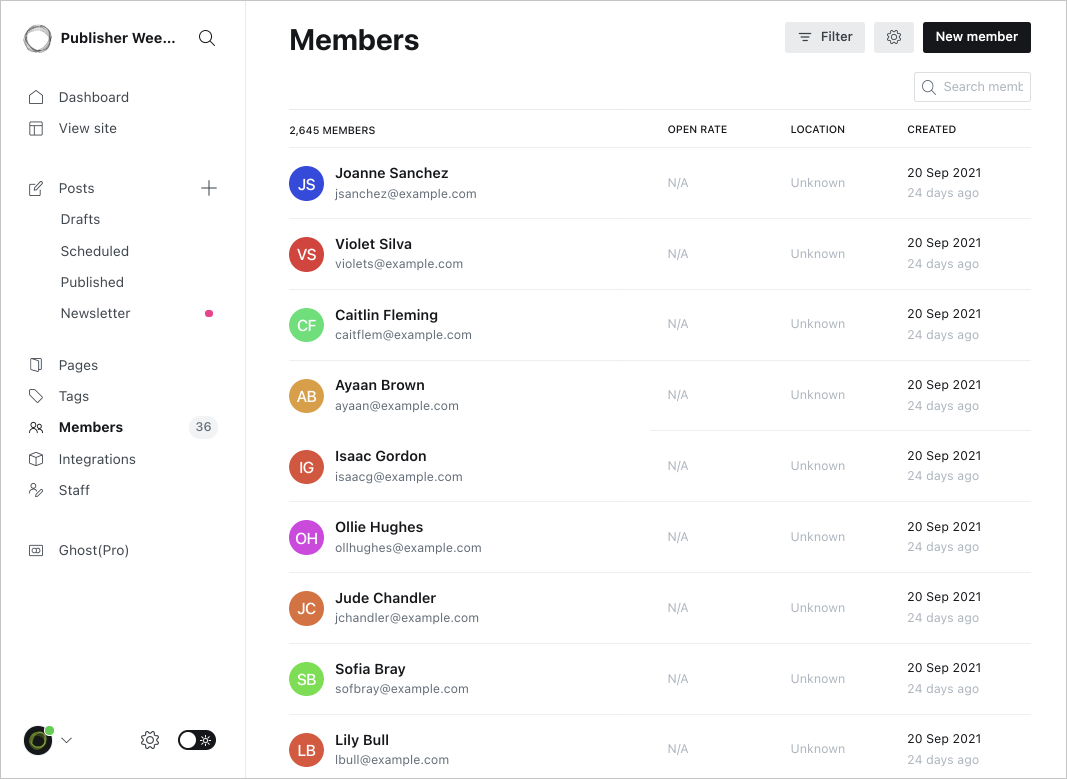
This is what most UX teams do, and I’m not here to convince you otherwise — it’s a terrific option with many benefits, but there are some downsides too, so let’s dive in.
Unlike other methods, the data resulting from this method is specifically representative of users actually using the product, an important segment that’s already segmented by nature (yay!).
Another benefit, assuming that you’re using a Customer Relationship Management (CRM) tool or CRM-like feature, maybe with built-in email features for extra convenience, is that this is the easiest audience to access. For example, if you were having difficulty with customer retention and wanted to get ahead of the problem, those that you’d need to research would be a part of this segment, whereas a community would be a more diverse set of folks that would require more segmentation and labeling.
Another comparison: while researching your product’s users can assist with customer retention, researching the non-user segment of your community can help you to cultivate or outright acquire new customers, including your very first ones. So again, it’s an additional method that you can utilize, not an alternative one.
As you might’ve guessed, this one’s super easy.
Simply reach out via email (or whatever) and invite them to participate in your study. The usual rules apply — create a file for them and note things that you’ve learned about them. These notes/labels supply additional context and enable you to segment participants further. With this particular method, you should be able to decipher how long they’ve been a customer/user, whether they’re possibly churning soon, what they’ve purchased, and so on from the get-go.
You are, after all, already acquainted with them, so you can begin to create something akin to a digital fingerprint from day one and then supplement that with further UX research. In fact, you should be doing this with all participants across all channels, at the very least, to ensure that you don’t end up with duplicate entries for people, tainting your data. Always collect email addresses for identification (be fully transparent about what this is for), tying any data sourced from your community to any data collected by reaching out directly, as well as any data autonomously collected by on-site/in-app methods such as surveys and analytics, which we’re going to move onto right this minute.
This method is more technical, but also more passive. It involves collecting data from those who use your website/app, whether they’re customers, users, or just visitors:
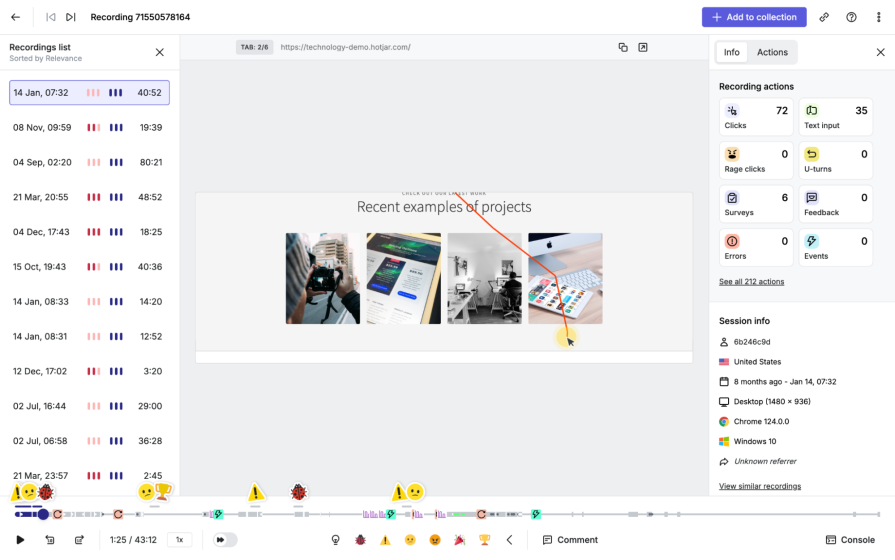
If you just synthesize the data into insights, then the research is totally unmoderated, but if you’re following up with participants, it’s moderated too. It depends on the method used, though — while it’s easy to follow up when surveying, since you can and should collect their email addresses to bind their data to data collected via other methods, it’s impossible to bind analytics, heatmaps, session recordings, and A/B test results to anonymous visitors.
Once again, let’s talk about the benefits and downsides.
As mentioned before, this approach targets customers, users, and visitors depending on the method and placement. Although uninterested visitors will likely ignore attempts to reach out, this is nonetheless the best method of accessing this audience.
The technicality of the implementation isn’t too tough, so I don’t consider that to be a true downside, and the mostly unmoderated nature of it all cancels out this downside anyway.
In addition to being unmoderated, this type of UX research is continuous as well — once you’ve set up your surveys/analytics/heatmaps/session recordings, they can accrue data for as long as you want them to (bar A/B tests, which you’d naturally dismantle once you’ve captured the data you need).
Also, and this probably goes without saying, this is the only method where data is collected during real scenarios, so you’re getting the truest and freshest data. However, keep in mind that non-surveying methods lack a lot of context, so the data has to be synthesized carefully and validated using summative research.
All in all, though, as long as you have a live product with people using it, this method is the least time-consuming, most versatile, and doesn’t even require participant recruitment.
Although dedicated tools exist, many tools conveniently cover surveys, heatmaps, session recordings, and A/B tests in a single implementation. The setup normally involves installing a script on your website/app, creating surveys and determining when they should show up, setting up heatmaps and session recordings, setting up A/B tests (when benchmarking multiple variations of a design), or simply setting up conversion flows using analytics.
Technically, marketing consent isn’t required for UX research, so logged-in users can have their data attributed to them. Other data will have to be anonymized, though.
Most businesses aren’t using research participant recruitment services, as they cost too much and the quality of the responses isn’t great. Although recruiting participants yourself can cost time in the short run, the long-term savings of time and money make it more than worth it.
The most difficult part is building a community of (or that includes) research participants, which is why I suggest working on that as soon as possible, especially if you don’t have actual users yet, as there aren’t really any effective ways to recruit research participants otherwise.
A bit further down the line, once you’ve acquired your first users, you’ll be able to approach them directly to recruit them for research studies.
Finding quality research participants takes work, but you don’t have to rely on dedicated recruitment platforms. Building a community, recruiting from your existing users, and collecting feedback through your product can all give you access to different audiences and different types of insights.
The important thing is not to rely on any one method. Understand where your participants come from, document that context, and screen them carefully so you know who your research actually represents.
That last part matters even more now. Synthetic participants can help you explore ideas and prepare for research, but they can’t replace the experiences of real users. At the same time, generative AI makes it easier for people to produce convincing screener and research responses. Participant quality therefore needs to be something you assess throughout the research process, not just during recruitment.
And finally, if you’re not sure which research methods to use, our handy introduction to the different types of research has you covered.
Ultimately, good recruitment isn’t about finding as many participants as possible or finding them as cheaply as possible. It’s about finding the right people and having enough confidence in your participants and your methods to trust what you learn from them.
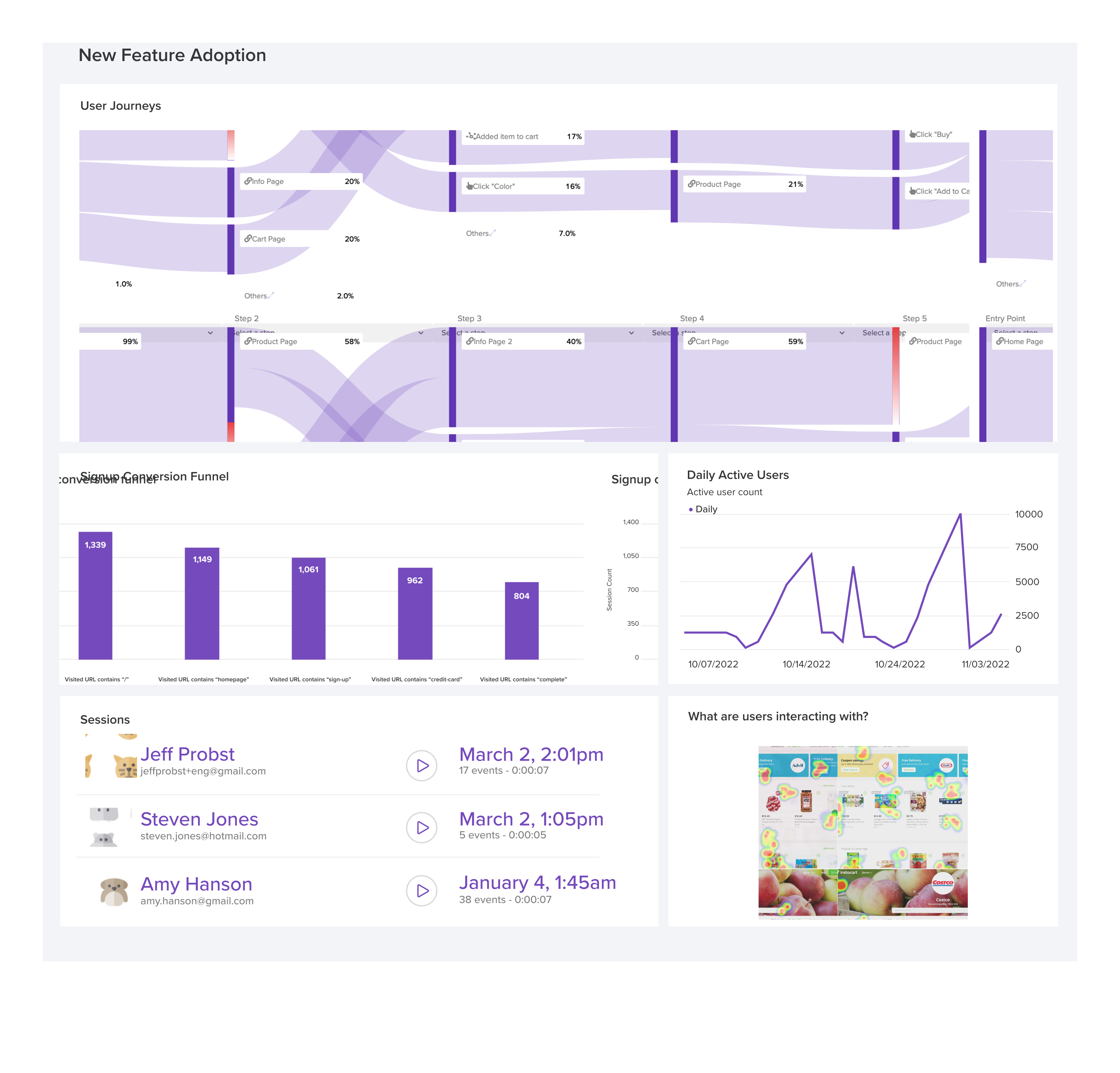
LogRocket's Galileo AI watches sessions and understands user feedback for you, automating the most time-intensive parts of your job and giving you more time to focus on great design.
See how design choices, interactions, and issues affect your users — get a demo of LogRocket today.

Your UX copy documentation isn’t just for human writers anymore. Here’s how to build a copy ecosystem that AI tools and agents can understand too.

Colors in UI aren’t just decoration. They’re the key to emotional impact, readability, and accessibility. This blog breaks down how to pick colors that don’t just look good — they work for your users.

For when you’re stuck in a UX design rut next, bring in lateral thinking. Lateral thinking will take your designs in fresh directions, solving tricky problems with unexpected creativity.

Giving designers AI tools is the easy part. I share how our team used office hours, small experiments, hackathons, and shared failures to build better AI habits together.

 Learn more →