
Dependency injection is a great pattern to use while building large and complex applications. The major challenge with building these applications is creating loosely coupled components, and this is where dependency management is most critical.

This article will introduce dependency injection, its pros and cons, and how dependency injection can be handled in Vue projects.
Dependency injection is a design pattern in which classes are not allowed to create dependencies. Rather, they request dependencies from external sources. This design pattern strongly holds that a class should not configure its dependencies statically.
Why should we use dependency injection in Vue when we can pass data from parent components down to the children components?
Some experience with using props would expose you to the term prop drilling, which is the process where props are passed from one part of the component tree to another by going through other parts that do not need the data, but only help in passing it through the tree:
RexComponent (Anyone needs my wallet address?)
├── TomComponent
   ├── PeterComponent
      ├── DurryComponent (yes I need it)
With the above snippet, let’s consider a scenario where RexComponent has a wallet address to give out and DurryComponent is the only one in need of the wallet address. We will have to pass the wallet address from RexComponent to TomComponent to PeterComponent, and finally to DurryComponent. This results in the redundant piece of code in both TomComponent and PeterComponent.
With dependency injection, DurryComponent would receive the wallet from RexComponent without passing through TomComponent and PeterComponent.
To handle dependency injection in Vue, the provide and inject options are provided out of the box.
The dependencies to be injected is made available by the parent component using the provide property as follows:
//Parent component
<script lang="ts">
    import {Component, Vue} from 'vue-property-decorator';
    import Child from '@/components/Child.vue';
    @Component({
        components: {
            Child
        },
        provide: {
            'name': 'Paul',
        },
    })
    export default class Parent extends Vue {
    }
</script>
The provided dependency is injected into the child component using the injected property:
<template>
  <h1> My name is {{name}}</h1>
</template>
<script lang="ts">
    import {Component, Inject, Vue} from 'vue-property-decorator';
    @Component({})
    export default class Child extends Vue {
        @Inject('name')
        name!: string; // non-null assertion operator
    }
</script>
The vue-property-decorator also exposes @Provide decorator for declaring providers.
Using the @Provide decorator, we can make dependencies available in the parent component:
//Parent component
export default class ParentComponent extends Vue {
  @Provide("user-details") userDetails: { name: string } = { name: "Paul" };
}
Similarly, dependencies can be injected into the child component:
//Child component
<script lang="ts">
    import {Component, Inject, Vue} from 'vue-property-decorator';
    @Component({})
    export default class ChildComponent extends Vue {
        @Inject('user-details')
        user!: { name: string };
    }
</script>
The provider hierarchy rule states that if the same provider key is used in multiple providers in the dependency tree of a component, then the provider of the closest parent to the child component will override other providers higher in the hierarchy.
Let’s consider the following snippet for ease of understanding:
FatherComponent
├── SonComponent
   ├── GrandsonComponent


//Father component
<script lang="ts">
    import {Component, Vue} from 'vue-property-decorator';
    import SonComponent from '@/components/Son.vue';
    @Component({
        components: {
            SonComponent
        },
        provide: {
            'family-name': 'De Ekongs',
        },
    })
    export default class FatherComponent extends Vue {
    }
</script>
In the above snippet, the family-name dependency is provided by the FatherComponent:
//Son component
<script lang="ts">
    import {Component, Vue} from 'vue-property-decorator';
    import GrandsonComponent from '@/components/Grandson.vue';
    @Component({
        components: {
            GrandsonComponent
        },
        provide: {
            'family-name': 'De Royals',
        },
    })
    export default class SonComponent extends Vue {
    }
</script>
In the above snippet, the SonComponent overrides the family-name dependency previously provided by the FatherComponent:
//Grand son Component
<template>
  <h1> Our family name is {{familyName}}</h1>
</template>
<script lang="ts">
    import {Component, Inject, Vue} from 'vue-property-decorator';
    @Component({})
    export default class Child extends Vue {
        @Inject('family-name')
        familyName!: string; // non-null assertion operator
    }
</script>
As you would guess, De Royals will be rendered in the template of the GrandsonComponent.
In some complex Vue projects, you might avoid overriding dependencies to achieve consistency in the codebase. In such situations, overriding dependencies is seen as a limitation.
Fortunately, JavaScript has provided us with the ES6 symbols as a remedy to the drawback associated with multiple providers with the same keys.
According to MDN, “Symbols are often used to add unique property keys to an object that won’t collide with keys any other code might add to the object, and which are hidden from any mechanisms other code will typically use to access the object.”
In other words, every symbol has a unique identity:
Symbol('foo') === Symbol('foo') // false
Instead of using the same string key on the provider and injection sides as we did in our previous code, we can use the ES6 Symbol. This will ensure that no dependency gets overridden by another:
export const FAMILY = {
    FAMILY_NAME: Symbol('FAMILYNAME'),
};
In this article, we established a basic understanding of dependency injection in Vue. We walked through the drawbacks associated with multiple providers with the same keys while we also implemented a remedy to the drawback using the ES6 symbols.
Debugging Vue.js applications can be difficult, especially when users experience issues that are difficult to reproduce. If you’re interested in monitoring and tracking Vue mutations and actions for all of your users in production, try LogRocket.
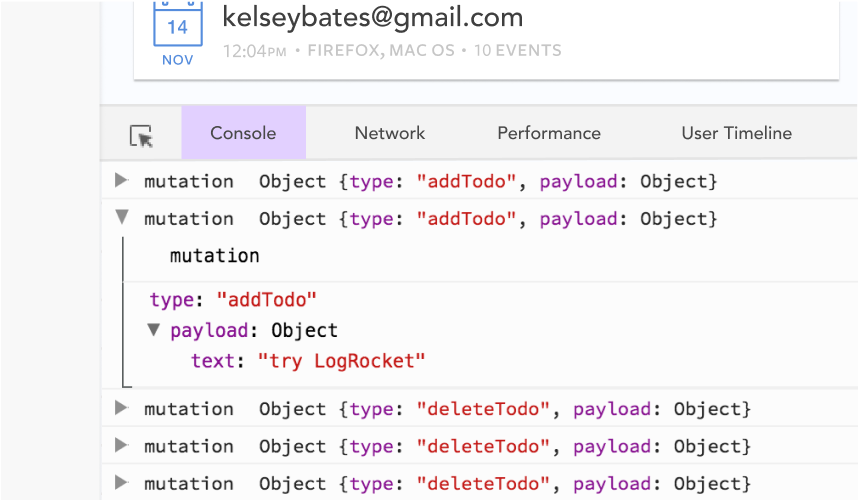
LogRocket lets you replay user sessions, eliminating guesswork by showing exactly what users experienced. It captures console logs, errors, network requests, and pixel-perfect DOM recordings — compatible with all frameworks.
With Galileo AI, you can instantly identify and explain user struggles with automated monitoring of your entire product experience.
Modernize how you debug your Vue apps — start monitoring for free.

Tailwind CSS component libraries provide pre-built components to streamline the process of developing aesthetic, user-friendly interfaces.

Jev is a TypeSafe AI decision model that classifies messages using typed questions. Learn how to use it for routing to reduce unnecessary LLM calls.

Vibe coding makes building apps faster, but speed without engineering can create serious failures. Here are five real-world examples and practical checks to help you ship AI-generated code safely.
Compare React ViewTransition and Motion across four animation patterns. The native build saved ~38.6kB of gzipped JS, but required 179 more lines of CSS.
Hey there, want to help make our blog better?
Join LogRocket’s Content Advisory Board. You’ll help inform the type of content we create and get access to exclusive meetups, social accreditation, and swag.
Sign up now

 Learn more →




