A few weeks ago, Cloudflare announced vinext, an experimental reimplementation of the Next.js API surface on top of Vite. The headline-grabbing part was obvious: one engineer, one week, and an AI-assisted workflow. But the bigger story is not the speedrun. It is what vinext says about framework portability, how much of Next.js can be treated as an API contract, and where AI actually adds leverage in modern development.

In this article, we’ll look at what vinext is, why Cloudflare built it, how you can try it today, and where its tradeoffs are most obvious. We’ll also look at how the project was built and what it actually suggests about AI-assisted software development, beyond the hype.
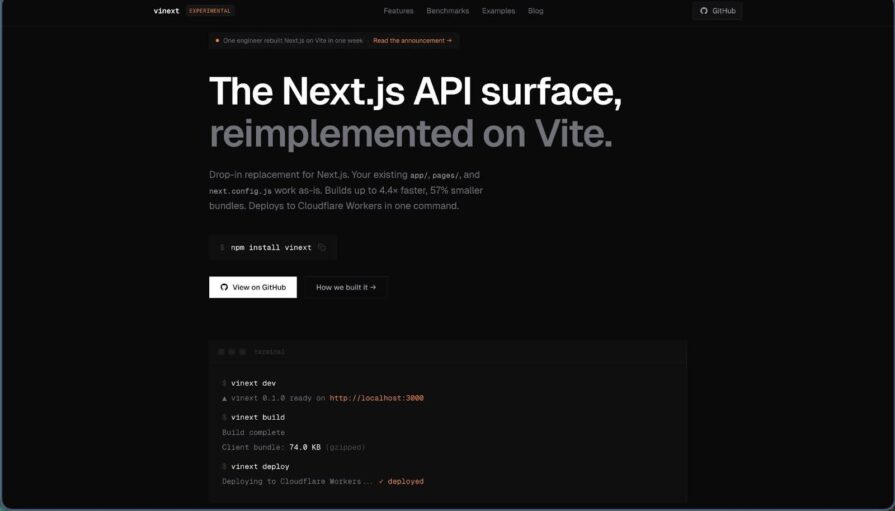
vinext is not a fork of Next.js. It is an alternative implementation of the public Next.js API surface built on top of Vite. In practical terms, that means you can keep familiar conventions like app/, pages/, and next.config.js, while swapping out the underlying toolchain.
That distinction matters. If you just want to run Next.js somewhere other than Vercel, you already have real options today, including self-hosting, OpenNext, and the new stable Next.js Adapter API. vinext is more ambitious than that. Instead of adapting Next.js output for another platform, it reimplements the framework’s public behavior on top of Vite itself.
The goal is not to invent a new full-stack React framework. The goal is to see how much of the Next.js developer experience can be recreated on a different compiler and runtime foundation. If you want more background on the portability side of this problem, LogRocket already has a useful piece on whether OpenNext is really the key to Next.js portability.
Next.js has long been awkward to deploy outside its default path. If you want to run a Next.js app on platforms like Cloudflare Workers, AWS Lambda, or Netlify, you often end up relying on adapters, platform-specific tooling, or extra build steps to smooth over differences in runtime behavior. Projects like OpenNext have made that much more workable, and Next.js itself has recently moved further in that direction with its now-stable Adapter API. But vinext takes a more radical approach. Instead of adapting Next.js output after the fact, Cloudflare reimplemented the Next.js API surface directly on top of Vite. That means keeping the conventions developers already know while swapping in a different engine underneath.
Cloudflare’s core argument is not just that Vite is faster. It is that a Vite-based implementation can preserve the parts of Next.js developers actually care about while removing some of the platform assumptions and build constraints that come with the original toolchain. That makes vinext less of a simple portability patch and more of an architectural alternative to standard Next.js. If you want a more traditional path to running Next.js on Workers, LogRocket’s guide to deploying Next.js to Cloudflare Workers is the better reference.
Cloudflare’s early case for vinext comes down to three main benefits.
That said, the benchmark story needs one important caveat. The vinext README explicitly notes that these tests measure compilation and bundling speed, not end-user serving performance. It also notes that Next.js and vinext currently make different default tradeoffs: Next.js pre-renders more static content at build time, while vinext currently leans more heavily on request-time rendering plus caching. The numbers are interesting, but they are not a clean apples-to-apples verdict on production performance.
Cloudflare’s setup flow is intentionally simple. If you already have a Next.js app, you can initialize vinext inside the project and continue using the same directory structure and most of the same framework conventions:
npx create-next-app my-app
cd my-app
npx vinext init
From there, vinext replaces next with vinext in your scripts and uses Vite under the hood. That migration path is part of the appeal: you keep the app model your team already knows while swapping out the engine underneath.
If your goal is not vinext specifically, but broader framework evaluation, it may also be worth comparing this direction with other React full-stack options. LogRocket’s TanStack Start vs. Next.js comparison is useful here because it highlights how much of the current React framework debate comes down to toolchain philosophy, not just features.
vinext isn’t perfect. A few reasons to tread lightly:
next/font. Webpack and Turbopack configuration are out of scope because vinext runs on Vite.This is also why OpenNext remains the safer recommendation for many teams today. Even the vinext README says as much. If you need the most mature, well-tested way to run Next.js outside Vercel right now, OpenNext or the official adapter-based path is the more conservative choice. vinext is more compelling as an experiment in architecture than as a default production recommendation.
The most striking part of the vinext story is not that AI wrote a lot of code. It is that Cloudflare treated the project like an engineering system, not a prompt stunt.
According to Cloudflare, the workflow started with architecture planning, then moved into a tight loop: define a task, have the model generate implementation and tests, run the test suite, and iterate on failures. They also wired agents into code review and used browser-level testing to catch issues that unit tests would miss. The result was not “AI built a framework by magic.” It was “AI accelerated implementation inside a heavily constrained, test-driven environment.” That is the more useful lesson.
The guardrails were substantial. Cloudflare says vinext has more than 1,700 Vitest tests, 380 Playwright end-to-end tests, coverage against the Next.js App Router Playground, and roughly 94 percent coverage of the Next.js 16 API surface. They also report more than 800 OpenCode sessions and about $1,100 in Claude API token cost. Those details matter because they explain why this project worked at all: the target framework was well specified, the test surface was large, and the human operator still handled architecture, prioritization, and course correction when the model drifted.
If you want to connect that to broader AI workflow patterns, LogRocket’s pieces on why AI coding tools shift the real bottleneck to review and context engineering for IDEs with AGENTS.md and skills are relevant. vinext reinforces the same point both articles make in different ways: generation gets faster, but review, constraints, and system-level judgment matter more, not less.
vinext is easy to misread as proof that one person with AI can replace an entire engineering team. That is the least useful interpretation.
A better interpretation is that AI sharply compresses implementation time when four conditions are already in place: the target system is well documented, the expected behavior is testable, the human operator can recognize bad output, and the surrounding workflow enforces quality gates. Cloudflare’s own write-up makes exactly that point. The project worked because Next.js has a mature spec, Vite provided a strong foundation, and the human steering the model knew when the output was plausible but wrong.
That is why vinext feels more like an argument for engineering fundamentals than against them. It does not show that architecture matters less. It shows that architecture, verification, and technical judgment become even more valuable when code generation gets cheap.
vinext is worth watching, even if you are not ready to adopt it. As a product, it is still experimental and clearly less mature than mainstream Next.js deployment paths. But as a signal, it is hard to ignore. It suggests that large frameworks may increasingly be treated as public API contracts that can be reimplemented on top of different toolchains, especially when the target behavior is well documented and heavily tested.
For teams making decisions today, the practical takeaway is straightforward. If you need the safest way to run Next.js outside Vercel, start with self-hosting, OpenNext, or the official adapter path. If you want to explore what a Vite-based reimplementation of Next.js could unlock, vinext is one of the most interesting experiments in the React ecosystem right now. And if you are focused on the AI angle, the lesson is not that AI replaces engineers. It is that engineers with strong architectural judgment, rigorous tests, and tight review loops can now ship much more than they could before.
Debugging Next applications can be difficult, especially when users experience issues that are difficult to reproduce. If you’re interested in monitoring and tracking state, automatically surfacing JavaScript errors, and tracking slow network requests and component load time, try LogRocket.
LogRocket captures console logs, errors, network requests, and pixel-perfect DOM recordings from user sessions and lets you replay them as users saw it, eliminating guesswork around why bugs happen — compatible with all frameworks.
LogRocket's Galileo AI watches sessions for you, instantly identifying and explaining user struggles with automated monitoring of your entire product experience.
The LogRocket Redux middleware package adds an extra layer of visibility into your user sessions. LogRocket logs all actions and state from your Redux stores.

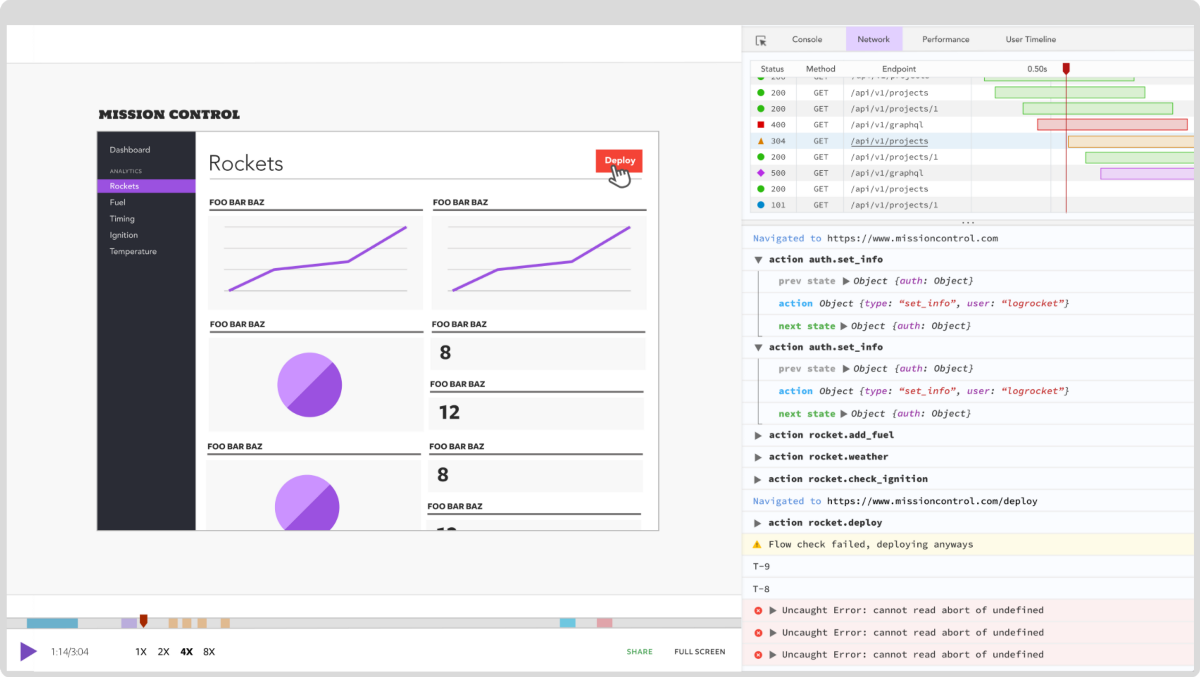
Modernize how you debug your Next.js apps — start monitoring for free.
Can a Rust toolkit speed up Node.js? We tested Nub’s script running, package management, and benchmarks to see how it compares to Bun and Deno.

Compare React Native Track Player and Expo Audio across background playback, lock-screen controls, queue management, licensing, and developer experience.
Can AI refactor legacy CSS without breaking your layout? We benchmarked 5 top AI assistants across cascade order, specificity ties, and stacking traps.

Learn how to offload long-running Gemini AI requests to Trigger.dev background jobs in Next.js using Server Actions and real-time React hooks.
Hey there, want to help make our blog better?
Join LogRocket’s Content Advisory Board. You’ll help inform the type of content we create and get access to exclusive meetups, social accreditation, and swag.
Sign up now


 Learn more →