Editor’s note: This article was last updated 12 July 2022 to reflect updated survey data.
Rust and Python are both popular programming languages with overlapping use cases in software development and data science. Within the past few years, Rust’s adoption has grown significantly, leaving many wondering if it will eventually overtake Python as a top programing language.
In this article, we’ll compare the Rust and Python programming languages, discussing applicable use cases for each, reviewing each language’s pros and cons, and exploring why Rust has grown in popularity over the last few years. Let’s get started!
We’ll cover the following:
Rust is a multiparadigm language that empowers developers to build reliable and efficient software. Rust focuses on safety and performance, similar to C and C++, and is fast and memory-efficient without garbage collection. Rust integrates with other languages and also runs on an embedded system.
Rust has excellent documentation, a friendly compiler with helpful error messages, and cutting-edge tooling, including an integrated package manager, build tools, smart multi-editor support with autocompletion and type inspections, an autoformatter, and more.
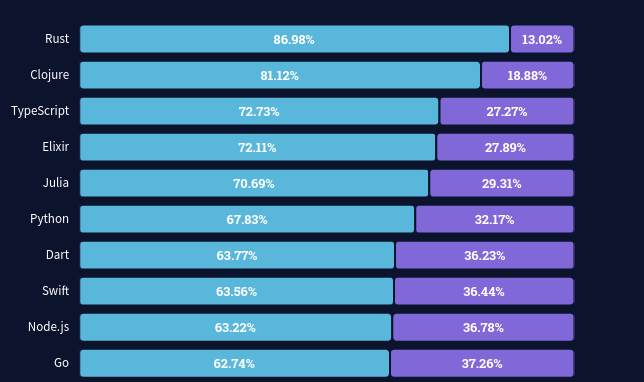
Rust was introduced in 2010 by Graydon Hoare of Mozilla Research. Although in comparison to Python, Rust is still a young language, it has a steadily growing community. In fact, 86.98 percent of respondents to Stack Overflow’s 2021 Developer Survey named Rust their favorite programming language of 2021, as opposed to only 86.1 percent in 2020.
At first glance, Rust being statically and strongly typed may seem extreme. However, you’ll see in the long run that this helps to prevent unexpected code behavior.
Python is a programming language designed to help developers work more efficiently and integrate systems more effectively. Like Rust, Python is multiparadigm and designed to be extensible. If speed is paramount, you can use lower-level API calls, like CPython.
Python, which dates all the way back to 1991 when it was introduced by Guido van Rossum, is notable for its code readability, elimination of semicolons, and curly brackets.
Besides its extensible nature, Python is an interpreted language, which makes it slower than most compiled languages. As you might expect given its maturity, Python has a large ecosystem of libraries and a large, dedicated community.
Rust is used in systems development, operating systems, enterprise systems, microcontroller applications, embedded systems, file systems, browser components, simulation engines for virtual reality, and much more.
Rust is a go-to language when performance matters because it works well for processing large amounts data. It can handle CPU-intensive operations like executing algorithms, which is why Rust is more suitable than Python for systems development.
Rust guarantees memory safety and lets you control thread behavior and how resources are allocated among threads. This enables you to build complex systems, which gives Rust an edge over Python.
To summarize, you should use Rust when:
Python can be used in many application domains, including web development, data science and analysis, AI and machine learning, and software development. In Summary, Python is:
You should use Python when:
Given Rust’s rapidly growing popularity and wide range of use cases, it seems almost inevitable that it will overtake Python in the near future. Let’s consider some reasons why.
One major reason why Rust is overtaking Python is performance. Because Rust is compiled directly into machine code, there is no virtual machine or interpreter sitting between your code and computer.
Another key advantage over Python is Rust’s thread and memory management. While Rust doesn’t have garbage collection like Python, the compiler in Rust enforces checks for invalid memory reference leaks and other hazardous or irregular behavior.
Compiled languages are generally faster than interpreted languages. But what puts Rust on a different level is that it’s nearly as fast as C and C++, but without the overhead.
Let’s see an example of an O(log n) program written in Python and calculate the time it takes to complete the task using an iterative approach:
import random
import datetime
def binary_searcher(search_key, arr):
    low = 0
    high = len(arr)-1
    while low <= high:
        mid = int(low + (high-low)//2)
        if search_key == arr[mid]:
            return True
        if search_key < arr[mid]:
            high = mid-1
        elif search_key > arr[mid]:
            low = mid+1
return False
The code above will return the following output:
> python -m binny.py
It took 8.6μs to search
Now, let’s look at a timed O(log n) program written in Rust using an iterative approach:
>use rand::thread_rng;
use std::time::Instant;
use floating_duration::TimeFormat;

fn binary_searcher(search_key: i32, vec: &mut Vec<i32>) -> bool {
    let mut low: usize = 0;
    let mut high: usize = vec.len()-1;
    let mut _mid: usize = 0;
    while low <= high {
        _mid = low + (high-low)/2;
        if search_key == vec[_mid] {
            return true;
        }
        if search_key < vec[_mid] {
            high = _mid - 1;
        } else if search_key > vec[_mid] {
            low = _mid + 1;
        }
    }
    return false;
}

fn main() {
    let mut _rng = thread_rng();
    let mut int_vec = Vec::new();
    let max_num = 1000000;

    for num in 1..max_num {
        int_vec.push(num as i32);
    }
    let start = Instant::now();
    let _result = binary_searcher(384723, &mut int_vec);
    println!("It took: {} to search", TimeFormat(start.elapsed()));
   }
We’ll get the following output:
> cargo run
Finished dev [unoptimized + debuginfo] target(s) in 0.04s
Running target\debug\algo_rusty.exe
It took: 4.6μs to search
It took Rust 4.6 microseconds and Python 8.6 microseconds to perform similar operations on the same machine without any optimization techniques, meaning it took Python almost twice as long as Rust.
Rust has a very strict typing system, which provides developers with many benefits, like the following:
Security flaws in software often come from mismanaged memory or unforeseen mistakes in the codebase. This strictness in Rust helps us catch and prevent these kind of errors before they ever make it to the user.
Python, like most modern programming languages, is designed to be memory-safe. Yet Rust gives Python a run for its money when it comes to memory safety, even without garbage collection.
Rust embraced a unique way of ensuring memory safety that involves a system of ownership and a borrow checker, which ensures that references and pointers do not outlive the data they point to.
Python, like every other language, provides error checking and logging mechanisms. But, when it comes to letting the developer know what went wrong, there is some contrast between Rust and Python.
Take this typical example of a Python variable error:
apple = 15
print('The available apples are:', apple)
Below is Python’s output:
Traceback (most recent call last):
    File "binny.py", line 2, in <module>
      print('The available apples are:', aple)
    NameError: name 'aple' is not defined
Let’s consider a similar example in Rust:
fn main() {
    let apple = 15;
     println!("The available apples are:", apple);
}
Rust’s output is below:
println!("The available apples are:", aple);
   ^^^^ help: a local variable with a similar name exists: `apple`
In the code above, Rust recommends possible variables that may have been what you wanted to type. Python only throws the error without giving suggestions on how to fix it. Take, for example, the following:
fn main() {
    let grass = 13;

    grass += 1;
}
This code throws an error because variables in Rust are immutable by default. Unless it has the keyword out, it cannot be changed. We’ll get the following error:
    let grass = 13;
      |         -----
      |         |
      |         first assignment to `grass`
      |         help: make this binding mutable: `mut grass`
The fixed error is shown below:
fn main() {
    let mut _grass: i32 = 13;

    _grass += 1;
}
As you can see, now our code throws no errors. Besides this, Rust does not allow different data types to operate on each other unless they are converted to the same type.
Because of this behavior, maintaining a Rust codebase is generally easy. Rust does not allow changes unless specified, however, Python does allow changes of this nature.
Rust is desirable due to its speed, guaranteed memory safety, reliability, consistency, and user friendliness compared to most compiled languages. We’re getting to the point in programming where speed begins to become a no-brainer.
As technology evolves, it gets faster, trying to perform more in a shorter time without as many trade-offs. Rust helps achieve this without putting roadblocks in the developer’s way. As technology tries to push the boundary of what it can achieve, it also considers the safety and reliability of the system, which is the main ideology behind Rust.
In addition to speed, Python also has limitations when it comes to parallel computing. Python uses Global Interpreter Lock (GIL), which encourages only a single thread to execute at the same time to boost the performance of single threads. This process is a hindrance because you can’t use multiple CPU cores for intensive computing.
As mentioned earlier, 86.98 percent of respondents to Stack Overflow’s 2021 Developer Survey named Rust their favorite programming language of 2021:
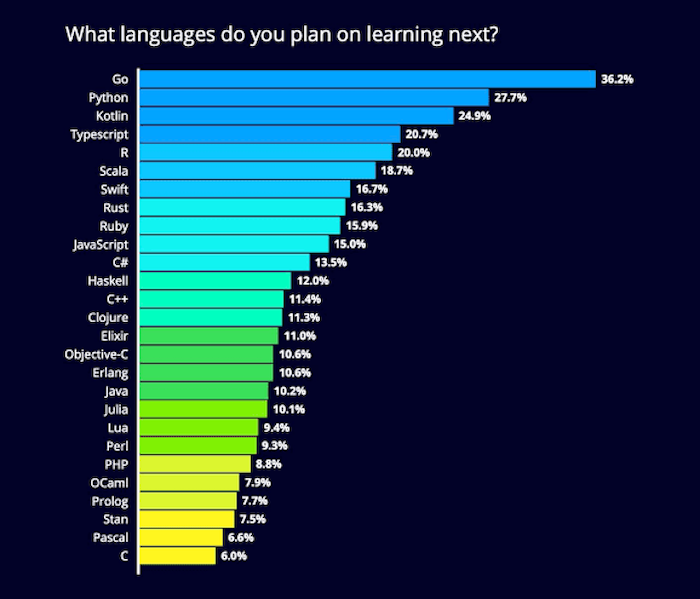
Similarly, respondents to the 2020 HackerRank Developer Skills Report placed Rust in the top 10 programming languages they plan on learning next:
By contrast, the 2019 survey placed Rust toward the bottom of the list, suggesting that the community of Rust developers is growing rapidly:
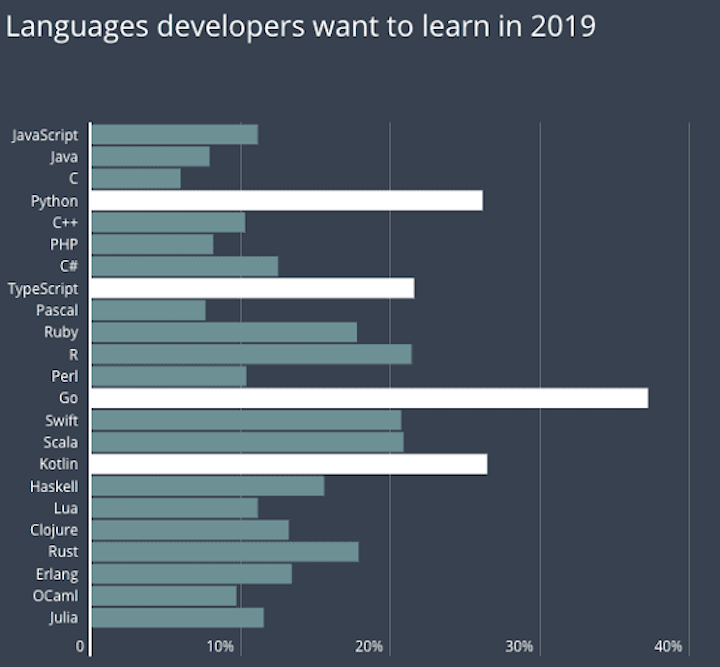
As this data shows, Rust is becoming part of the mainstream developer community. Many large companies use Rust, and some developers even use it to build libraries that other programming languages use. Notable Rust users include Mozilla, Dropbox, Atlassian, npm, and Cloudflare, to name just a few.
Amazon Web Service has also adopted Rust for performance-sensitive components in Lambda, EC2, and S3. In 2019, AWS announced its sponsorship of the Rust project and has since provided Rust with the AWS SDK.
Companies are increasingly replacing slower programming languages with more efficient ones like Rust. No other language nails the tradeoff between simplicity and speed like Rust.
| Rust: Pros | Rust: Cons | Python: Pros | Python: Cons |
|---|---|---|---|
| Fast | Substantial learning curve | Easy to use | Poor performance relative to lower-level languages |
| Reduces memory-related errors | Large selection of libraries | ||
| Growing selection of libraries and community support | Robust community |
Having evolved into a go-to programming language, Rust has seen an increase in its adoption. Although Python holds a firm place in the machine learning and data science community, Rust is likely to be used in the future as a more efficient backend for Python libraries.
Rust has huge potential to replace Python. With its strength in terms of application, performance, and speed, Rust isn’t just a programming language, it’s a way of thinking.
Debugging Rust applications can be difficult, especially when users experience issues that are hard to reproduce. If you’re interested in monitoring and tracking the performance of your Rust apps, automatically surfacing errors, and tracking slow network requests and load time, try LogRocket.
LogRocket lets you replay user sessions, eliminating guesswork around why bugs happen by showing exactly what users experienced. It captures console logs, errors, network requests, and pixel-perfect DOM recordings — compatible with all frameworks.
LogRocket's Galileo AI watches sessions for you, instantly identifying and explaining user struggles with automated monitoring of your entire product experience.
Modernize how you debug your Rust apps — start monitoring for free.

Can AI refactor legacy CSS without breaking your layout? We benchmarked 5 top AI assistants across cascade order, specificity ties, and stacking traps.

Learn how to offload long-running Gemini AI requests to Trigger.dev background jobs in Next.js using Server Actions and real-time React hooks.

Learn how to use Google’s LiteRT.js to build a browser-based OCR receipt scanner with WebGPU acceleration and on-device LLM structuring via LiteRT-LM.

Learn how to use the TypeScript Compiler API and AST traversal to extract imports and build a file dependency graph CLI.
Would you be interested in joining LogRocket's developer community?
Join LogRocket’s Content Advisory Board. You’ll help inform the type of content we create and get access to exclusive meetups, social accreditation, and swag.
Sign up now

 Learn more →