I was working with an intern on a UX research project, and before we even started, we both had private reservations about the concept. Quietly, between the two of us, we wondered how this product was supposed to work. Honestly, it felt odd and a little hard to believe in.

But that is the thing about being a UX researcher: your personal opinion is not the job. You set it aside, go into the field with an open mind, and let what you find speak for itself. So that is exactly what we did.
What we found surprised us both. Users were curious about the product. They welcomed the idea, asked questions, wanted to know more, and were genuinely engaged. When the report came together, the findings were positive and encouraging. People were interested in the product. It had real potential. That was the honest conclusion sitting right there in the data, clear enough to say without hesitation.
But when it came time to write the recommendation, I noticed the intern pulling back. The data was not the problem, but his language was becoming cautious in a way that did not match what we had found. He was hedging, finding careful ways to suggest the conclusion without fully committing to it.
So I asked him what was going on, and he said, “What if this product fails even after we say people are interested in it?”
That question stayed with me because I knew immediately what he meant. I also knew he was far from the only researcher who had ever felt that way.
Not long after that project, I was speaking with a stakeholder who told me he had conducted research on a product idea, reviewed the findings, and moved forward with building the product. But the product was not doing well, and senior leadership kept coming back to him with the same question: “I thought the research said people wanted this, so why is it not working?”
That question captures the misconception both researchers and stakeholders often bring into this work. It is exactly what we need to clarify.
There is a fundamental confusion at the heart of this entire conversation: research gives you insight, not prophecy.
The moment we start expecting research to tell us whether a product will succeed in the market, we are asking it to do something it was never designed to do. We also set up everyone involved, including researchers, stakeholders, and product teams, for a very specific kind of disappointment.
UX research can tell you who your users are, how they think, what frustrates them, and what they are trying to accomplish. It can show where a product concept resonates and where it creates confusion.
It can reveal whether users understand what a product is offering, whether they find the experience intuitive, and whether the problem the product is trying to solve is a problem they actually have. It can surface behavioral patterns, expose assumptions that are not grounded in reality, and help a team make better-informed decisions about direction.
Done well, research reduces the risk of building the wrong thing by grounding decisions in something real rather than something assumed.
What research cannot do is guarantee that a product will succeed once it enters the market.
Market success is the result of many moving parts working together, and research is responsible for only one of them. A product can have compelling user insights behind it and still struggle at launch because of how it was positioned, priced, marketed, or delivered.
If the marketing team does not put the product in front of the right people at the right time, if the go-to-market strategy is weak, if digital marketing is inconsistent, if the brand messaging does not land, or if there is no clear plan for acquisition and retention, none of that is something research could have fully fixed or predicted.
Research also cannot guarantee the quality of the product itself. If a digital product launches with a broken onboarding flow, users may drop off before they ever experience what the product is actually offering. No amount of positive research findings changes that reality.
A study that shows strong user interest is telling you that appetite exists at that moment, among those users, under those specific conditions. It is a signal, and a valuable one, but it is not a guarantee of what will happen when the product meets the full complexity of the market.
Conflating the two is where much of the frustration in this field begins. It is also where researchers start carrying blame that was never theirs to carry.
Research should own the honesty of its findings. That means going into every study without an agenda, listening without filtering what you hear through what you hope to find, and reporting what is actually present in the data. This matters even when the findings are uncomfortable, contradict what the team wants to hear, or raise more questions than they answer.
Research should also own the clarity of how insights are communicated. Findings need to be presented in a way that the people receiving them can understand and act on, rather than being buried in jargon or drowned in caveats.
Research should own the quality of its methodology. This includes choosing the right approach for the right question, being transparent about the limitations of the study, and being honest about what the sample size can and cannot represent.
Research should own the depth of its understanding of users. Identifying user needs, behaviors, pain points, and motivations is the core of what research exists to deliver.
Research should also own the risks it can see from the user side. If certain decisions may create friction, confusion, or drop-off, researchers should flag those risks so the team can move forward with their eyes open.
Finally, research should own the confidence in its recommendations. Researchers should state conclusions clearly rather than burying them in so much hedging that the people reading the report cannot tell what was actually found.
Research should not own the product decision. It informs the decision, but the decision belongs to the product team, the business, and the stakeholders who weigh research findings alongside budget, timeline, technical constraints, business strategy, and market conditions.
Research should not own the outcome of the launch. Once the findings leave the researcher’s hands, what happens next involves too many other variables for research to be held responsible for where the product lands.
Research should not own implementation. A researcher can make a recommendation and advocate for it, but they cannot force a team to act on it. They also should not be measured solely by whether their recommendations were followed.
Most importantly, research should not own the pressure of being right about the future. Its job is to be honest about the present: what users think, feel, need, and do right now. That is already a significant and valuable contribution on its own.
The way research is communicated matters just as much as the research itself. That communication starts long before the report is written. It starts with how you ask questions in the field.
When you go out to speak with users, you cannot afford to stop at surface-level responses. If a user tells you that a product confuses them, that is not the finding. That is the starting point.
You need to ask what specifically is confusing them, what they expected instead, and what they think could make it better. You need to have a real conversation, not simply collect yes-or-no answers, because rich findings come from rich conversations.
The depth of what you uncover in the field is what gives your report credibility and usefulness. If you go in with shallow questions, you will come out with shallow insights. Those are the insights most likely to be misread as certainties or dismissed as unhelpful.
Once you have gathered your findings, the most important thing to understand is that they reflect what users think and feel at a specific point in time, under specific conditions. They are not set in stone.
Consider a researcher exploring whether users would adopt a new POS system. Users respond positively. They say it would make transactions easier, solve a real problem, and fit into their workflow. That is a genuine and valuable signal.
But by the time the product is ready to launch, a competitor may have released something more seamless, better priced, and already gaining traction. Research could have flagged that something similar existed in the market, but it could not predict with complete certainty what a competitor’s full value proposition would look like or how far ahead they would be by launch.
This is why findings must always be presented as signals: directional, informed, and grounded in real user input. They should not be framed as definitive answers about what will happen next.
Insights and decisions are not the same thing, and researchers need to be deliberate about keeping them separate.
An insight is what you found: what users said, what they did, what they need, and where they struggle. A decision is what the business chooses to do with that information. That decision belongs to the product team and stakeholders, not the researcher alone.
When researchers blend the two together and present findings in a way that implies a specific business decision is the only logical next step, they risk overstepping their role. They also set themselves up to be blamed if that decision does not work out.
Present what you found clearly, explain what it means, and let decision-makers do their job with it.
Not all findings carry the same weight, and your report should reflect that honestly.
If a finding came from a large, well-structured study with a diverse sample, say so. If it came from five exploratory interviews designed to generate hypotheses rather than validate them, say that too.
Stakeholders who understand the confidence level behind a finding are better equipped to make proportionate decisions with it. Overstating the certainty of weak findings is just as damaging as understating the strength of solid ones.
Be clear about what you know, what you suspect, and what still needs more investigation.
One of the most effective ways to communicate findings is to connect them directly to the risks the business is trying to manage.
Rather than presenting insights in isolation, frame them around what could happen if the team moves in a particular direction. If users showed confusion around a core feature, explain what that confusion could mean for adoption if it is not addressed before launch. If the research reveals that users have a strong existing habit the product is trying to disrupt, flag that as a risk worth planning for.
This kind of framing makes research immediately useful to decision-makers. It connects what users said to what the business needs to think about, and it positions the researcher as a strategic partner rather than just someone who collected data.
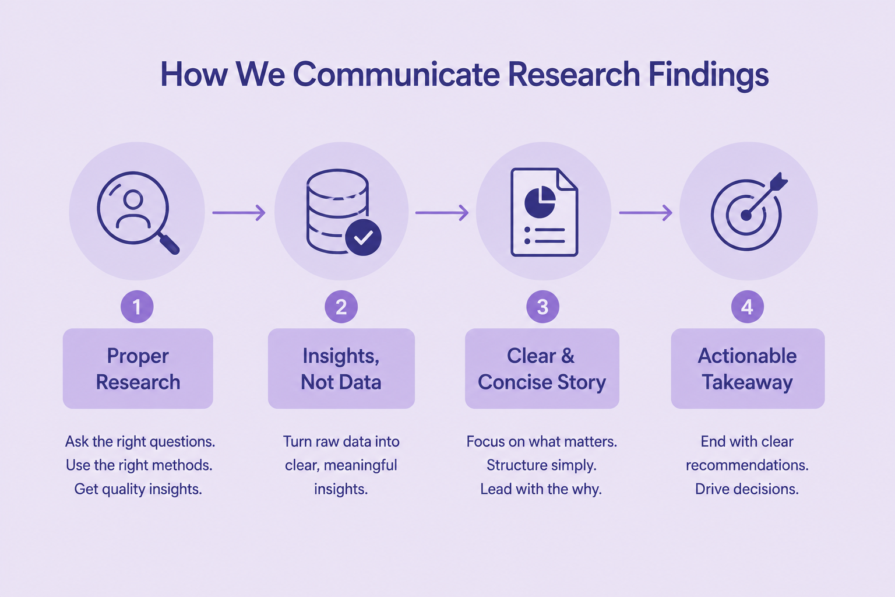
Research is there to surface the truth about your users. Sometimes that truth is encouraging, and sometimes it is inconvenient.
The moment research is treated as a validation exercise, it loses its value. A researcher who feels pressured to produce a particular outcome may end up producing findings that tell the team what they want to hear rather than what they need to know.
Good research is not there to confirm a decision that has already been made. It is there to help the team understand reality more clearly before they make the next one.
When a product succeeds, many teams take a share of the credit, and rightly so, because many teams contributed to that success. The same logic has to apply when a product does not perform.
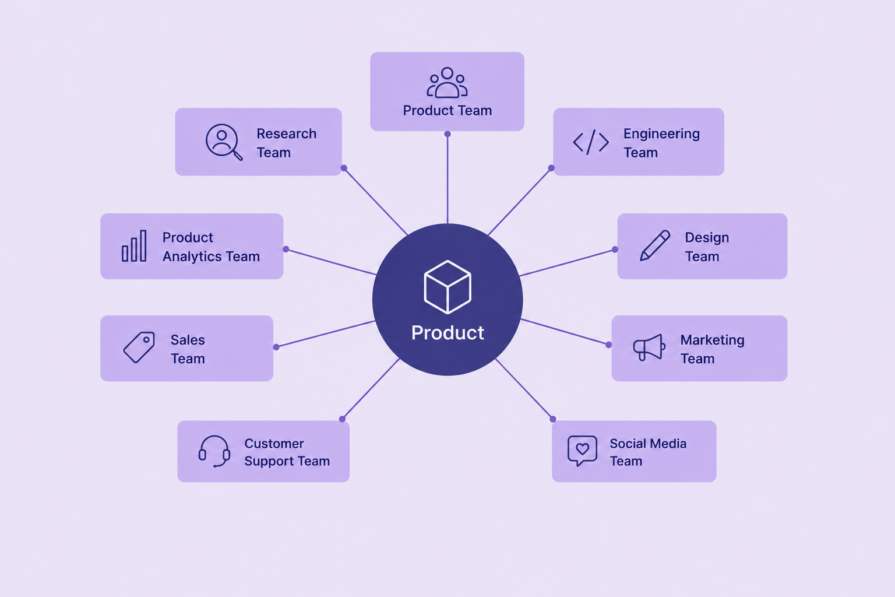
Research provides the user insight. The product team translates that insight into features and decisions. The design team shapes the experience. The engineering team builds it. Business leaders determine the strategy, budget, and direction. The marketing team decides how to position and promote the product, who to put it in front of, and how to tell its story in the market.
Every one of these functions plays a role in where a product ends up. No single team, least of all the research team, can be held solely responsible for the outcome.
But there is another pattern that makes this worse: the tendency to accept poor product performance without truly investigating why it happened.
A user might find the product, try to get onboarded, hit a wall because something is not working, and quietly move on to a competitor that makes the experience easier. They will not send an email explaining why they left. They will simply leave.
If no one is paying attention to where and why users are dropping off, the assumption becomes that the product “just did not work.” But that skips the more important question: what specifically caused it not to work, and was that problem fixable?
This is also where it becomes clear that research is not a one-time event. The work does not end at launch.
Once a product is in the market, the research mindset needs to continue. Teams need to track how users are actually engaging with the product, understand where they are experiencing friction, and keep an eye on what competitors are doing. How are competitors pricing their products? What value are they offering that your product is not? Where is their experience smoother?
If a competitor offers users a better deal, a smoother experience, or a stronger value proposition, users may move toward them without explanation. The only way to understand and respond to that shift is to keep learning.
Product analytics, social listening, competitor analysis, and user feedback are not afterthoughts. They are the continuation of the same commitment to understanding users that research began before the product was ever built.
A product that launched on strong research findings but never invested in ongoing learning after launch is not a research failure. It is a follow-through failure, and that distinction matters.
The question my intern asked, “What if this product fails even after our research says people are interested?” is not a bad question. It is actually a very honest one.
But the problem with the question is the assumption underneath it: the idea that research and product success are directly linked in a way that makes one responsible for the other. They are not.
Once you understand that, the question changes.
Instead of asking, “What if the product fails after we recommended it?” the better question is, “Did we find the truth about our users and communicate it honestly?”
Instead of asking, “Why did the research not predict this outcome?” the better question is, “Did every team involved do its part with what the research gave them?”
UX research is not a crystal ball, and it was never meant to be one. It is a torch. It illuminates the path ahead well enough for a team to move with more confidence and less risk.
What the team does once it can see the path is a shared responsibility. That distinction, simple as it sounds, is what can save researchers from carrying weight that was never theirs to carry. It can also help stakeholders build products with a clearer and more honest understanding of what good research actually makes possible.
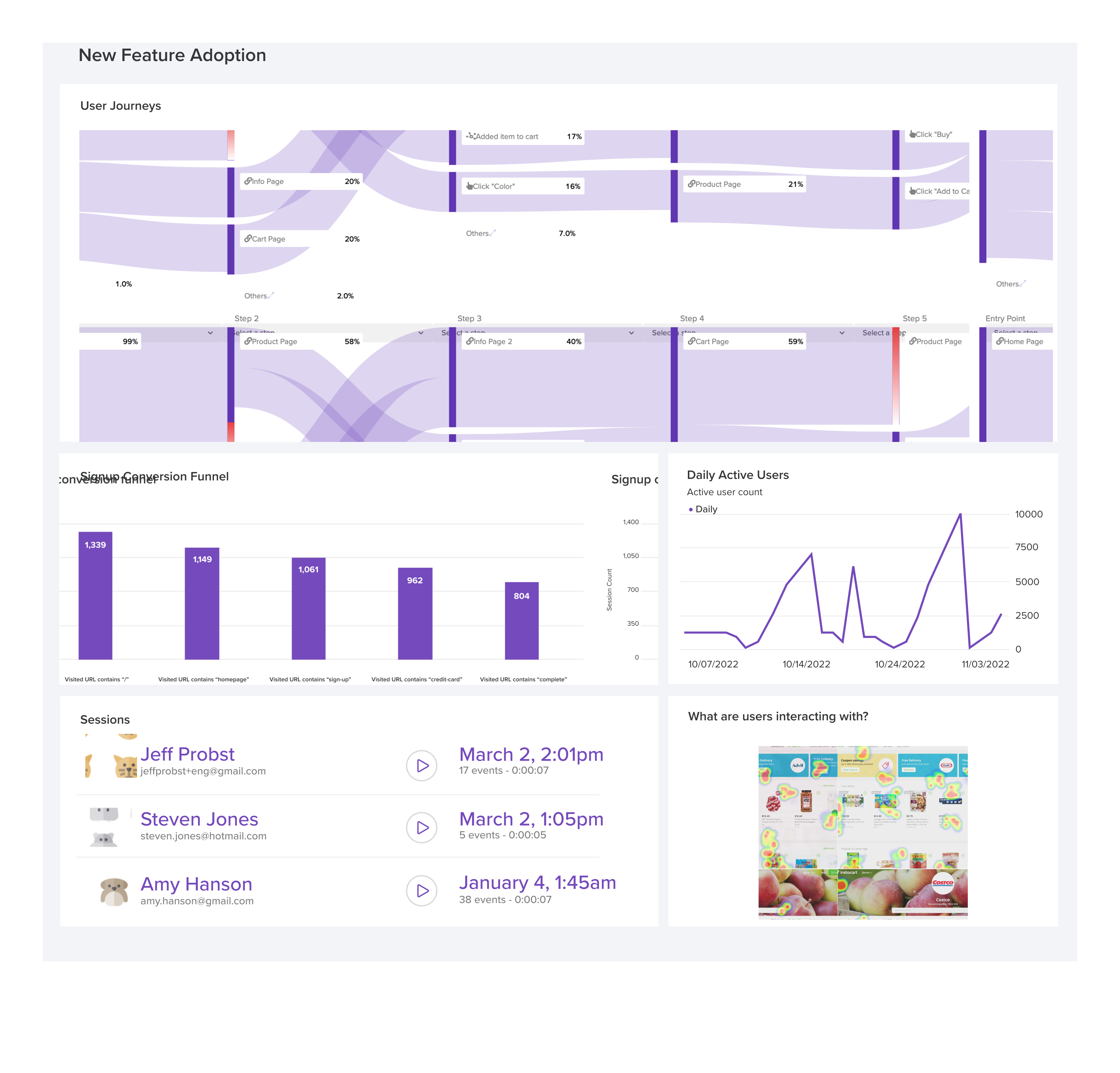
LogRocket's Galileo AI watches sessions and understands user feedback for you, automating the most time-intensive parts of your job and giving you more time to focus on great design.
See how design choices, interactions, and issues affect your users — get a demo of LogRocket today.

Fixed user flows still have a place, but AI is changing how products respond to user intent. Here’s what designers need to rethink when flows become dynamic.

Framer brings design, CMS, publishing, and AI into one workspace. Here’s how its 2026 workflow compares with Figma Sites, Relume, and Webflow—and when consolidation makes sense.

Three predictions for the next UX era, revisited against Liquid Glass, Material 3 Expressive, and spatial widgets—with a practical, conditional outlook for 2027.

AI-first helpdesks can answer questions and take action, but good UX depends on accurate information, clear approval limits, and human handoffs that preserve context.

 Learn more →