In frontend development, proper measures have to be taken to ensure that secrets and credentials are properly stored and managed as they have the potential to cause havoc with reckless practices. In this article, we will be looking at the best ways to manage secrets and keys, usually from APIs.

APIs could be private or public. A private API is developed and hosted by in-house developers within an organization, and they’re not shared or used by developers outside that organization. Private APIs are easily managed because the developers have full control of how applications are developed with it.
A good example of a private API would be an API developed by a backend developer that allows you, the frontend developer, access to your organization’s data. Since private APIs are restricted, there is no need to include a key or secret before using the API.
On the other hand, a public API is a service offered by a third party that is publicly available and provides access to a proprietary software application or web service. As the name implies, public APIs are available for all developers both within and outside the organization where it was developed.
They allow developers to leverage features already available to enhance their applications instead of building those features from scratch. A good example of a public API is the Google Maps API, which allows developers to use Google Maps within their applications.
Some service providers offer their public APIs for free for a lifetime, while others are paid or free for a specific number of requests. For effective authorization and authentication, API providers use keys and credential secrets that are unique to each user of the API. These keys and secrets must be safely managed and stored because they could otherwise pose serious challenges if they get into the wrong hands.
API keys and credential secrets that are not properly stored could cause financial, regulatory, or reputational damage.
I will be using React in the following code snippet, but the principles can be applied to vanilla JavaScript and other frameworks as well:
import React from "react";

const index = () => {
 const Api_key = "1234567"

 return(
   <>
   <p>Hello, Secrets </p>
   </>
 )
}
export default index;
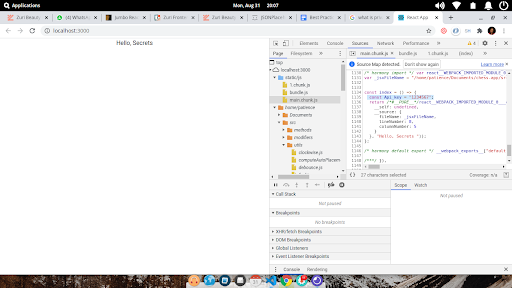
This is a bad practice because your credential secret can easily be extracted from the browser with the dev tools:
Control+Shift+Istatic/jsmain.chunk.jsYou will find your credential secret, pretty easy for anyone to extract:
import emailjs from ‘emailjs-com’
function App(){
    const handleSubmit = (e) => {
 e.preventDefault();

 emailjs
   .sendForm(`gmail`, "876TY43sa23r56y789", e.target, process.env.REACT_APP_USER_ID)
   .then(
     (result) => {
alert("Message Sent, We will get back to you shortly",     result.text);
     },
     (error) => {
       alert("An error occured, Please try again", error.text);
     }
   );
};

    return(
    <>
    <form onSubmit={handleSubmit}>
<input name="name"/>
<input name="email"/>
<button type="submit">Submit</button>
</form>
    </>
)
}
export default App;
This is also a bad practice because anyone can access your repository online. Even if your repository is private, some hackers use GitHub crawlers to crawl repositories for credential secrets. A good solution to this is to store your credential secrets in a .env file, which we will see in the next section.
If at any point you committed and pushed your API credentials to your Git repo, you should reset the key as quickly as possible. This can be done by accessing the dashboard from the API service provider or by removing all traces of it by using a Git rebase to remove the particular commit that added the keys.
Most API service providers allow you to restrict usage by setting a limit on the number of requests to be made per day and a particular URL from which the API can be accessed. From the image below, no domain was saved, so requests can be sent from any URL with the API credentials:
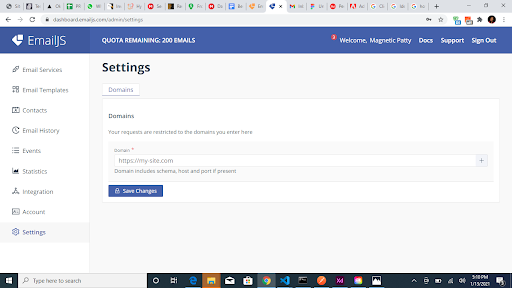
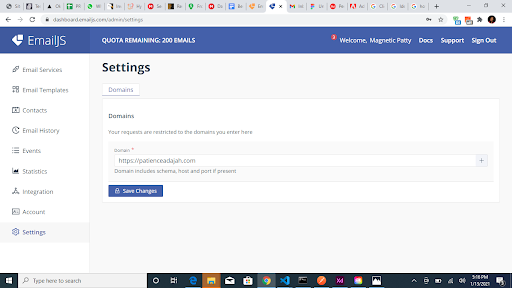
Some service providers allow you to set restrictions on the usage of the API key such that the API key can only be accessed from the URL you have specified. This means even if a hacker gets access to your key, it would be useless; it can only be used with the specified URL.
You can also set a daily limit on the usage of your API credentials. In the image below, requests to the API can only be made to the URL specified:
.env) fileWith a .env file, your secret is not directly in your code. This is particularly great with Git. You can upload your code to Git and add the .env file to your .gitignore file. This way, your .env file will not be committed to GitHub. This can be done with the following steps:
.env file in the root of your project:
- your_react_project_folder
 - public
 - src
 - node_modules
 - .env         <-- your .env file
 - .gitignore
 - package-lock.json
 - package.json
.env file, add REACT_APP_ as a prefix to your API key name and set the value (for React applications) and VUE_APP_ as a prefix to your API key name and set the value (for Vue applications). This allows the frameworks to identify the variables:
# .env

REACT_APP_YOUR_API_KEY_NAME=your_api_key  <-- for react apps
VUE_APP_YOUR_API_KEY_NAME=your_api_key <-- for vue apps

# Example:
REACT_APP_TEMPLATE_ID=98765432123456789
REACT_APP_USER_ID=98765432123567
VUE_APP_USER_ID=98765432123456789
Add the .env file to your .gitignore file, this way your .env file is not committed to git and this hides your API key when you push your repo to GitHub:
#.gitignore file

# dependencies
/node_modules

# env
.env
Now you can use the API key in your code by appending it with process.env:
//app.js
//here I used api keys from emailjs already declared in the .env file.
import emailjs from ‘emailjs-com’
function App(){
    const handleSubmit = (e) => {
 e.preventDefault();

 emailjs
   .sendForm(`gmail`, process.env.REACT_APP_TEMPLATE_ID, e.target, process.env.REACT_APP_USER_ID)
   .then(
     (result) => {
alert("Message Sent, We will get back to you shortly",     result.text);
     },
     (error) => {
       alert("An error occured, Plese try again", error.text);
     }
   );
};

    return(
    <>
    <form onSubmit={handleSubmit}>
        <input name="name"/>
        <input name="email"/>
        <button type="submit">Submit</button>
        </form>
    </>
)
}
export default App;
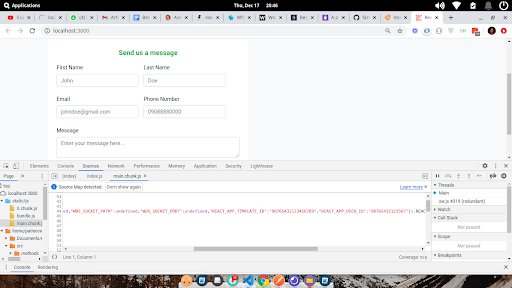
This is a good practice, but not a very secure one because your API key is still visible in the browser dev tools. Your API credentials will still become part of the build and would be visible to anyone who inspects your files, just like we did earlier.
You will find the API keys defined in the .env files in the dev tools:
Secret scanning tools are tools that scan Git commits in remote repositories whether on GitHub, GitLab, or Bitbucket to check for secrets that were accidentally committed. This helps to prevent sensitive information from being exposed to remote repositories. With these solutions, secrets committed to the repo are automatically detected and captured.
To set up GitGuardian for your project:
Do not share GitHub credentials with anyone outside of your development team and make sure to revoke access for developers who no longer work on your team.
Securing API keys and secrets is very important in your frontend application. Storing secrets in a .env file is good, but that alone is not safe. Always make sure to set restrictions on your key. With this, even though your secret is leaked, it will be useless in the hands of whoever has access to it.
An extra layer of security is using secret scanning services to scan your repositories. Use the practices highlighted in this article to ensure sensitive data is protected while working on projects. Thanks for reading.
Install LogRocket via npm or script tag. LogRocket.init() must be called client-side, not
server-side
$ npm i --save logrocket

// Code:

import LogRocket from 'logrocket';
LogRocket.init('app/id');
// Add to your HTML:

<script src="https://cdn.lr-ingest.com/LogRocket.min.js"></script>
<script>window.LogRocket && window.LogRocket.init('app/id');</script>

Compare React ViewTransition and Motion across four animation patterns. The native build saved ~38.6kB of gzipped JS, but required 179 more lines of CSS.

Learn how to run Cline locally with Ollama to build a secure, private AI coding agent that keeps your proprietary code off cloud servers.

Compare TanStack Charts, Recharts, and Chart.js by building the same React dashboard three times. See how each library’s mental model affects your code.

Is the Rust React Compiler’s 10x speed claim real? We put Babel, Vite (Oxc), and Bun to the test on a real app to find out where the speed actually matters.
Hey there, want to help make our blog better?
Join LogRocket’s Content Advisory Board. You’ll help inform the type of content we create and get access to exclusive meetups, social accreditation, and swag.
Sign up now

 Learn more →